
Published November 5, 2026
What do people ask an AI before they hire a lawyer?
Before they hire a lawyer, people ask an assistant three kinds of things: what the situation means, what the first meeting involves, and only then who to call. A firm can be quoted on the second only if a page states the meeting in sentences: what to bring, what the meeting does not decide, and which matter it is. A form that says “call us” is not that page. This is general information, not legal advice, and nobody can promise that an assistant will name the firm.
Three kinds of questions, in that order
The first is the situation: “does a shop tenant need a lawyer for a lease fight?”. The second is the process: what to bring, how long the first meeting is, and what it will not decide. The third is the name: who in this city does that work. Most firms publish only for the third, and only as a list of practice areas.
Most people ask the first two before the third. By the time they ask for names, they have often already taken the assistant’s description of the meeting. If your page never describes the meeting, the assistant describes someone else’s, or it describes the meeting and names nobody.
Where that answer comes from
With web search on, each assistant summarizes pages that agree. A bar pamphlet and a “contact” button do not agree on what to bring. A page that lists three documents, a clock time, and a sentence about what the meeting is not can be quoted. A photographed brochure cannot.
The mechanism is the intake, written the way the client says it. The questions on the first call are the list. A list that changes every week cannot show whether the answer changed. The four assistants disagree between runs, so one screenshot proves little.
The most common mistake: the site only says call us
Almost every firm publishes the practice list and a form, and keeps the real answer for the phone. It happens because the lawyers think the meeting is too particular to write down. To an assistant, a form is the same absence as the next firm’s form.
The cost is concrete. The tenant takes the firm whose page says what to bring to the first meeting about a shop lease. The remedy is one process page for one matter, written as information about how that meeting usually works, not as advice on the reader’s lease. What a firm may publish differs by bar. Check yours.
A worked example, step by step
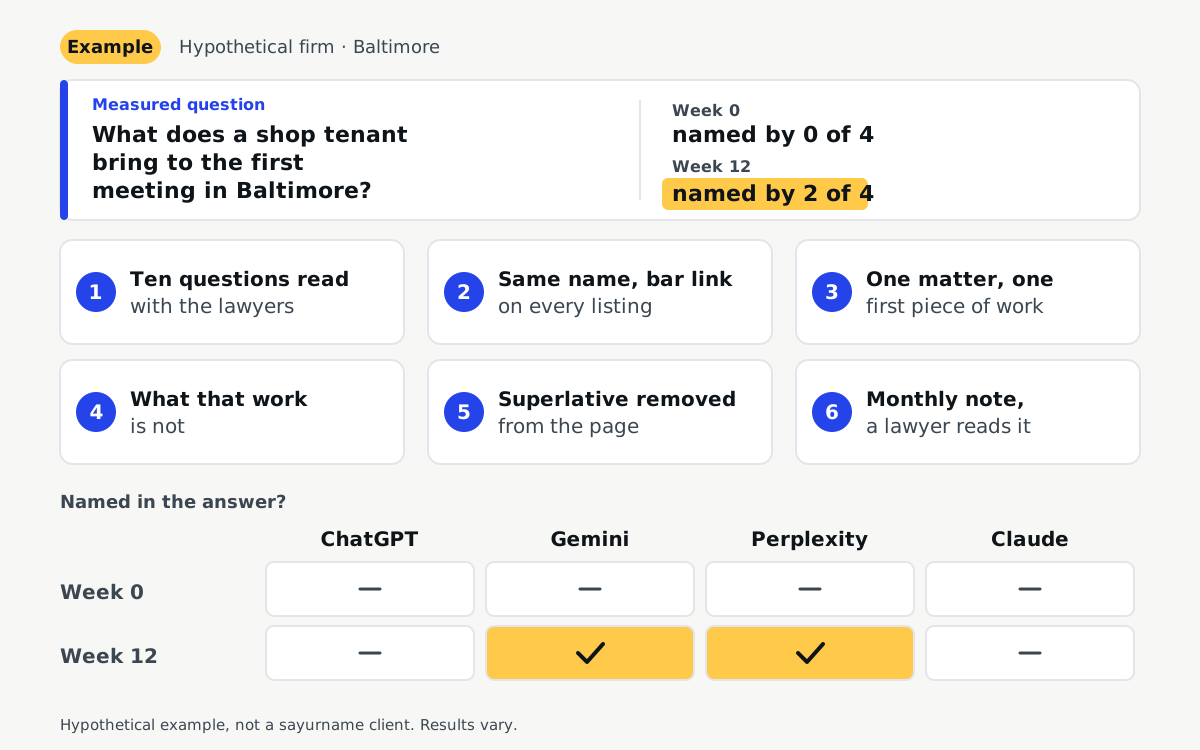
Example: a hypothetical firm, not a sayurname client. Imagine Harbor Court Counsel in Baltimore, Maryland: two lawyers, nine years, 70 Google reviews averaging 4.7. They meet shop tenants about a commercial lease. The first meeting is 45 minutes. The tenant brings the lease, any notice, and the last rent invoice. The meeting does not decide whether to sue, and it is not a residential eviction. A written note after the meeting is $350 to $600. The old site said “call us about your lease” and a form.
The measured question was “What should a shop tenant in Baltimore bring to a first meeting about a lease dispute, and who does that work?”. At week 0 the firm was named by 0 of 4. ChatGPT described a generic first meeting and named two large firms. Gemini listed map ratings. Perplexity cited a bar pamphlet. Claude explained leases and named nobody.
- Read the four answers with the lawyers and wrote ten questions from the first calls that year, in the tenant’s words.
- Fixed the base: the same legal name and address on the site and on the bar lookup, with a link to that lookup.
- Published one page: a 45-minute first meeting for a shop tenant, the three documents to bring, and the note at $350 to $600.
- Wrote what the meeting is not: not a decision to sue, and not a residential eviction.
- Removed “Baltimore’s best lease lawyers”. No source can confirm a superlative.
- Kept the ten questions fixed, and a monthly note when the page changed, each read by a lawyer. Reviews were asked with no discount and no suggested wording.
Nothing moved for five weeks. In week 6 Gemini named the firm and quoted the three documents. In week 12 Perplexity followed, after two reviews mentioned the 45-minute meeting. At week 12 ChatGPT still named the large firms, and Claude named the firm in one run of four, which does not count.
A paid “best of Baltimore” badge changed no answer. The residential-eviction question never moved, because the firm does not do that work. Another firm might see none of this in twelve weeks.
When it is not worth it
If the lawyers will not keep the page in step with the meeting they actually hold, do not publish the list. A wrong list of documents is worse than none. If the bar forbids describing a meeting this way, stop and ask the bar before you write it.
Nor does it pay when the firm wants only the name question and has no meeting it is willing to describe. The process question will keep going to whoever describes one.
How the work runs
It starts with the free test. Once subscribed, we measure up to 10 questions every week in ChatGPT, Gemini, Perplexity and Claude and publish as much as we judge necessary for AI to cite your firm in the answers you want. Volume and format follow what each question needs, and that part is our call. We also ask for inclusion in the sites those assistants use. What we promise is the request, not the listing.
It costs $299 a month, with no lock-in. A one-time $599 bonus is charged only when an AI starts naming your firm for a measured question, checked by a person on our team, or Google Analytics shows a visit coming from an AI. Your firm stays responsible for validating the legal content of what is published, and each piece comes with one revision. It is not legal advice, and it promises no client.
Questions
Should the page answer the reader’s own lease?
No. Describe how this kind of meeting usually works and say the lease itself is a different conversation. Specific advice belongs with a client.
How many questions belong on the list?
As few as you can keep stable, up to about ten. Fixed wording is what lets you compare one week with the next.
Will describing the meeting make an assistant name the firm?
Nobody can promise that. In the example, two assistants quoted the documents and two had not by week 12.
Does a “best of” badge answer the process question?
It can buy a click. In the example it changed no assistant. The process question is answered from a sentence, not from a badge.
What if the three documents are sometimes wrong?
Then do not publish them. A page that lists a document the meeting never uses becomes the wrong answer the reviews repeat.