
Published November 5, 2026
What a law firm publishes if it wants an AI to cite it
An assistant cites a firm when a page states one piece of work in text: what the note looks at, what it does not decide, who it is for, and a range. A PDF of a bar brochure, or a photo of a pamphlet, cannot be quoted. The page is information about how that work usually goes. It is not advice on the reader’s contract, and nobody can promise the firm will be named.
What can be quoted
A citable page answers one piece of work. For a written note on a consumer bank contract, that means: which contract, what the note looks at, what it will not say, how long it takes, and a range. Titles that work name the note, not the firm’s ambition.
An excerpt that an assistant can lift: “A written note on one consumer credit contract looks at the clauses the client marks. It does not file a case and it does not say what a court would do. It takes ten business days. The range is $600 to $900.” What makes it citable is the boundary.
Where the citation comes from
With web search on, each assistant summarizes pages that agree. A brochure that says “know your rights” agrees with every other brochure. A note with a scope, a clock, and a range agrees with itself, and that is enough to be quoted when the question asks for that note.
The mechanism is HTML, not a file. A PDF is a download. A photograph of a pamphlet is a picture. Neither is a sentence. The four assistants still disagree between runs, so one screenshot proves little.
The most common mistake: publishing the brochure
Almost every firm uploads the bar’s general pamphlet, or its own PDF, and calls that publishing. It happens because the pamphlet already exists and a new page feels like a second job. To an assistant, the pamphlet is the same text on a hundred sites.
The person takes the firm whose page describes the note. The remedy is one HTML page for one note. The trade-off is that the page looks plainer than the designed PDF. A pretty file that cannot be quoted does not enter the answer. Advertising rules differ by bar. This guide is general information, not legal advice.
A worked example, step by step
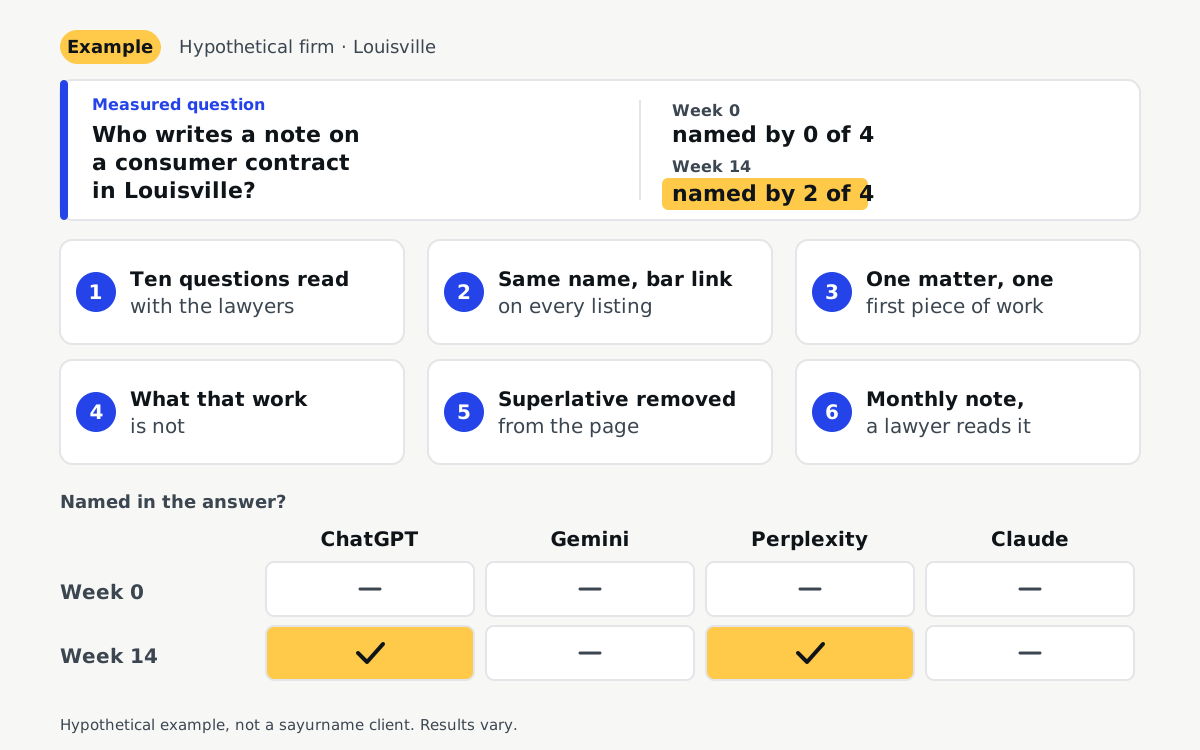
Example: a hypothetical firm, not a sayurname client. Imagine River Note Counsel in Louisville, Kentucky: two lawyers, eight years, 58 Google reviews averaging 4.6. They write a note on one consumer credit contract the client already has. Ten business days. $600 to $900. The note does not file a case. The site links to the Kentucky bar lookup and does not invent a bar number. The old site offered a PDF of a general brochure and a form.
The measured question was “Who in Louisville writes a note on a consumer credit contract and says what the note does not decide?”. At week 0 the firm was named by 0 of 4.
- Read the four answers and chose ten questions from the letters clients had sent that year.
- Fixed the base: the same legal name and address, with a link to the bar lookup.
- Replaced the PDF with an HTML page: one consumer credit contract, ten business days, $600 to $900.
- Wrote what the note is not: not a filing, and not a prediction of what a court would do.
- Removed “Louisville’s most trusted consumer firm”.
- Kept a monthly note when the description changed, each read by a lawyer, and asked clients to mention the note in a review, with no discount.
Nothing moved for six weeks. In week 8 Perplexity named the firm and quoted the ten business days. In week 14 ChatGPT followed. At week 14 Gemini still cited the brochure that many firms host, and Claude named the firm in one run of four, which does not count.
A redesigned PDF of the same brochure changed no answer. The question about filing a case never moved, because the firm does not file that case on this page. Another firm might see none of this in fourteen weeks.
When it is not worth it
If the lawyers will not sign the range, do not publish it. A range you will not honor becomes the complaint. If the only true sentence is “it depends”, say that, and do not invent a scope to have something to quote.
Nor does it pay when the brochure is the only text the bar has approved and the firm will not ask whether a plainer page is allowed. Ask first.
How the work runs
It starts with the free test. Once subscribed, we measure up to 10 questions every week and publish as much as we judge necessary for AI to cite your firm in the answers you want. Volume and format follow what each question needs, and that part is our call. We also ask for inclusion in the sites the assistants use. What we promise is the request, not the listing.
It costs $299 a month, with no lock-in. A one-time $599 bonus is charged only when an AI starts naming your firm for a measured question, checked by a person on our team, or Google Analytics shows a visit coming from an AI. Your firm stays responsible for validating the legal content of what is published, and each piece comes with one revision. It is not legal advice, and it promises no client.
Questions
Is a well-designed PDF enough?
Not for this question. In the example, a redesigned brochure changed no assistant. The answer moved when the same scope was text.
Should the range be on the page?
Only if you will honor it. A range you walk away from becomes the review. No range is better than a false one.
Can the bar’s pamphlet be the page?
It can explain the public’s rights. It cannot say what your note does, because the same pamphlet sits on other firms’ sites.
How long until anything changes?
In the example, the first assistant named the firm in week 8 and the second in week 14. Two had not by then.
Does this tell a reader what their contract means?
No. The page describes the note the firm writes. Reading the reader’s contract is the note, not the page.