
Published November 4, 2026
Which sources do AIs cite when they recommend a lawyer?
When an assistant names a lawyer, the sources behind the answer are usually the firm’s own page, the bar lookup, and one directory or article that states the same matter. A paid “top lawyer” badge moves the answer only if that page also states the matter, the city, and a boundary. Buying every directory does not. Nobody can promise a listing, and a request to be included is not the same as getting in. This is general information, not legal advice.
The few kinds of pages
Open the answer and look at what it cites. For a residential tenancy question the pages tend to be: the firm’s site, the official bar lookup, a directory that names the matter rather than every matter, and sometimes a local article. Review sites appear when the review names the matter.
A page that only says “super lawyer” without the matter is a badge. The assistant can quote a matter. It cannot quote a medal.
What to check, and what not to buy first
Read those pages and see whether the firm is there, and whether the matter, the city, and the name match. That is a list of facts to verify, not a shopping list. Fix the firm’s own page and the bar record before you pay a third site to repeat a vague description.
The offer includes asking for inclusion where there is a way in. Many directories are editorial or paid and do not take a request. You should see what was requested and what got in. The request is the promise. The listing is not.
The most common mistake: paying for every listing
Almost every firm buys a badge the week a competitor appears in an answer. It happens because the badge is a product with a price, and the firm’s own sentence is not. To an assistant, ten badges that say “top” are the same sentence.
The tenant takes the firm whose own page and the bar lookup say the same thing: residential tenancy, this city, and what the first letter is not. The remedy is to make those two agree, then ask the one directory that already states the matter. The trade-off is that you decline the other nine. They were not the source.
A worked example, step by step
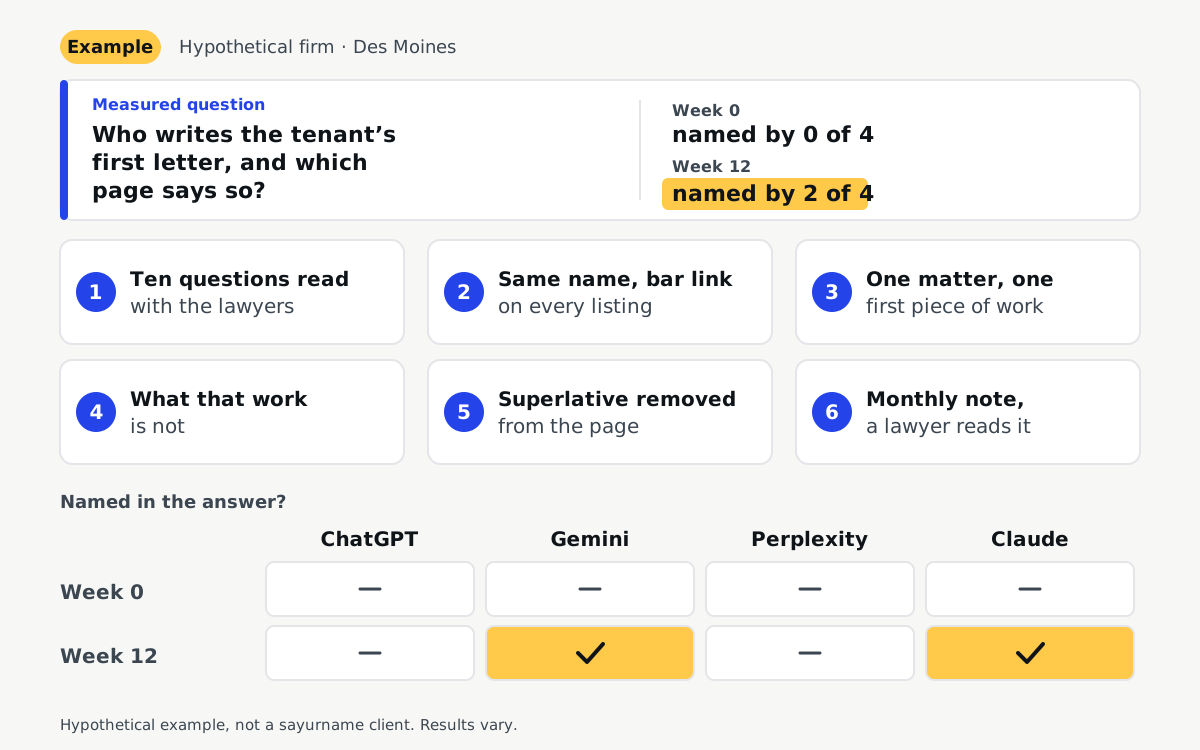
Example: a hypothetical firm, not a sayurname client. Imagine Cedar Tenancy in Des Moines, Iowa: two lawyers, ten years, 80 Google reviews averaging 4.7. They write a first letter for a residential tenant about a repair the landlord has not done. The letter is $250 to $400. They do not do commercial leases. The site links to the Iowa bar lookup. The old site said “top-rated for every housing problem” and listed six paid badges.
The measured question was “Who in Des Moines writes a first letter for a residential tenant about a repair, and which page says so?”. At week 0 the firm was named by 0 of 4.
- Opened the four answers and listed every source they cited, then marked which ones named a residential repair.
- Fixed the firm’s page and the bar lookup so the name, the city, and the matter matched, with a link to the lookup.
- Replaced the six badges with one sentence: a first letter for a residential tenant about a repair, $250 to $400, not a commercial lease.
- Asked one directory that already had a residential-tenancy category to correct the firm’s description. The other five were left.
- Removed “top-rated for every housing problem”.
- Each month, checked whether the cited pages still matched, and a lawyer read the note. Reviews were asked with no discount.
Nothing moved for five weeks. In week 6 Gemini named the firm and cited the firm’s page and the bar lookup. In week 12 Claude followed, citing the same two. At week 12 ChatGPT still named a firm whose badge page listed every housing problem, and Perplexity named the firm in one run of four, which does not count.
The five unused badges kept charging and changed no answer. The commercial-lease question never moved, because the firm does not do that work. Another firm might see none of this in twelve weeks.
When it is not worth it
If the bar record and the door do not match, stop and fix that before any directory. A request to a directory that copies a wrong name spreads the wrong name.
Nor does it pay when the firm wants to be in every list and will not say which matter the page is for. The assistant will keep citing whoever states one.
How the work runs
It starts with the free test. Once subscribed, we measure up to 10 questions every week and publish as much as we judge necessary for AI to cite your firm in the answers you want. Volume and format follow what each question needs, and that part is our call. We also ask for inclusion in the sites the assistants use. What we promise is the request, not the listing.
It costs $299 a month, with no lock-in. A one-time $599 bonus is charged only when an AI starts naming your firm for a measured question, checked by a person on our team, or Google Analytics shows a visit coming from an AI. Your firm stays responsible for validating the legal content of what is published, and each piece comes with one revision. It is not legal advice, and it promises no client.
Questions
Should the firm be in every legal directory?
No. In the example, one directory that already named the matter was worth a correction. Five badges were not.
Is the bar lookup a source?
Yes, when the answer is checking who is admitted. Keep the name on your page identical to that record, and link to it.
Does asking for inclusion mean the firm will be listed?
No. Many sources are editorial or paid and do not take a request. The promise is the request, and you see what got in.
How long until anything changes?
In the example, the first assistant named the firm in week 6 and the second in week 12. Two had not by then.
Can a badge still be the better answer?
Yes, when the question is only “who is top-rated” and the badge page is what the assistant quotes. The repair question went to the page that named the letter.