
Published November 2, 2026
Why assistants can suggest different businesses in different languages
Different wording, regional context, available sources and product settings can lead assistants to produce different answers across languages. A translation is not automatically the same question in the same market. Record the exact prompts, language, location, assistant and complete answers; examine local service facts and sources separately. Localized pages may help people find accurate information, but no page or tag guarantees a particular recommendation.
Language changes more than words
A customer asking in Portuguese for a service in Lisbon and a customer asking in English for the same service in Boston may need different providers. Even within one city, language can carry different terms for a service, imply a different audience or produce different search queries. A literal translation can lose the intent, location or qualification that matters to the customer. Start by deciding whether you are comparing languages within one market or comparing different markets altogether.
Assistant products can use different models, retrieval systems, sources and settings, and their outputs can vary between runs. A result in one language does not by itself reveal the cause of the difference. Avoid the claim that an assistant favors a language or business because of a single pair of responses. Save the complete answers and collection context so the differences can be investigated rather than attributed to one assumed mechanism.
Make the comparison fair
Choose an unbranded customer question and ask a fluent reviewer to write a natural equivalent in each language. Keep the service, budget or urgency if relevant, city and intended customer consistent. Record the exact wording rather than assuming that a machine translation preserved every detail. If a term has no exact equivalent, note the difference. Changing both the city and language at once makes it impossible to isolate the language comparison.
Record the assistant, date, visible search setting, account context where relevant and full responses. Mark unavailable answers separately. Repeat a small set of representative questions at consistent intervals if the decision warrants it. For each response, classify a positive business name, a neutral or negative mention, and source-only links separately. Do not turn a link into a positive recommendation or treat an unavailable answer as a negative result.
Improve the information customers can verify
Review whether the business actually serves the location, language and service described in each question. Publish clear, accurate service details in the relevant language where the business can support customers. A translated page that promises support the team cannot provide can mislead people even if it attracts traffic. Have a fluent reviewer check prices, service boundaries, contact methods and terminology; keep the original and translated versions aligned when facts change.
For Google Search, hreflang annotations can identify localized variants of a page when implemented according to Google's documentation. They are a signal to Google about alternate versions, not a command to an assistant to recommend a company. Use stable links, make pages reachable and verify technical changes with the site operator. Other assistants and retrieval systems have their own behavior; do not assume a Google-specific annotation controls them.
Worked example: a fictional plumbing service
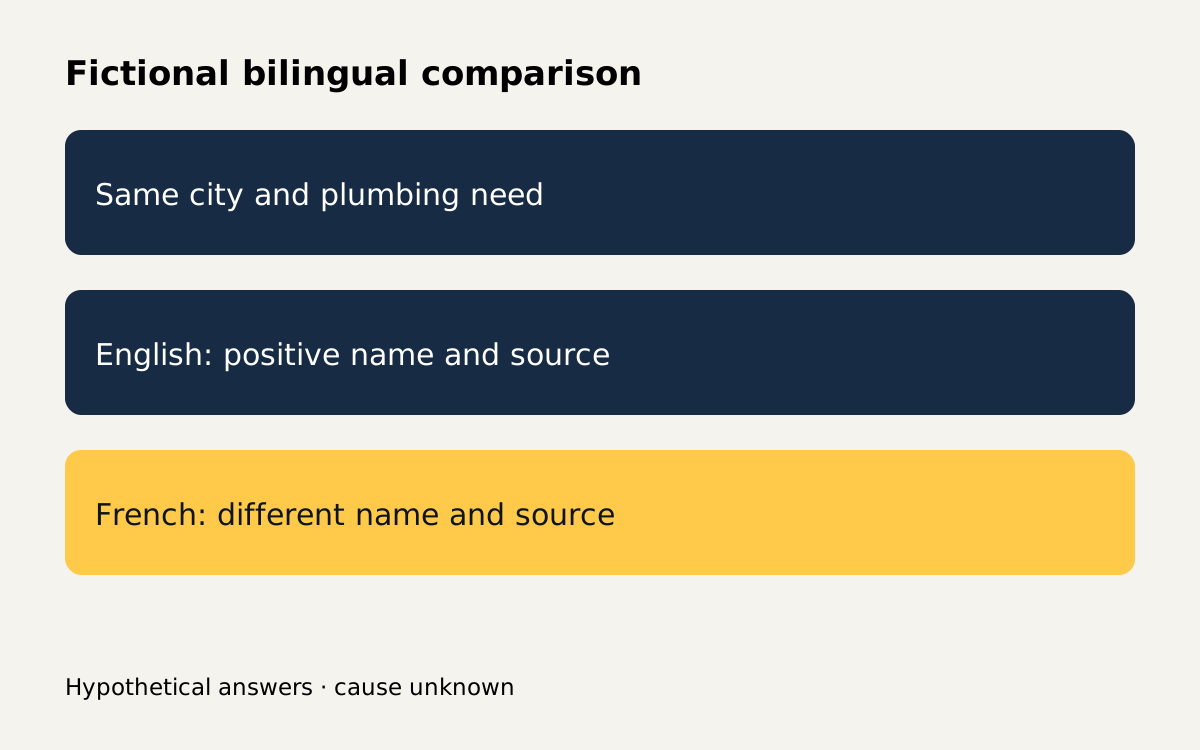
This example is hypothetical, not a sayurname client or a measured result. A plumbing service operates in one bilingual city and can answer customers in English and French. Its owner wants to know whether a person asking about a leaking sink receives the same useful information in both languages. A fluent employee checks that the two prompts describe the same city, leak and service request before the team records answers.
In an invented baseline, the English answer positively names the service and links to its page. The French answer names a different service and links to a local directory. This pair of observations does not prove that language caused the difference: source availability, retrieval and answer variation are possible influences. The English name and link are two observations, not two recommendations or two visits.
- Write the two natural, unbranded questions with the same location and service need. Record any wording that cannot be matched exactly, then save the assistant, date, visible settings and complete answers.
- Have the fluent employee review both responses. Mark the positive company names and source links separately, and label unavailable answers rather than inserting an assumed result. Save the precise evidence for any ambiguous mention.
- Check the company's real service area and capacity. Compare its English and French pages for accurate contact details, service scope and information about language support. Correct discrepancies that affect customers, with an owner responsible for maintaining both pages.
- If the site has equivalent localized URLs, have the site operator assess the relevant technical documentation and implement appropriate links and hreflang for Google Search. Verify the URLs and annotation; do not claim this forces any assistant to select the page.
- Repeat the same questions at a later date and preserve all results, including no-name and unavailable responses. If the French answer later names the company positively, show both observations and the dates, but do not claim that the page change alone caused the new answer.
Do not expand into a language or region merely to influence a dashboard if the business cannot actually serve those customers or maintain accurate translated information. A focused page in a supported language is better than a misleading promise of local availability. Ask a fluent reviewer and the service owner to approve material details before publication.
Keep assistant answers, citations and analytics referrals as separate records. If the business sees a visit from an AI service in connected analytics, that does not identify the answer or language that prompted it. If a source appears in an answer, it does not establish that anyone clicked it or purchased a service.
Sources and maintenance
Google's localized versions documentation describes hreflang and the conditions for identifying alternate language or regional pages: https://developers.google.com/search/docs/specialty/international/localized-versions. It concerns Google Search and does not promise assistant recommendations. Use the documentation for the specific system you are configuring and check it again when implementing a change.
Maintain a small comparison log with exact prompts, language, location, date, assistant, settings, complete answers and a human review of names and links. Track page revisions separately from answer observations. When changes coincide, describe the timing without assigning causation. Review localized facts whenever service boundaries or contact details change so all supported customers receive consistent information.
How sayurname works
The free test sends one question to ChatGPT, Gemini, Perplexity and Claude and saves the available answers. After subscription, sayurname works on the questions, requests inclusion where sources offer a route and measures weekly. The monthly service is $299 without lock-in. A one-time $599 bonus can be charged for a new positive name in a measured answer where the business was absent at baseline, or an AI-referred visit recorded by connected Google Analytics during the service. A team member checks the evidence first. Neither outcome is guaranteed.
Questions
Does translating a page guarantee a recommendation?
No. Translation can help people access accurate information, but it does not control an assistant's response.
Does hreflang control every assistant?
No. Google's documentation describes a signal for Google Search; other products use their own systems.
How do I compare languages fairly?
Use natural equivalent questions with the same service and location, record the context and review complete answers.
Is a source link the same as a positive name?
No. A source can be cited without the business being named positively. Record them separately.