
Published October 30, 2026
Why ChatGPT gives a different answer each time, and how to measure your brand anyway
The same question can produce different text, sources or named businesses across runs. Models, conversation context, search availability and underlying information can change, and not every assistant exposes every setting. Preserve the question and full answers, document visible settings and compare a series of runs. A single screenshot is a sample, not a reliable estimate or proof of why the answer changed.
Why the answer changes
An assistant generates a response rather than retrieving one fixed answer. Differences can arise from generation, prior conversation, model or search configuration and changes in the information available to it. Not every response uses live search, and a source shown in the interface is not a complete trace of the process. Record what the interface exposes; do not assert a hidden cause.
What changes and what tends to hold
The wording changes most. The list of brands, the order and the pages cited can change too, especially on questions where many brands compete. What you are looking for is the pattern: a brand that is named in most of the answers over several weeks is in a different position from one that appeared once.
A recurring name is an observation about the sampled questions and runs. It does not establish a fixed rank or the probability that every buyer sees it. A business name in the answer, a source link and a negative mention need separate labels; a source-only link does not mean the assistant named or recommended the business.
Why one screenshot proves little
A screenshot is a single sample, and nothing in it shows how often the answer repeats. Someone can show you the one good answer out of many. Treat a screenshot as an example, never as proof, and ask to see the full answers and the dates behind it.
A cropped screenshot can omit the question, date, sources or a qualifying sentence. Save the complete answer as well as the assistant, date and visible search setting. An unavailable response should remain in the record with its own status, rather than being treated as a clean absence or removed without explanation.
How to measure anyway
Write down the questions customers ask and preserve the wording. Ask each assistant at a regular interval and save every full answer with date and assistant. Compare names, descriptions and sources across the recorded runs. A sustained pattern can prompt investigation; one different reply is too little evidence to establish a trend or its cause.
Use a fresh conversation for each question, and record meaningful changes to the model or search settings if they are visible. Each added question receives its own first measurement. If a question changes, start a separate series. Comparing outputs collected with different settings without a note can make an interface change look like a business result.
Worked example: reading four weekly runs
This example is hypothetical, not a sayurname client or an estimate of real-world visibility. A fictional bike repair shop in Austin wants to know whether assistants name it for an unbranded question about repairing a commuter bicycle. The shop freezes one question in English, opens fresh conversations and saves the answers from four assistants once a week. The owner separates a positive name in the text from a link that appears only among sources.
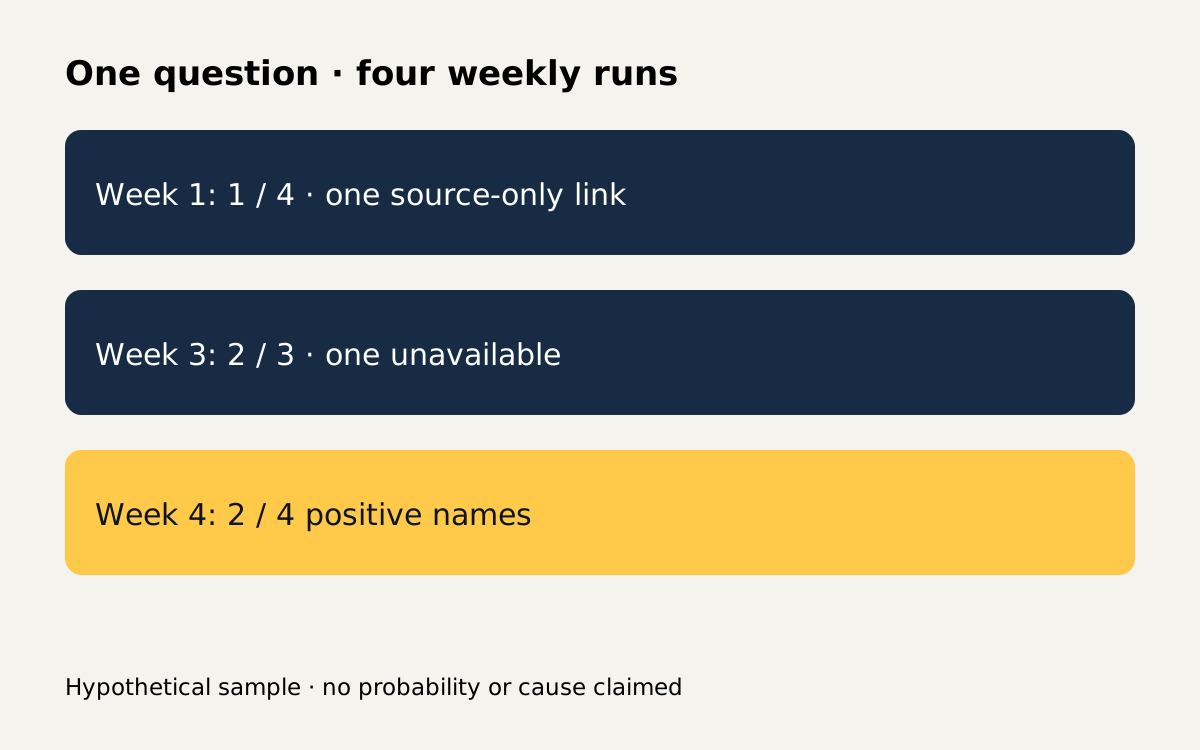
In the first illustrative week, one of four available answers names the shop positively; another links to its website as a source without naming it, and two do not name it. In week two, no answer names it. In week three, one assistant is unavailable and two of the three available answers name it. In week four, two of four answers name it. These are invented observations, not a probability estimate for all users.
- Write the exact customer question, intended market and language before the first run. Avoid placing the shop name inside the discovery question, because doing so changes what is being measured. A named diagnostic question can be useful, but belongs in a separate series.
- For every assistant and week, save date, full answer, names in the prose, source links and visible settings. Preserve the unavailable week-three result as unavailable. A site linked only among sources is not a positive name in the answer, and a negative mention should not be counted as a recommendation.
- Compare like with like. Week one is one positive name in four available answers; week three is two in three, not two in four. Keep the denominator next to the count. Do not add the source-only link to the positive-name count.
- Review the full week-three responses rather than relying on the larger fraction. Suppose one assistant shows a new model label that week. Note the change; the comparison now has a limitation even though the wording was unchanged. A model label alone does not explain the result.
- In the example the shop corrected its hours between weeks one and two. Do not claim that this caused the later names: other information and settings may also have changed. Keep the dated change log beside the answers so the owner can inspect what did and did not move.
- Decide whether to continue collecting comparable evidence or investigate a specific discrepancy. If the answer falsely states that the shop is closed, verify hours on the site and controlled profiles and request an external correction where needed. Record the request; an independent source may not accept it.
The four observations make variability visible, but they do not show every user’s answer or a causal effect of a particular edit. The weekly series is useful because its question, evidence and gaps are documented. A larger or more frequent sample can answer a different question, but must still disclose its method and denominator.
Do not compare a changed city or newly branded question with the original as if it were the same series. Do not promise that a repeated answer will persist. If a customer needs to know whether AI sent a visit, consult a connected analytics property separately; a visit and a name in an answer measure different things.
Where sayurname fits
The free test saves the full answers to one question from ChatGPT, Gemini, Perplexity and Claude. After subscribing, the service works on the questions, requests inclusion where sources offer a route, and measures weekly. It costs $299 a month without lock-in, plus a one-time $599 bonus when a new positive name in a measured answer where the business was absent at baseline or an AI-referred visit recorded by connected Google Analytics occurs during the service. A team member checks the evidence; neither result is guaranteed.
Questions
Why did ChatGPT name my brand once and not the next time?
Because it writes a new answer each time. One mention is a sample. Ask the same question on a regular schedule and look at how often your brand appears over several weeks.
How many times should I ask the same question?
There is no magic number. Ask every week, keep the wording fixed and judge the pattern over several weeks rather than a single reply.
Can I trust an agency that shows me one good answer?
Not on that alone. Ask for the list of questions and the full saved answers with their dates, so you can see how often the good answer repeats.
Does a repeated name prove a particular edit worked?
No. It is evidence in those runs. Other sources, model settings or circumstances may have changed, so preserve the comparison and avoid claiming causation.