
Published October 23, 2026
GEO red flags: how to assess an AI visibility provider
Treat guaranteed AI recommendations, unverifiable screenshots and unclear payment triggers as reasons to ask more questions. A credible proposal identifies the buyer questions to test, the work included, the evidence kept and the limits of the provider's control. Check the terms before spending money.
Start with the promise and the evidence
Generative engine optimization (GEO) is work intended to improve how a business is represented in AI answers. An agency can research customer questions, improve material it controls, contact sources and record answers. It cannot dictate another company's assistant or guarantee that an answer will mention a particular brand. Ask exactly which assistant, question, conditions and time period a claim refers to. A specific promise is useful only if the evidence and the limitations are equally specific.
A screenshot can be an observation, but it is not enough on its own to establish a repeatable result or a sale. Request the whole answer, exact question, date, source links and any relevant settings. Compare those records with a baseline taken before work began. A single answer can vary when the question or environment changes, so avoid treating an isolated favorable example as a market-wide result.
Claims that deserve careful questions
Be cautious if a provider promises a ranking in every AI assistant, a fixed date for a recommendation or guaranteed revenue. Ask how it proposes to control systems it does not operate, what happens if the result does not occur and whether the terms in the contract match the sales conversation. Google states that crawling and indexing are not guaranteed, and its guidance for AI features does not require special markup: https://developers.google.com/search/docs/appearance/ai-features. This is Google's guidance, not a rule for every assistant.
Be equally careful with claims of exclusive access to an assistant's answers or a secret submission that guarantees inclusion. Ask for the official documentation and a demonstration of the specific capability. Paid advertising, a listing, an organic search result and an AI answer are different things; do not accept one as proof of another. A provider should be able to explain its method without asking you to accept an extraordinary claim on faith.
Ask to see a sample report with the original question, date, assistant and complete answer, including an example where the business was absent. Check who owns any site changes and whether you can keep the records after cancellation. A polished chart without the underlying observations makes independent review difficult. An explanation of a failed attempt can be more informative than a screenshot selected only because it looks favorable.
Inspect the practical terms
Ask for the monthly price, duration, cancellation process, any setup charge and the conditions for any additional fee. If a bonus depends on a result, define the exact event, baseline, evidence, timing and who verifies it. Get the answer in writing before subscribing. Clarify who can access your analytics, who owns materials and accounts, and what will be handed over if you stop. These terms let you compare proposals on their actual cost and responsibilities.
Review what work will be done and how it will be reported. A useful report separates actions completed from observations and business outcomes. For example, an accurate mention is not a website visit, and a visit is not a sale. If an agency changed a page and an answer later changed, that sequence alone does not prove causation. A transparent provider can explain what remains uncertain without hiding the work performed.
Hypothetical proposal review
Imagine a fictional regional supplier comparing two proposals for improving answers about its service. This is an invented example, not a report about a real provider. The owner has a limited budget and wants to know what can be checked before making a decision. The same questions can be used whether the business eventually hires an agency or does the work itself.
At the end of the review, the owner has a written comparison and can make a decision without relying on a sales call alone. Even a well-documented process cannot promise an assistant's answer. The value of this exercise is understanding the work, its cost and the evidence the business will receive, not discovering a formula that guarantees a recommendation.
For the exercise, proposal A costs $300 a month and promises inclusion within 30 days; proposal B costs $250 a month and reports work and observations without guaranteeing inclusion. These prices and providers are invented. The lower price alone is not a recommendation: the owner still needs to compare scope, access and cancellation terms.
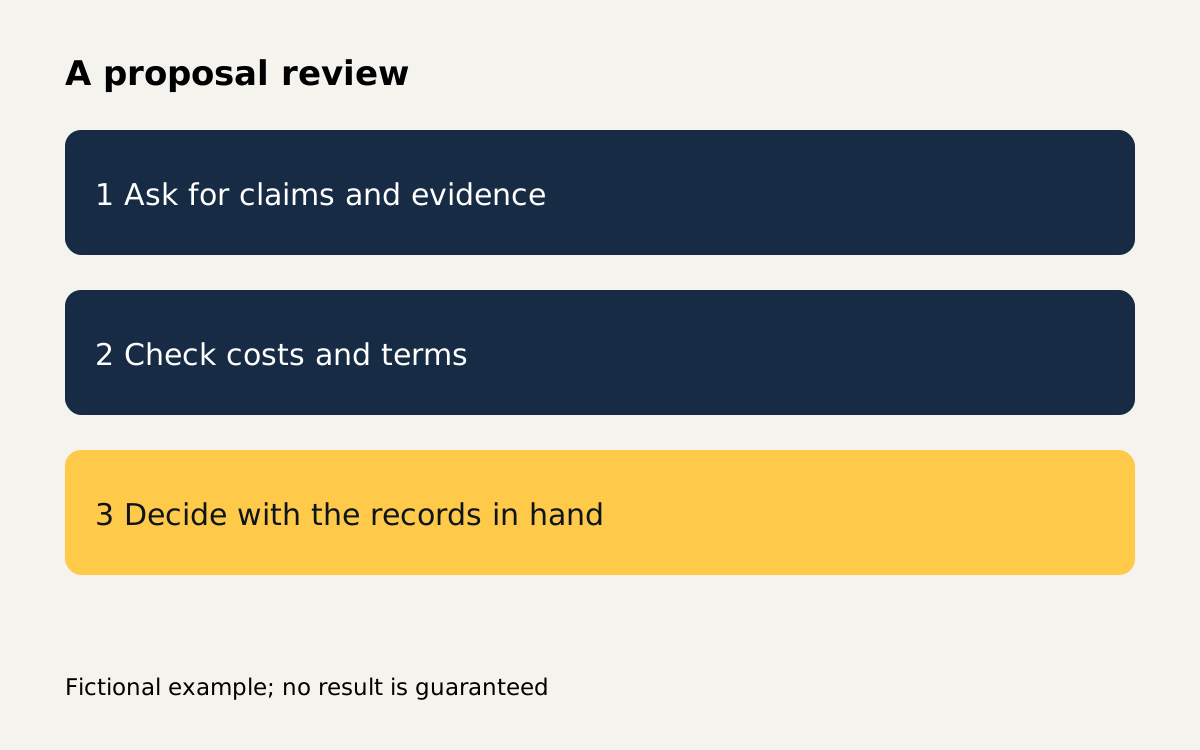
- First, the owner asks both providers for the exact customer questions and assistants they would test, plus a sample of the complete records they would save.
- Next, the owner requests a written price, cancellation process and definition of any bonus, including the starting measurement and the evidence needed to charge it.
- Then, the owner checks a claim of guaranteed inclusion against official documentation and asks the provider to explain which part of the process it actually controls.
- Finally, the owner compares the scope, access requirements and reporting samples, rejects unsupported promises and chooses whether the remaining proposal fits the budget and risk.
When to wait or use another approach
Do not sign a contract if you cannot understand the payment trigger, cannot retain access to your own accounts, or are being pressed to decide before seeing the terms. Wait until the offer is clear and the provider answers your questions. If the business has no reliable information about its products, availability or customers, correct those foundations first; an agency cannot honestly substantiate facts that the business cannot verify.
If the immediate need is sales or basic website repair, compare other channels and maintenance work against the cost of an ongoing GEO service. If you decide to try GEO, choose a budget you can afford, name an internal owner and agree on a review point. Stop or adjust if the reports do not answer the agreed questions, costs no longer make sense, or the business can no longer check the evidence.
How sayurname works
The free test sends one question to ChatGPT, Gemini, Perplexity and Claude and saves the available answers. After subscription, sayurname works on the questions, requests inclusion where sources offer a route and measures weekly. The monthly service is $299 without lock-in. A one-time $599 bonus can be charged for a new positive name in a measured answer where the business was absent at baseline, or an AI-referred visit recorded by connected Google Analytics during the service. A team member checks the evidence first. Neither outcome is guaranteed.
Questions
Is a guaranteed recommendation credible?
No provider controls every assistant's responses. Ask what the provider controls, what it will record and how its written terms handle uncertainty.
Does a screenshot prove a campaign worked?
It records at most an answer at one time. Ask for the exact question, date, full response, sources and baseline before drawing conclusions.
Should I share analytics access?
Only if the access is needed for agreed work. Review the permissions and make sure the business retains control of its own account.
What if the provider will not explain its method?
Ask for a description of the work, evidence and contract terms. If essential details remain unclear, wait until you can make an informed decision.