
Published October 21, 2026
Best GEO agencies: what to check before you hire one
Compare agencies by the questions they measure, the complete evidence they preserve, the work they can actually perform, their fees and the responsibilities your team retains. Nobody can guarantee an independent assistant will recommend a business. A useful proposal lets you inspect what was done and decide whether its cost and constraints suit your situation.
1. A fixed list of questions
GEO is measured by asking the AI assistants the questions your customers ask. Ask the agency for the list, agreed with you, and for the promise that the wording will not change from week to week. If the questions change, the results cannot be compared.
A good list reflects actual buying questions and the locations you serve, without inserting your name to make a test look favorable. Agree how a question is added or retired. Each new question needs its own baseline, and a changed language or location creates a different comparison.
2. The full answer, saved as proof
A screenshot of one good answer proves very little: the same question can return a different answer tomorrow. Look for an agency that saves each full answer with its date and the assistant that wrote it, so you can read them yourself.
Ask for the question, assistant, date, visible search setting and complete response, not only the excerpt that makes the provider look good. A name in the answer, a link among sources and an unavailable response are separate observations. A negative mention is not a positive recommendation.
3. No guaranteed citations
Nobody controls what an AI says. An agency that guarantees a citation, or a position, is promising something it cannot deliver. A serious one promises the work, the measurement and the proof.
A request to an editor or directory is an action the agency can document. Acceptance is controlled by that source, and the assistant still chooses its answer. Ask to see requests and their status. Avoid a proposal that treats a paid listing or a single screenshot as a guarantee of future recommendations.
4. How you are charged
Compare the entire agreement, not just a headline monthly amount. Ask the provider to show the conditions, evidence and timing for every charge in writing.
Compare the full recurring fee, setup charges, bonus triggers, taxes where applicable and cancellation terms. A result-linked fee is one possible model, not proof of skill. Ask what is owed if no qualifying event happens and whether a source link, negative name or an analytics visit is treated as a result.
5. What you receive, and where it is published
Ask how many pieces of content you get each month, in what formats, and where they go: on a subdomain of your own domain or delivered to you. Content that lives only on the agency's site does not build your brand.
Ask who owns and approves each deliverable, how site access works, what is published on your domain, and what you can retrieve if the relationship ends. More content is not automatically better. The provider should explain why a proposed change answers a customer question and how an independent source request will be tracked.
A worked comparison: two proposals for one business
Imagine a fictional home repair business, West Harbor Repairs, with four technicians and a service area covering one city. It does not install roofs. The owner can spend three hours a month reviewing work and wants to understand who can help with a measured question about repairing a leaking window. The business is not a sayurname client; the following numbers and proposals are invented to show a decision process, not a ranking or forecast.
The owner requests the same written proposal from two suppliers. Provider A offers a monthly report and says its private score will show progress. Provider B offers to preserve full responses, identify inaccurate site information, prepare source requests and provide a list of changes for approval. Neither example price below represents an actual offer. The first task is to check whether the two quotes cover the same work, rather than assuming a lower monthly amount is cheaper.
- Write one unbranded question with the city and specific service, and save the complete initial answers from each assistant. Record an unavailable response separately. A provider should not silently replace a difficult question with one that already contains the business name.
- Ask both suppliers for a sample deliverable. Provider A supplies one cropped screenshot but will not share the original question or date. Provider B supplies a dated full answer and a change log. This does not prove B will achieve a recommendation; it makes its claimed work reviewable.
- Inspect the proposed site work. The old page promises roof installation even though the company does not offer it. Ask who verifies and removes that claim, who gets access, and who approves the replacement. A vendor cannot verify the business’s actual service area without the owner’s input.
- Request the policy for external sources. Provider B lists one directory with a submission route and promises to report whether it accepted the request. Provider A promises placement but does not name the publication. A request is not an accepted listing, and a listing is not control over an assistant.
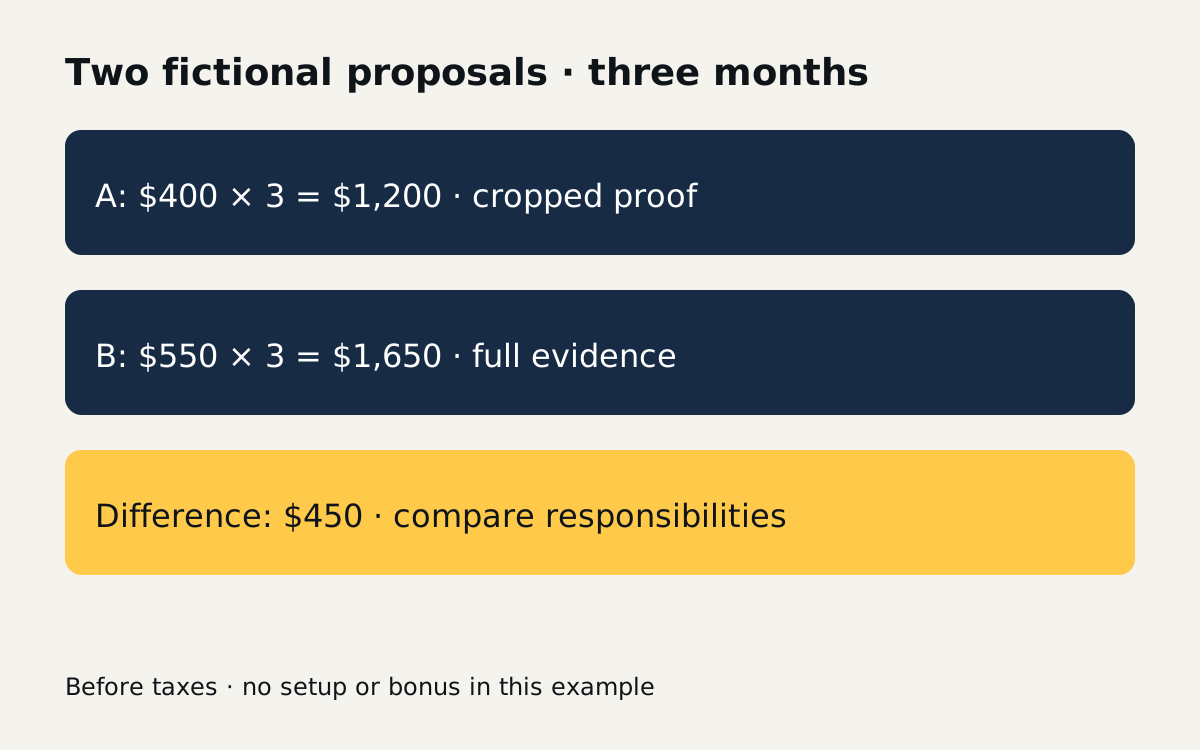
- Compare costs over a defined period. In this hypothetical comparison, A quotes $400 monthly for three months and B quotes $550 monthly for three months, with no setup or bonus in either quote. The totals are $1,200 and $1,650 respectively, before taxes. Ask whether those assumptions match the actual proposals, and add any setup, bonus or cancellation charges before comparing.
- Choose a review date. The owner selects B because access to evidence and clear responsibility matter more than the $450 difference in this example. At the review, examine all responses and completed changes. If the business cannot supply approvals or the results cannot be compared, pause and fix that process before extending the engagement.
Neither provider can promise what the assistant will answer. If a later run names West Harbor, keep the entire response and compare it with the first run; do not conclude that a specific edit caused the change. A traffic report is a separate signal and depends on the analytics property being connected and configured.
This comparison is not a recommendation to choose the more expensive quote or a claim about real agencies. The decision changes if the business has no capacity for more jobs, cannot give access, or can do the corrections itself. When those constraints dominate, postpone hiring and fix them first.
How sayurname answers the five
You start with a free test of one question on ChatGPT, Gemini, Perplexity and Claude, and the answers are saved. After you subscribe, your questions are measured every week, with the same wording and the full answers saved. We promise no citations. We find the sites AI uses to answer your questions and request your inclusion wherever there is a way in. We also publish content for those questions, through a subdomain in your DNS or ready for your team to publish.
The free test gives a starting point for one question. Each additional question starts with its own first measurement. The service requests inclusion where a source offers a route, without promising acceptance, and retains the full answers so the customer can inspect the evidence.
sayurname costs $299 a month without lock-in, plus a one-time $599 bonus subject to the conditions below.
A qualifying positive name in an answer on a measured question where the business was absent at baseline, or an AI-referred visit recorded by connected Google Analytics during the service, can trigger the bonus. A team member checks the evidence first. The bonus is charged once per customer; neither result is guaranteed.
Questions
Is there a ranking of the best GEO agencies?
Not one we would trust. The field is new and results depend on your market. The five checks above compare agencies on things you can verify.
Should I avoid an agency that promises citations?
Yes. An agency does not control what an AI says, so a guarantee of citations is a warning sign.
What proof should I ask for?
The list of questions, and the full answers each assistant gave, with dates. If it only shows screenshots, ask for the rest.
How can I test an agency before paying?
Ask how it would measure your first question. With sayurname you can run that first measurement yourself in the free test, with no card.