
Published October 21, 2026
GEO vs an SEO agency: how to choose the work you need
SEO focuses on helping relevant pages appear in search results; GEO focuses on how generative assistants answer relevant questions. The work can overlap, but the measurements and promises are different. Choose based on your customers' questions, the work required, the evidence you can inspect and the budget you can sustain.
Understand the difference in the questions
Search engine optimization (SEO) concerns how search systems discover, understand and present pages. An SEO agency may work on site access, page content, technical issues and search performance. Generative engine optimization (GEO) focuses on how AI assistants answer questions and represent a business. A GEO provider may research questions, improve source material, request corrections from third parties and measure answers. Actual agency scopes vary, so ask for the specific tasks rather than relying on the label.
The two approaches overlap when an assistant uses information available on the web. A clear, accessible page can help both readers and search systems, but a search position does not guarantee a recommendation in an AI answer. Google describes its own AI search features and says no special AI markup is required: https://developers.google.com/search/docs/appearance/ai-features. That guidance applies to Google Search, not automatically to all assistants.
Compare deliverables, not just names
Ask each provider which customer questions it will investigate, what it will change and what it needs from your team. An SEO proposal might include a technical audit and work on pages that serve search demand. A GEO proposal might include a baseline of assistant answers and requests to correct relevant external profiles. Either provider may offer both kinds of work; check the scope, owner, timeline and reporting in writing.
Look for accurate statements about the product and who it serves, rather than a promise that a particular format or trick will force an assistant to include a brand. If important facts are missing or incorrect, the business should supply and verify them before a provider publishes or requests a change. Ask who approves public changes, who owns the accounts and materials, and what happens to access after the engagement ends.
Before comparing fees, ask whether the proposal includes the work itself or only a list of recommendations. Identify who can approve changes, update business information and respond to requests from third-party sources. A lower fee may require more of your staff’s time. Agree on an initial review date and a way to inspect the work completed, even if no assistant names the business during that period.
Measure different outcomes separately
For search work, a team can inspect relevant pages, search queries and available performance data. For assistant answers, choose a fixed set of buyer questions and save the exact wording, assistant, date, complete response and source links. Record whether the brand is mentioned, described accurately or recommended, and keep answers from before the work as a baseline. An answer is an observation for that test, not a complete picture of every user's experience.
Do not combine mentions, citations, visits and sales into one success number. A linked source does not prove a visit, and an analytics visit does not prove a sale. Attribution can be incomplete, while assistants and search systems can change independently of the work. If an answer changes after a page edit, describe the sequence and the evidence without claiming the edit caused it. A useful report shows completed tasks and remaining uncertainty.
Hypothetical comparison for a growing business
Consider a fictional company that sells appointment software to independent clinics. It has an accessible site but does not know whether buyers find its pages in search or receive an accurate description from assistants. This is an invented illustration, not a case study or a prediction of results. Its owner asks two providers for proposals and compares the work against a limited budget.
For this illustration, the company can spend $800 in the first month. One proposal quotes $500 for an SEO audit, while another quotes $600 for one month of GEO work. Together they exceed the budget by $300. These prices are invented; compare the proposed scope and whether the audit includes implementation before choosing.
The owner may decide to hire one provider, split the work or wait. The choice depends on what the records show and what the business can maintain. A provider can be useful without controlling search rankings or assistant responses; the practical test is whether the work and reporting are understandable, verifiable and worth the agreed cost.
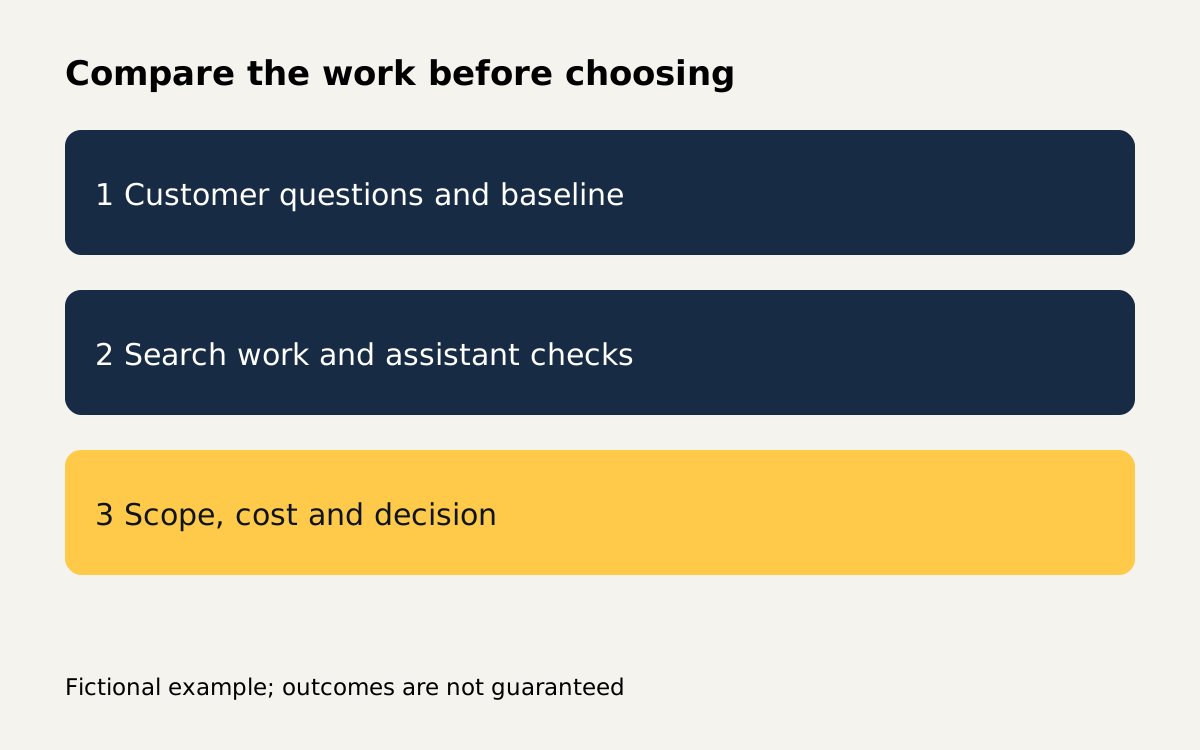
- First, the owner lists real questions about reminders, integrations and clinic size, then records available search data and complete assistant answers as separate baselines.
- Next, an SEO provider explains which site access problems and pages it would investigate, while a GEO provider explains which answers and outside sources it would check.
- Then, the owner compares costs, access, reporting, cancellation and who approves corrections. The owner asks both providers to distinguish their own work from outcomes outside their control.
- Finally, the owner chooses a scope that fits the budget and sets a review point. At that review, the team compares the original records with new observations and decides whether to continue or change course.
When to choose neither, or start with foundations
Do not hire either type of provider solely because it guarantees a specific ranking, recommendation or revenue. No agency controls all the systems and users involved. Ask for a written scope, price, cancellation terms, access requirements and evidence. If a proposal does not answer those questions, wait. If product claims, availability or ownership of the website are unresolved, address those issues before paying for ongoing optimization.
A business that needs immediate orders may need to prioritize direct sales, customer support or other channels it can operate now. Another business may have sufficient internal capacity to run a small baseline and correct its own information before outsourcing. Revisit the decision when you can identify a concrete problem, assign an owner and afford to evaluate the work without treating an uncertain outcome as guaranteed.
How sayurname works
The free test sends one question to ChatGPT, Gemini, Perplexity and Claude and saves the available answers. After subscription, sayurname works on the questions, requests inclusion where sources offer a route and measures weekly. The monthly service is $299 without lock-in. A one-time $599 bonus can be charged for a new positive name in a measured answer where the business was absent at baseline, or an AI-referred visit recorded by connected Google Analytics during the service. A team member checks the evidence first. Neither outcome is guaranteed.
Questions
Does an SEO agency automatically provide GEO?
Not necessarily. Some agencies offer both, while others do not measure assistant answers. Ask for the exact work and reporting in the proposal.
Does good search ranking guarantee an AI recommendation?
No. Search results and assistant responses are different observations, and neither a ranking nor a page change guarantees a recommendation.
Can the same provider do both?
Yes, if the provider has the relevant skills and includes both scopes. Compare its tasks, measurements, costs and evidence rather than the label alone.
How should I divide a limited budget?
Start with the customer problem and the current evidence. Prioritize essential site and product information, then choose the work you can afford to review and maintain.