
Published October 20, 2026
What a generative engine optimization (GEO) agency does
A GEO agency works to improve the chances that AI assistants name a business when customers ask relevant questions. It measures a starting point, improves verifiable site information, requests inclusion in relevant sources where possible, and measures again. The agency controls its work and requests, not an editor’s acceptance or the assistant’s answer.
What GEO means
Search engines return a list of links. AI assistants return an answer, and the answer names a few brands. GEO is the work of being one of the brands named. The target is the answer an assistant gives to a customer's question, not a position on a results page.
Both search results and assistant answers vary, and assistants may link to sources alongside their prose. A link to your site is useful evidence of discovery, but it is different from the assistant naming your business. Neither a high search position nor a published page guarantees a recommendation.
Job 1: measure what AI answers today
It starts with the questions your customers ask. The agency asks each one to the assistants, saves the full answers, and records whether your brand appears. That first measurement is the starting point everything else is judged against.
A useful baseline keeps each question’s exact wording, language and intended market. It records the assistant, date, available settings and full response, including the sources. The first answer to a later-added question becomes that question’s own baseline. Mark unavailable responses separately rather than counting them as absent.
Job 2: create the content that answers those questions
For each question, a page that answers it directly, with the answer in the first paragraph, written so an assistant can quote it. The content is published on your own domain or delivered to you ready to publish.
A good page states a verifiable offer, the customer it serves and the boundaries of that offer. First correct wrong or conflicting facts on the business site and profiles. Where a source used for the question accepts requests, ask for inclusion; the request is work the agency can do, while acceptance remains the source’s decision.
Job 3: measure again, every week
The same questions, worded the same way, asked again every week. When the answers change, the agency can show which question changed, on which assistant, with the full answer saved as proof.
Record model or search changes as a break in comparability, and preserve the previous result. Read each assistant and question separately: one favorable answer is a snapshot, not proof of a trend. If the question is changed, start a new series rather than silently comparing different wording.
What you should receive
A list of questions agreed with you. Content for each one. A weekly record of what each assistant answered. No promise of guaranteed citations: an agency does not control what an AI says, and a promise like that is a warning sign.
Ask for the submitted requests and their status, the complete answers, and copies of work delivered. Establish who approves facts and where the files live. A contract should describe cancellation, access and what the customer retains; a screenshot alone cannot demonstrate the entire process.
Example: a hypothetical specialist clinic
Consider a fictional Austin physiotherapy clinic, Cedar Run, with three clinicians and room for twelve new appointments a month. It helps runners return after injury but does not perform surgery. The clinic is not a sayurname client. Its owner wants people to find that specific service, and asks an agency to work on “Which Austin clinic helps runners return after an injury?” The example is an illustration, not a forecast.
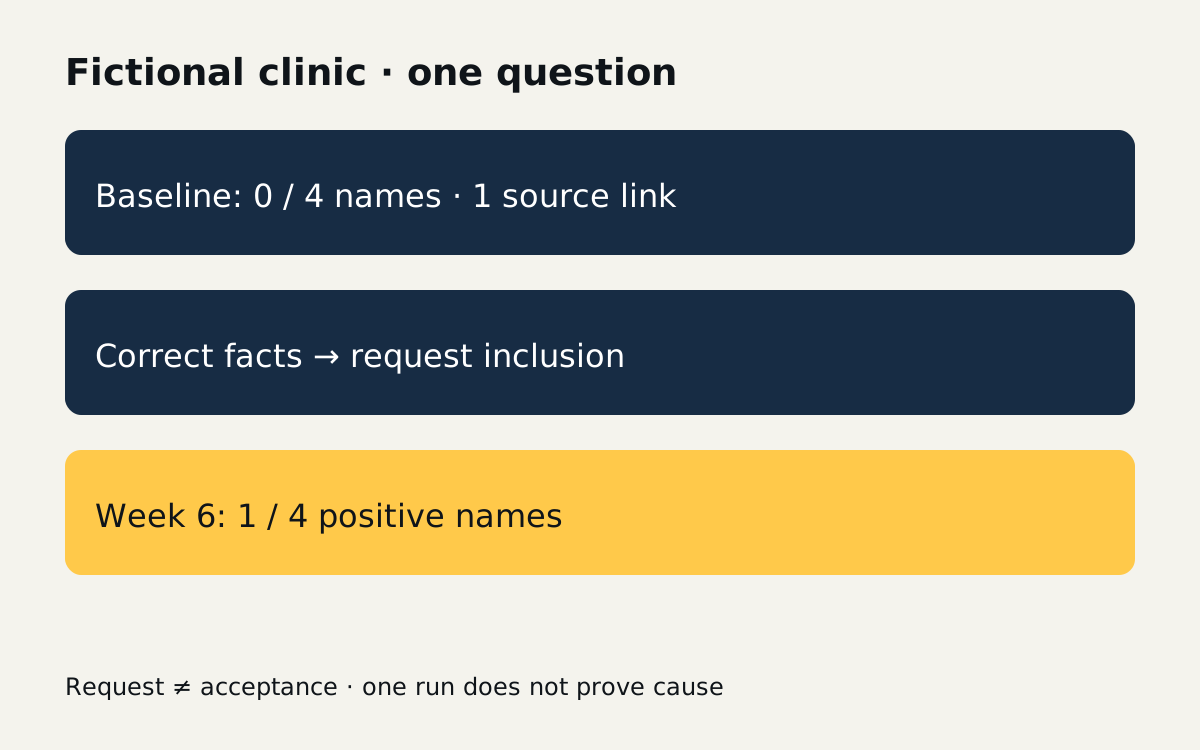
At the start, the question is asked in four assistants with the same language and location. In this invented run, none names Cedar Run in the answer; one links to its site as a source, two name other clinics, and one gives advice without a list. The agency stores the full answers. Zero names in four responses and one source-only link are separate facts.
- Agree the question and save the exact text, the date, each assistant and the search setting shown. If a new question is added later, save its own first answers rather than treating this baseline as universal.
- Inspect the clinic’s site and the sources visible in the answers. The agency finds a general rehabilitation page, a profile with an outdated address and a directory that allows corrections. The clinic confirms its service area and the scope of its running assessment.
- Correct the profile and clarify the page: who the assessment is for, what happens in the first appointment, and what the clinic does not offer. A clinician verifies the facts. The agency keeps the earlier version and the date of the update so the client can see what was actually done.
- Where the directory has a documented submission route, send a request and keep a copy and status. Do not describe the business as included until the editor accepts it. An independent publication may reject or ignore a request, so a list of requests is not a list of guaranteed placements.
- Ask the unchanged question again each week. In a fictional week six, one of four assistants names Cedar Run positively. Save all four answers, including the ones that do not. The team checks the name against the baseline and notes any model or search change before calling it a qualifying result.
- At the review, show the clinic the changed page, the request status and the dated answers. One new name in one run does not establish that the page caused it or that the same answer will recur. The clinic can compare the work delivered with its cost and decide whether to continue.
The source-only link at the start may be interesting to investigate, but it does not count as the business being named in the answer. A subsequent AI-referred visit is a separate signal when connected analytics records it. Neither signal proves that someone booked an appointment or that a particular edit caused the change.
Do not hire for more visibility if the clinic cannot accept patients or if it cannot verify its claims. First settle capacity, service boundaries and who approves changes. The agency should be able to describe its work and evidence without guaranteeing the answer of an independent assistant.
How sayurname does it
You start with the free test: one question, asked to ChatGPT, Gemini, Perplexity and Claude, with the answers saved as your starting point. We find the sites AI uses to answer your questions and request your inclusion wherever there is a way in. We also publish content for those questions, through a subdomain in your DNS or ready for your team to publish. We measure your questions every week on ChatGPT, Gemini, Perplexity and Claude and save the full answers.
The team checks evidence before any bonus is charged. A qualifying first positive name in a measured answer or an AI-referred visit recorded by connected Google Analytics while the service is active can trigger the one-time bonus. A source-only link or a negative mention is not a qualifying positive name.
sayurname costs $299 a month without lock-in, plus a one-time $599 bonus subject to the conditions below.
A qualifying positive name in an answer on a measured question where the business was absent at baseline, or an AI-referred visit recorded by connected Google Analytics during the service, can trigger the bonus. A team member checks the evidence first. The bonus is charged once per customer; neither result is guaranteed.
Questions
Is GEO the same as AEO?
GEO and AEO are overlapping labels used in different ways. Ask what the provider actually measures and delivers rather than assuming the label defines the work.
Can a GEO agency guarantee that AI will recommend my brand?
No. An agency cannot control an assistant’s answer. At sayurname, a qualifying new positive name or an AI-referred visit recorded by connected Google Analytics can trigger the one-time bonus after human review.
Do I need to give a GEO agency access to my website?
You can choose a DNS subdomain for publication or receive content ready to publish. For site corrections, appropriate access lets the team implement changes; otherwise your team receives instructions and the result is checked.
How do I see the results?
Through the weekly measurement: each question, each assistant, each date, with the full answer saved. You can read the answers yourself instead of taking our word for it.