
Published October 23, 2026
How long does GEO take? A practical way to measure the wait
No one can promise when an AI assistant will mention or recommend a business. Start with a fixed set of real customer questions, record the first answers and compare later observations under similar conditions. A change in an answer is evidence of a change in that test, not proof that a specific action caused it.
Why a date cannot be promised
Generative engine optimization (GEO) means improving information about a business and checking how AI assistants answer relevant questions. Assistants differ in their sources and methods, and their responses can change between requests. A supplier can control its own work and record a test, but it cannot control another company's assistant or promise the date of a recommendation. Treat a precise deadline as a sales claim, and ask what evidence supports it.
Google explains that its search systems discover, index and serve pages in distinct processes, and that crawling and indexing are not guaranteed: https://developers.google.com/search/docs/fundamentals/how-search-works. Those search processes are not a timetable for every AI assistant. Even an accessible page may not appear in a particular answer, and an answer can change without an obvious reason. Budget for learning rather than treating a calendar date as an outcome.
Build a baseline that you can repeat
Choose questions customers actually ask before buying, including a relevant use case and location when those details matter. Save the exact wording, assistant name, date, full answer and any linked sources. Record whether the business appears, whether its description is accurate, and whether the answer is favorable, neutral or unfavorable. Include questions on which it does not appear; otherwise you cannot identify a new appearance later.
Repeat the same questions in similar settings and keep the original records. Responses can vary, so one run is an observation rather than a complete measure of visibility. Check source links yourself and separate a brand mention from a recommendation, a website visit and a sale. If settings, wording or the assistant change, note the difference instead of presenting the two tests as perfectly comparable.
A useful schedule names decisions as well as dates. At the first review, check whether the baseline is complete and whether the team can update the pages it identified. At the next review, compare the saved answers under the same conditions and inspect the work log. If there is no change, decide whether to test another relevant question, investigate an access issue or stop spending; the calendar alone does not explain the result.
A change in provider, model or web-search setting can break a comparison even when the question is identical. Record these details when available, and mark the series when any of them changes. Do not replace the original baseline with a later favorable answer. Keeping the less flattering observations makes it possible to explain what actually changed and what remains uncertain at the next review.
A hypothetical timeline and decision
Consider a fictional scheduling software company that serves independent clinics. It is not a client result. Its team wants to learn whether assistants can accurately describe the product for a specific buyer. The example below illustrates a method, not a predicted schedule or a guarantee of appearance.
Suppose the team asks three questions in four assistants, producing twelve baseline answers, with no positive mention. It repeats the same twelve checks weekly and, in week four, finds two positive mentions. These invented numbers describe one test round, not a typical waiting time, a forecast or proof that the work caused the change.
The team records each observation in a shared table and keeps the original answers beside its notes. A later positive answer would be useful evidence for that exact question, but it would not establish that the company reached every buyer or prove that one edit caused the change. If nothing changes, the team can still review whether the work addressed the buyer's actual questions and whether accessible sources contain the necessary facts.
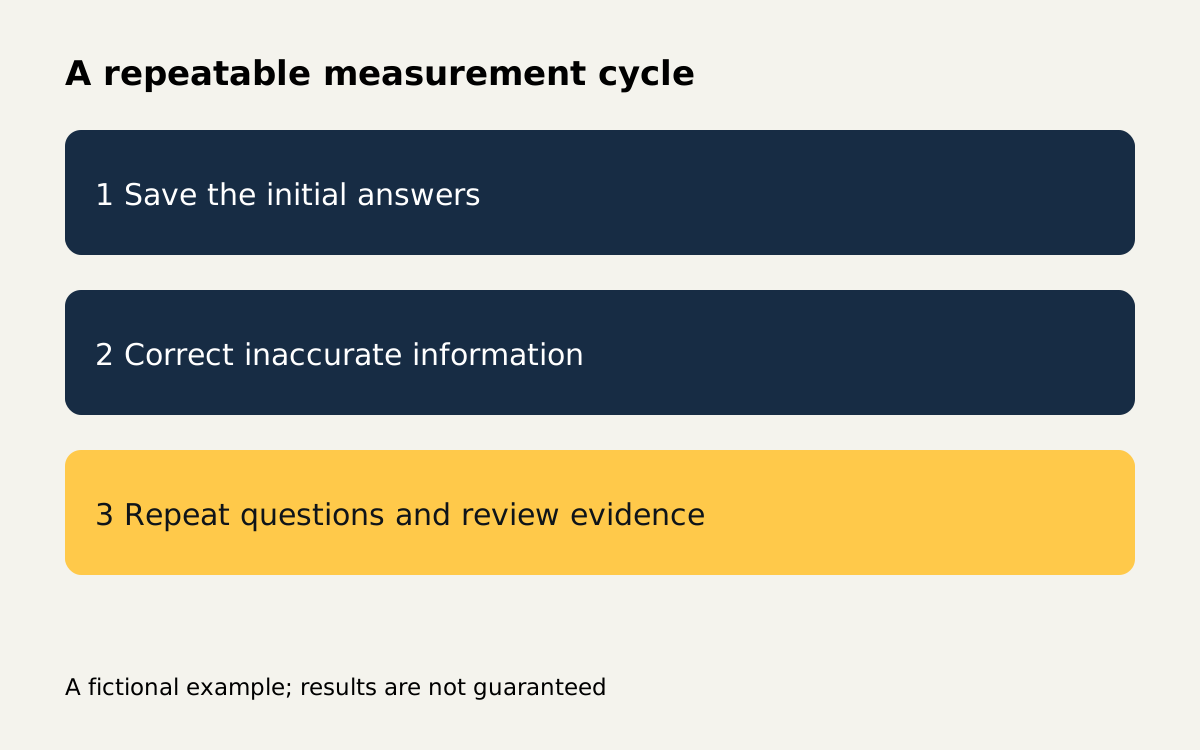
- First, select customer questions about appointment reminders, clinic size and supported regions. Run each question in the chosen assistants and save the complete answers as the starting point.
- Next, compare the answers with the company's current documentation. Correct a dated statement about integrations and clarify who the product serves; keep claims that the team can substantiate.
- Then, ask relevant independent directories to correct inaccurate profiles where they provide a contact route. Record each request and its response, without assuming a directory will comply.
- Finally, repeat the same questions and compare the saved answers with the baseline. Review any new mention and source manually; decide whether to continue, change the questions or stop based on the evidence and available budget.
Read the signals without inventing causation
An accurate mention, a useful citation or an AI-referred visit can each be worth investigating, but they answer different questions. A citation does not establish that someone visited the site; a visit does not establish that the visitor became a customer. Analytics may also have incomplete attribution. Review the original answer and the relevant analytics records before drawing a conclusion, and compare like with like whenever possible.
Keep a simple change log: what was changed, when, where and why. If visibility changes afterward, report the order of events without claiming the change caused the answer. The assistant may use other sources or change its own behavior. Look for repeated patterns across the selected questions, and state the size and limits of the sample whenever you share results with a stakeholder.
When to pause and what to do instead
Do not buy an ongoing GEO service solely to meet a promised recommendation date, or when there is no budget to verify the work. If your offer, audience or essential product facts are still changing, settle those first. If the business needs sales immediately, evaluate channels you can operate and measure now alongside longer-term work; an assistant's answer is not a substitute for a sales plan.
Pause or adjust when repeated checks reveal that the questions do not reflect real buyers, the source material cannot be verified, or the cost no longer fits the potential value. Discuss the records and next decision with the person responsible for the budget. A transparent provider should explain what it did, show the evidence and accept that some outcomes remain outside its control.
How sayurname works
The free test sends one question to ChatGPT, Gemini, Perplexity and Claude and saves the available answers. After subscription, sayurname works on the questions, requests inclusion where sources offer a route and measures weekly. The monthly service is $299 without lock-in. A one-time $599 bonus can be charged for a new positive name in a measured answer where the business was absent at baseline, or an AI-referred visit recorded by connected Google Analytics during the service. A team member checks the evidence first. Neither outcome is guaranteed.
Questions
Is there a guaranteed number of weeks?
No. The timing and content of an assistant's answer are outside a provider's control. A test can document an observation, not guarantee when an outcome will occur.
Does publishing more make the result faster?
There is no universal relationship between volume and timing. Prioritize accurate, useful information and check whether it addresses real customer questions.
What should I check before a recommendation appears?
Compare the saved answers with the baseline for accurate descriptions, mentions and sources. Record the limitations of the sample and avoid treating a mention as a sale.
Does an AI referral prove the work caused it?
No. A recorded referral is a visit attributed to a source under the analytics configuration. It does not by itself establish why the visitor came or which action caused it.