
Published October 21, 2026
What the MemberVIP sign-up data says about ChatGPT
The existing MemberVIP case reports 66 ChatGPT-attributed sign-ups out of 151 recorded sign-ups in the 90 days ending October 13, 2026: roughly 44%. Google is reported at 60. These are reported acquisition figures, not proof of which answer named the business, what caused the result, or whether the people bought anything. Compare channels only after checking the event definition, attribution model and dates.
Read the original figures as a snapshot
The published case describes MemberVIP, a platform for content creators, and reports 151 sign-ups in Google Analytics during the 90 days ending October 13, 2026. Of those, 66 were attributed to ChatGPT, 60 to Google, 17 to direct traffic and eight to other sources. Sixty-six divided by 151 is approximately 43.7%, rounded to 44%. These four categories add up to the reported total.
That result is a snapshot of one property and period, not a forecast of the next quarter. The original case attributes the numbers to Google Analytics, but the underlying report, event configuration and attribution settings are not published with the article. Reproduce the report and inspect those settings before using the figures for a current investment decision. A different date range or attribution dimension may produce different totals.
A source is not a transcript
An analytics source can associate a recorded visit or conversion with ChatGPT according to the available referrer and the reporting configuration. It does not capture the wording of the chat, whether the assistant mentioned MemberVIP positively, or which source the assistant consulted. Someone can also learn about a business through an assistant and visit later without a detectable AI referrer.
Keep three separate records: a saved answer to a named question, a tagged or otherwise observable site visit, and a sign-up event. A link to a source is not the same as the assistant naming a business in its response. A positive name in an answer is not the same as a visit. A visit is not a sign-up, and a sign-up is not a paying customer.
Source: Google Analytics and MemberVIP sign-up data, 90 days to Oct 13, 2026.
The figures show sign-ups attributed to ChatGPT. They do not isolate which site or content change caused each recommendation.
What cannot be concluded from the case
The existing account says the work included clearer site pages, content answering customer questions and checks of search presence. Those actions happened alongside the observed acquisition results. The data as presented does not isolate a particular change, prove that it caused a recommendation, or compare the company with an untreated control. Other activity and changes in demand could also matter.
The original article also reported 23% and 9% conversion rates, but did not provide the underlying denominators or the calculation. It mentioned a separate sign-up database period; that window and its source definition are different from the 90-day Analytics snapshot. Do not add those records to the 151 or compare the rates until their definitions and raw counts are available. No revenue, retention or advertising-spend conclusion follows from these totals alone.
A practical measurement plan
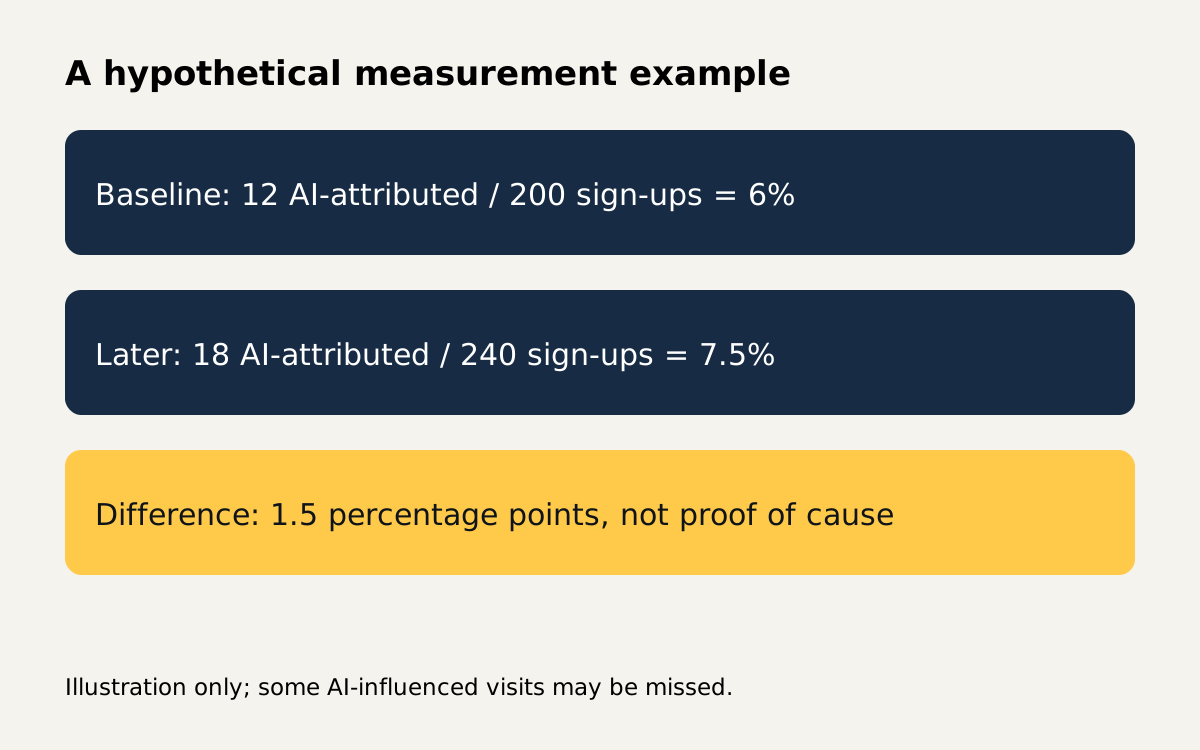
Consider a hypothetical software company called Harbor, not a MemberVIP result. It wants to know whether assistants are discovering its scheduling product and whether visitors register. The team fixes a 28-day observation window, selects a small set of buyer questions and records the following steps before changing content. This example illustrates a method; the numbers are invented.
- Save answers to five questions in each available assistant, with date, language, location, exact prompt and whether Harbor is named positively. Record links separately, including answers where Harbor is absent.
- Define the sign-up event once and verify it fires for a completed account, not merely for a click. Record the Analytics property, date range, time zone, attribution dimension and filters so a colleague can reproduce the report.
- Suppose the baseline contains 200 recorded sign-ups: 12 attributed to identifiable AI referrals, 100 to search, 58 direct and 30 other. The AI share is 12 divided by 200, or 6%; it is not a measure of every person who used AI.
- Improve a page that answers a specific buyer question, document the change and repeat the same questions weekly. Suppose a later 28-day report shows 18 AI-attributed sign-ups out of 240, or 7.5%. Preserve the raw counts and acknowledge seasonality, source loss and other changes before interpreting the difference.
- Inspect a sample of completed registrations and compare with backend totals without exposing personal data. If source definitions or event counts diverge, fix measurement first; do not claim the content change caused the increase.
The two percentages differ by 1.5 percentage points, while the denominators also changed. This is a useful prompt to investigate, not a controlled estimate of impact. Keep screenshots or exported reports, sampling details and negative answers alongside the positive examples so the next review can reproduce the conclusion.
When not to copy this approach
Do not spend on a visibility campaign because of a single impressive percentage. First ensure the sign-up event works, the business can serve the demand, and the selected questions reflect actual buyer choices. A product without a clear offer or a working registration flow has more immediate problems than its appearance in an assistant.
Avoid comparing two tools with different date ranges, attribution windows or definitions of a completed sign-up. If an assistant blocks automated collection, respect its terms and use available manual checks. If the sample is small or referrers are missing, report the uncertainty rather than multiplying a short-lived result into a sales projection.
Use evidence to decide the next action
Separate observation from decision. If a product is named in saved answers but few visits appear, inspect links and referral measurement before changing the offer. If visits arrive but registration fails, test the signup flow. If people register but do not become customers, examine onboarding and product fit rather than assuming visibility is the bottleneck.
Google explains acquisition dimensions and attribution in its Analytics documentation: https://support.google.com/analytics/answer/12923437 and https://support.google.com/analytics/answer/10596866. Use the documentation for the current property and save the exact report settings. The MemberVIP figures above remain the historical figures reported in the existing case, not a new independent audit of the underlying data.
How sayurname works
The free test sends one question to ChatGPT, Gemini, Perplexity and Claude and saves the available answers. After subscription, sayurname works on the questions, requests inclusion where sources offer a route and measures weekly. The monthly service is $299 without lock-in. A one-time $599 bonus can be charged for a new positive name in a measured answer where the business was absent at baseline, or an AI-referred visit recorded by connected Google Analytics during the service. A team member checks the evidence first. Neither outcome is guaranteed.
Questions
Did ChatGPT generate 44% of MemberVIP sales?
The reported figure concerns 66 of 151 sign-ups attributed to ChatGPT in a specified 90-day Analytics period. It does not measure sales or revenue, and the article does not publish the underlying report settings.
Does an AI referral prove a positive recommendation?
No. An Analytics referral and the wording of an answer are different evidence. Save the answer with the prompt and date to evaluate a mention, and use Analytics separately to study recorded visits and sign-ups.
Can another company expect the same result?
No. The snapshot concerns one company, market and period. The result is not a forecast or a guarantee, and the existing data does not establish which activities caused it.
Why not combine the database count with the Analytics total?
The original case describes a different database window and a different measurement source. Records may overlap and the definitions may differ, so adding them would risk double counting.
What should I check before comparing percentages?
Confirm the date range, property, event definition, attribution dimension, filters and denominators. Preserve raw counts and check that both periods use the same settings.