
Published October 28, 2026
What to publish if you want AI assistants to cite your business
Publish information that answers a real question for a specific reader and that your business can substantiate. A practical page might explain a service, eligibility, prices or a method, with examples and a way to check its facts. Make it accessible and keep it current. Different assistants select and cite sources differently; publication alone does not guarantee a citation, a mention or a customer.
Start with the reader's actual decision
A useful page begins with a question someone asks while choosing or using a product or service. A buyer might want to know what a repair includes, how long an inspection takes, or when a provider cannot help. Ask the people who handle sales and support which questions recur, and compare those questions with the information already available on your site. Prioritize gaps that matter to a decision, not a list of phrases chosen only because they seem popular with an assistant.
Write the direct answer in plain language, then provide conditions, exceptions and the next practical step. If a price depends on inspection, describe the factors and explain how to obtain a quote instead of inventing an exact price. Identify the business, its location or service area, and a contact route. The goal is information a person can verify and use; an assistant may still choose a different source or omit your business entirely.
Choose evidence your business can maintain
Different businesses have different evidence. A repair shop can describe its inspection process, supported equipment and warranty terms. A restaurant can publish a current menu and allergy contact. A professional service can explain what a consultation covers and which qualifications are held by the people doing the work. Give concrete boundaries and dates when details can change. Avoid making unsupported claims of being the best, the only provider or the cheapest in a region.
For each important statement, keep the source and an owner. Distinguish your own observations from information published by a regulator, manufacturer or other external party, and link to the original document where it is available. Customer stories need permission and enough context to avoid implying every customer gets the same result. A hypothetical example is useful when it is clearly labeled; it must not be presented as a measured case or a client testimonial.
Make the page usable and checkable
A readable page has a descriptive title, a clear answer, meaningful headings and enough detail to help a reader verify its claims. Place the essential information in ordinary page text rather than only inside an image. Explain technical terms when they matter. Add contact information and a date or review process for material that changes. If a statement applies only to a certain location or period, put that condition close to the statement itself.
Check that the public URL loads without a login, the intended content is visible, and navigation and source links work. If you control the site, inspect the relevant crawler rules and hosting configuration before assuming a crawler can access the page. Access is only a prerequisite for an eligible crawler; it does not force a search engine or an assistant to discover, select, quote or cite the page. Provider rules and capabilities differ.
Run a small measurement instead of promising a citation
Before publishing or updating, save the exact question, assistant name, date and answer. Record whether the business appears, whether it is described accurately and whether a source link points to the relevant page. Repeat with the same question after the page is available, while keeping the old answer and noting any changes to the prompt or assistant. Answers can vary between sessions, accounts, locations and dates, so a single favorable response is an observation, not a stable ranking.
Look separately at a cited source, a brand name in prose, an AI-referred website visit and a purchase. Each is a different observation. Analytics can miss or classify traffic differently, and a customer can arrive through a route that does not identify the assistant. Even if a citation appears after publication, the timing alone does not establish that the page caused it; the assistant, its sources and other information may have changed too.
Worked example: a fictional repair shop
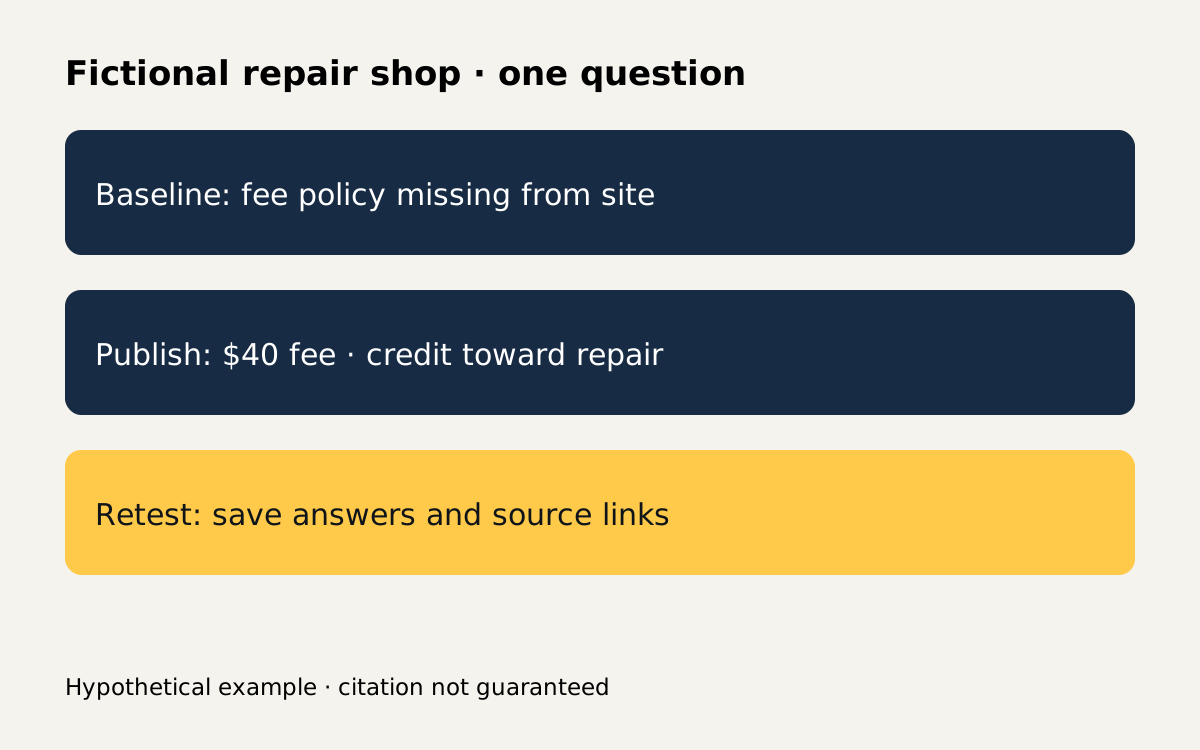
This is an invented example, not a sayurname customer or measured result. Cedar Lane Repairs services home espresso machines in one city. Its owner receives about twelve calls per month asking whether an inspection fee is credited toward a repair. The existing site lists a phone number but does not answer that question. The owner wants to create a page people can use and then observe whether an assistant cites it; there is no claim that the page will be chosen.
In this scenario the shop charges a $40 inspection fee, credits that fee toward an approved repair, and tells customers that replacement parts are quoted separately. These are fictional figures for the exercise, not prices from an actual shop. The owner checks the policy with the person who handles the work and keeps a dated copy before changing the public page.
- Save a baseline: ask the same precise question in the assistants being evaluated, record the date and full response, and note whether Cedar Lane Repairs and any source link appear. An answer without the business is a valid baseline; do not alter the question to make the result look better.
- Draft a page that answers the inspection-fee question first, then explains the $40 fee, the repair credit, parts quoted separately, the city served and the contact method. State which machine types are accepted and which are outside the shop's scope. Do not add services merely to match a query.
- Have the repair manager verify the amounts and conditions against the current policy. Ask a colleague unfamiliar with the policy to identify any ambiguous exception, and correct it. Include an update date and designate someone to review the page when prices or service areas change.
- Publish the page at a public URL and test it in a private browser window. Follow the contact link, check the text on a phone, and inspect any access restrictions relevant to the chosen provider. Save the published version and date so later observations can be compared with what was actually available.
- After allowing time for discovery, repeat the original question and save each response with its date and source links. In this invented test one assistant links to the new page and another does not. This is a hypothetical observation, not a promised result, and neither response demonstrates a sale.
- Review the answers for outdated prices or missing conditions. If a source provides a correction process, follow its instructions; otherwise update the original page and continue monitoring. Compare actual enquiries independently, without claiming that any single citation caused them.
The example shows how a clear policy can become a verifiable public source and how to keep a baseline. It cannot prove why an assistant selected the page or predict the result for another question. If the shop changes its fee, the value of the page depends on keeping it accurate rather than preserving an outdated claim for visibility.
Do not publish a claimed customer result without permission and evidence. Do not publish sensitive customer details to make a page appear original, and do not create a page if the business cannot substantiate the claim or maintain material facts. Fix the policy or gather reliable evidence first; a shallow answer copied from other sites adds little for a reader.
Sources and limits
Google's guidance on helpful, reliable, people-first content is available at https://developers.google.com/search/docs/fundamentals/creating-helpful-content. It advises creating useful information for people; it does not guarantee an AI citation or prove that a particular change will affect an answer. Review the guidance relevant to the specific search product, not a claim that one rule applies to every assistant.
OpenAI describes distinct search, training and user-triggered crawlers at https://developers.openai.com/api/docs/bots. Their access rules and purposes differ. Check the provider's current documentation and your own server configuration, and avoid equating a crawler visit with a citation or a customer visit. Keep your own test records alongside the public page and its evidence.
How sayurname works
The free test sends one question to ChatGPT, Gemini, Perplexity and Claude and saves the available answers. After subscription, sayurname works on the questions, requests inclusion where sources offer a route and measures weekly. The monthly service is $299 without lock-in. A one-time $599 bonus can be charged for a new positive name in a measured answer where the business was absent at baseline, or an AI-referred visit recorded by connected Google Analytics during the service. A team member checks the evidence first. Neither outcome is guaranteed.
Questions
Will publishing a guide guarantee a citation?
No. Assistants use different sources and may not find, select or cite a particular page. A useful page helps readers regardless of the answer.
Should I copy a competitor's guide?
No. Start with what your business can substantiate, link to original sources and explain the conditions that apply to your own offer.
How often should I update a page?
Assign an owner and review it when material facts change. The right interval depends on how quickly prices, availability and policies change.
Does an assistant citation prove it sent a customer?
No. A citation, referral visit, enquiry and purchase are separate events. Measure each where possible and acknowledge attribution limits.
Can I use a fictional example?
Yes, if it is clearly identified as hypothetical, uses plausible assumptions and is not presented as a customer story or measured result.