
Published October 22, 2026
How to track AI-referred visits in Google Analytics 4
In GA4, use the Traffic acquisition report and inspect Session source / medium for recognizable referring services. An AI-referred session is a visit recorded by analytics, not proof that an assistant recommended your business or cited a particular page. Referrers can be lost, reports depend on consent and collection, and campaign tags can override referral details. Save your definitions and review complete assistant answers separately.
Choose the question the report can answer
The Traffic acquisition report helps you investigate where recorded sessions came from. Its session-scoped source and medium describe how a session was acquired; they are not the same as a count of people, assistant answers, recommendations or purchases. A visitor can have more than one session, and one session may include several page views. Decide whether you are reviewing sessions, users, events or conversions before comparing values, and keep the selected dimension beside every number you share.
A positive name in an assistant answer, a linked source and a recorded visit are three separate observations. An assistant can name a company without a click; it can link to a source without recommending that source; and a visit may arrive from an AI service without proving what the visitor saw or why they clicked. GA4 alone generally cannot reconstruct the complete answer. Save the answer and its context separately when the question is whether a business was named.
Find candidate referrals
Open the correct GA4 property, choose a date range and navigate to Reports, Acquisition, then Traffic acquisition. Select Session source / medium in the table or use the available report controls to inspect it. Search for recognizable services and review the underlying source and medium rather than relying only on a broad channel group. Interfaces and reporting permissions can differ, so ask the property administrator for access if the report or dimension is missing.
Keep a documented list of sources you actually observe and revisit it as products, domains and referral behavior change. Do not assume a list of domains captures every AI product or that every session from a domain represents an answer recommendation. If campaign tags are present, source and medium can reflect those tags rather than an untagged referrer. When tagging links you control, use a consistent naming convention; you cannot add campaign parameters to every link an assistant generates.
Understand what can be missing
A missing AI source row is not proof that nobody arrived after using an assistant. The original referrer may be unavailable after a redirect, app transition or browser behavior, and some visits can appear as direct. Tags may fail to fire, be blocked or be subject to a visitor’s consent choices. Reporting settings and processing also affect what is visible. Investigate collection and consent with the site operator instead of treating an incomplete report as a complete census.
Record the property, date range, time zone, dimension, filters and any channel definitions used for an export. Compare like with like and annotate changes to tracking or a site migration. A rise in candidate referral sessions after an editorial change does not establish that the change caused them: seasonality, campaigns, assistants, consent rates and many other factors can change too. Check any landing-page or event breakdown with compatible scopes before drawing a conclusion.
Worked example: a fictional repair shop
This example is hypothetical, not a sayurname client or a measured result. A small bicycle repair shop wants to know whether people reach its booking page from AI services. It has a connected GA4 property, an owner who can view acquisition reports and a public booking page. The shop also keeps a separate set of assistant answers to a local question; the owners want to avoid presenting a source link or a session as a recommendation.
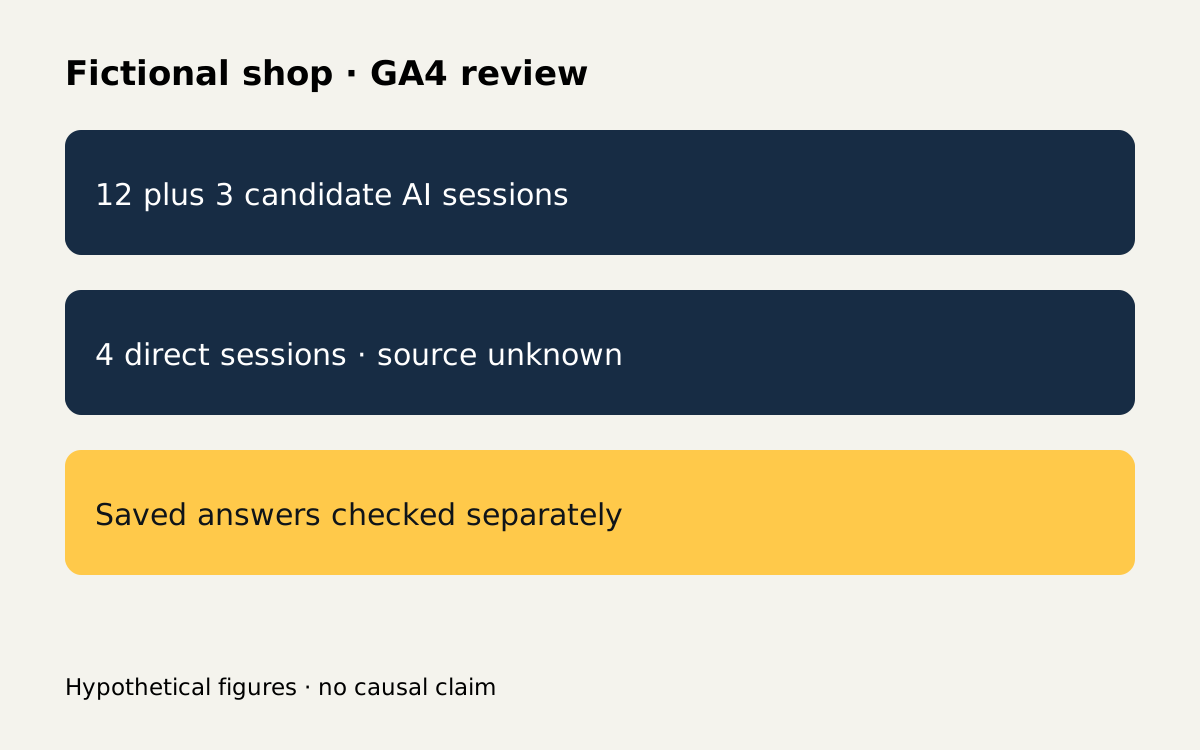
For an invented month, the Traffic acquisition table shows twelve sessions with a recognizable AI service as source and three with another recognizable AI service as source. Four sessions have a direct source and medium. These numbers illustrate a reporting exercise, not actual platform performance. The fifteen candidate sessions are not fifteen positive recommendations, and the four direct sessions cannot be assigned to AI merely because their original referrer is unknown.
- Confirm the correct property and reporting period, document its time zone and open Traffic acquisition. Select Session source / medium and sessions. Export or record the complete rows and filters rather than copying a dashboard total without its definitions.
- Review the two candidate source rows and the landing-page breakdown available in the property. Ask the site operator whether redirects, campaign tags, consent configuration or recent tracking changes could alter the attribution. Label uncertain rows as uncertain rather than allocating all direct traffic to an assistant.
- Test a link and the booking page with the site operator using the property’s supported debugging approach and appropriate consent. Check that the expected session and events are collected; do not publish private customer information or assume a successful test accounts for every visitor’s device.
- Save the exact local customer question, date, language, assistant and complete available answers in a separate record. Mark each positive business name and each source link separately, and mark unavailable answers as unavailable. A source without a positive name is not a positive name.
- Repeat the same report and answer checks later. If a fictional subsequent report shows more candidate sessions or an answer names the shop, show the evidence with the dates and definitions. Do not attribute either change to a particular page edit without a suitable causal study; do not infer sales from sessions.
If GA4 is not connected, the team cannot verify the visit condition through that property until it is connected and collecting data. If collection quality is unknown or consent prevents measurement, report the limitation and improve the setup where appropriate rather than promising that every visit will appear. A business seeking only verified bookings should also check its own booking records, without assuming that analytics source proves why an individual booked.
Do not build an elaborate AI channel dashboard when traffic is too small, the property is unreliable or the organization cannot review the classifications. Start with a simple source table and reliable collection. A dashboard is useful only if its labels remain auditable and someone owns the periodic review.
Sources and a repeatable record
Google’s documentation explains the Traffic acquisition report and its session dimensions at https://support.google.com/analytics/answer/12923437 and attribution of traffic sources at https://support.google.com/analytics/answer/14264492. Google also describes direct traffic at https://support.google.com/analytics/answer/15258820. These are GA4 reporting definitions, not a promise that every assistant passes a referrer or that a visit is a recommendation.
Keep the report export, definitions, observation dates and any known collection limitations together. Record revisions to your list of candidate AI sources so a historical comparison is interpretable. When you share a finding, state whether it concerns observed sessions, names in answers, source links or verified business outcomes. This preserves the distinction between a useful signal and a claim the evidence cannot support.
How sayurname works
The free test sends one question to ChatGPT, Gemini, Perplexity and Claude and saves the available answers. After subscription, sayurname works on the questions, requests inclusion where sources offer a route and measures weekly. The monthly service is $299 without lock-in. A one-time $599 bonus can be charged for a new positive name in a measured answer where the business was absent at baseline, or an AI-referred visit recorded by connected Google Analytics during the service. A team member checks the evidence first. Neither outcome is guaranteed.
Questions
Does an AI referral mean my business was recommended?
No. It is a recorded session associated with a source. Review the answer itself to see whether the business was named positively.
Does zero recorded AI traffic mean nobody used AI?
No. Referrer information or collection can be missing, and visits can be attributed elsewhere. Check the property and document limitations.
Can a source citation be counted as a visit?
No. A citation is a link or reference in an answer; a visit requires a recorded session after a click or other navigation.
Can I prove a page edit caused more sessions?
A before-and-after report alone cannot establish causation. Other changes can affect both sources and collection.