
Published November 18, 2026
What to do when AI recommends your law firm for a matter you do not take
State on the firm’s own pages, in the first paragraph, who you act for, which matters you take and which you do not, and where a person with the other kind of matter can go instead. Then make the directory profiles say the same thing in the same words. Assistants match a person’s problem to the label they find for the firm, so a label that is broader than the practice sends the wrong enquiries. Measure it before and after with frozen questions, and promise no outcome. This is general information, not legal advice.
A wrong recommendation costs more than a missing one
A firm that is not named for a matter loses an enquiry it never saw. A firm that is named for a matter it does not take pays for the enquiry: the call, the intake form, the partner’s time to say no politely. Worse, the person leaves with a recommendation that did not work, and the next time they ask an assistant about their own problem they learn nothing about the firm that actually is right for it.
There is a second cost that is easier to miss. Assistants repeat what they have already read, and a firm described as “housing law” in a directory, on its own page and in a legal guide will keep being described that way. The label spreads faster than the correction, so the work is to fix the source of the label, not to argue with the answer.
This page is about one narrow situation: the firm is recommended, and for the wrong reason. If the firm is not being recommended at all, start with what a firm publishes to be cited. If it is recommended for the right matter but you cannot tell whether answers changed, read how to tell if AI answers changed.
Why it happens: the assistant matches the problem to a label
An assistant asked “which solicitor can help me, my landlord is keeping my deposit?” looks for firms described with the words of that problem and with the place. It finds a profile that says “housing law” and a page titled “Housing disputes”, and it does not read the sentence on the third page that says the firm acts for landlords only. Nothing is wrong with the assistant’s logic. The firm’s own label was wider than its practice.
The causes are usually few and dull. A practice-area category chosen because it was the nearest option in a directory. A page title written for search years ago. A founder biography that mentions “tenants and landlords” once. A guide the firm published for both sides of a dispute, with no sentence saying which side it acts for. Any one of them is enough, because the assistant has no way to know which sentence the firm meant.
You can find the cause with the same method you use for everything else: read the full answers, copy the words they use to describe your firm, and search for those exact words on your own pages and profiles. The phrase that appears there first is the label that needs to change.
What to change, in the order that matters
Start with the first paragraph of the page that describes the practice. Name who you act for in plain words (“We act for landlords and letting agents”), the kind of matter you take, the places you work, and then, in one sentence, the matters you do not take. Do not hide the exclusion lower down or in a footnote: the first clear statement on the page is the one an assistant is most likely to quote.
Add where a person with the other kind of matter can go. A neutral pointer is enough and is kinder than a refusal: the referral service of the local bar or law society if there is one, a legal aid body, or a regulator’s directory of firms. Do not name a competing firm and do not criticise anyone. The page should read as a firm that knows its own practice, because that is what makes an assistant trust the rest of it.
Then make every other place say the same thing in the same words: the directory profiles, the firm’s social bios, the guides that mention both sides of a dispute. Choose the narrowest category each directory offers and drop the general one. A profile that still says “housing law” beside a page that says “landlords only” keeps the old label alive.
Check your regulator’s rules on how a firm may describe its practice and on referral statements before you publish. Where the rules limit what you can say, keep the page to what the lawyer responsible for compliance has approved.
A worked example, step by step
Example: a hypothetical firm, not a sayurname client. Harlow Law is an invented five-lawyer firm in Manchester that acts only for landlords and letting agents. Three times a week someone who is a tenant contacts it, asking for help to recover a deposit. The partner has to explain that the firm cannot act for tenants.
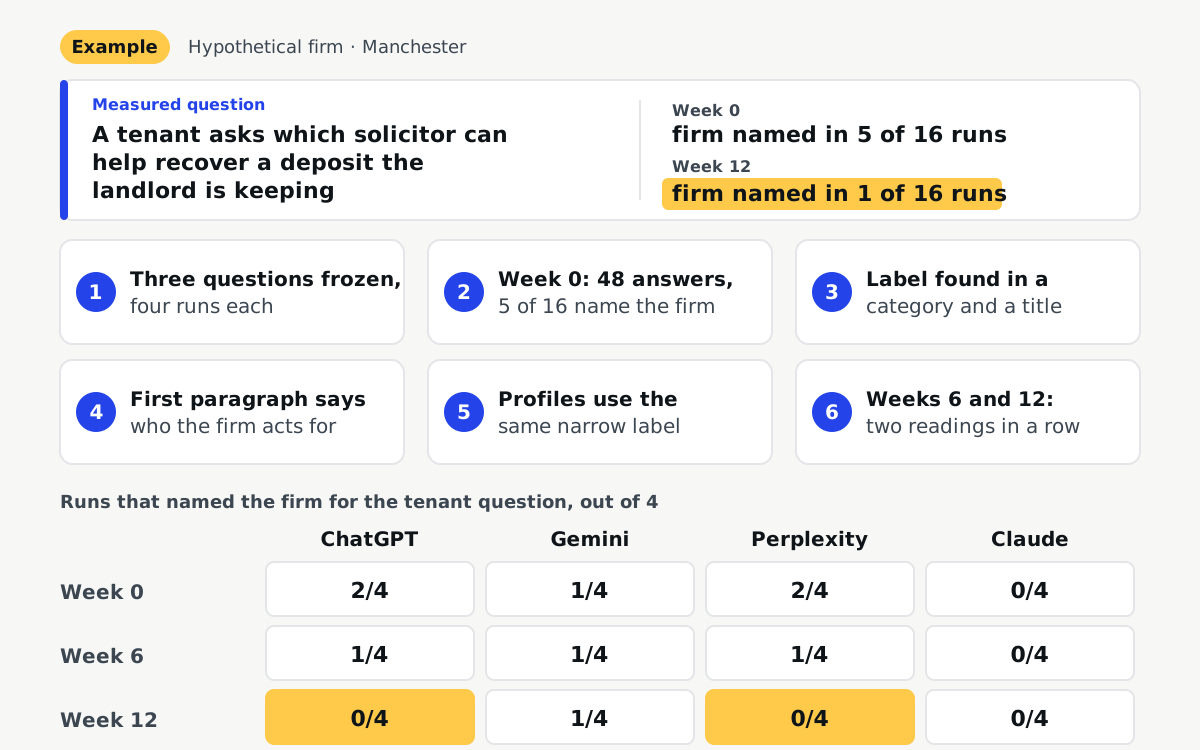
The firm froze three questions, all asked four times on each of the four assistants, which makes 48 answers at every measurement: the tenant’s question (the wrong match), a landlord’s question (the match it wants), and a control about a matter the firm never touches, so it can tell when answers move for reasons that have nothing to do with its pages.
- Froze the three questions and saved every full answer with its date.
- Week 0: read the 48 answers. The tenant’s question named the firm in 5 of 16 runs. The landlord’s question named it in 6 of 16.
- Copied the words the answers used for the firm (“housing law specialists”) and searched for them. They came from one directory category and the page title “Housing disputes”.
- Rewrote the title and the first paragraph: “We act for landlords and letting agents in England. We do not act for tenants.” Added one sentence pointing tenants to their local law society’s referral service.
- Set the two directory profiles to the narrowest landlord category, removed the general housing category, and used the same sentence in the profile text.
- Weeks 6 and 12: asked the same questions again. A change counted only when two readings in a row were lower than week 0.
The tenant’s question went from 5 of 16 runs to 3 at week 6 and 1 at week 12. ChatGPT and Perplexity each moved from 2 of 4 to 0 of 4 over two readings in a row, so those two counted. Gemini stayed at 1 of 4 in all three readings, and Claude stayed at 0 of 4, so neither counted. The control did not move.
The landlord’s question went from 6 of 16 to 9 of 16. The firm’s own intake log showed tenant enquiries falling from about three a week to about one, and it kept that log, not the assistants’ answers, as the main measure. Another firm might see no assistant change in twelve weeks and still have a page that sends the right enquiries to the right people.
When it is not worth fixing, and what not to do
If one tenant a month finds the firm by this route, the cost may be lower than the cost of rewriting profiles in several countries. Count the misdirected enquiries from your own intake form for a month before you decide. The firm’s log tells you how large the problem is and does not depend on any assistant.
If the firm could take the matter, the right fix may be to take it, or to publish a page saying you do and on what terms. Do not describe the practice narrowly to cut the volume of enquiries when the lawyers would in fact act. A description that is too narrow loses the matters you want.
Never remove a matter from your pages to look more selective than the firm is. The page must describe what the firm does, because a client will rely on it and so will the assistant that repeats it.
How the work runs
It starts with the free test. Once subscribed, we measure up to 10 questions every week and publish as much as we judge necessary for AI to cite your firm in the answers you want. Volume and format follow what each question needs, and that part is our call. We also ask for inclusion in the sites the assistants use. What we promise is the request, not the listing.
It costs $299 a month, with no lock-in. A one-time $599 bonus is charged only when an AI starts naming your firm for a measured question, checked by a person on our team, or Google Analytics shows a visit coming from an AI. Your firm stays responsible for validating the legal content of what is published, and each piece comes with one revision. It is not legal advice, and it promises no client.
Questions
Can I ask an assistant to stop recommending my firm for that matter?
Not in a way that lasts. The answer comes from what the assistant reads about the firm, so the lasting fix is on your pages and profiles. Change those first and re-read the answers after a few weeks.
Should the page say which matters we refuse?
Yes, in one plain sentence near the top, with a neutral pointer for the other person. Check what your regulator allows a firm to say about referrals before you publish.
Is it wrong to take the enquiry anyway?
That is the firm’s decision and may depend on conflict and capacity rules. The fix here is only about making the pages say what the firm does.
How do I know the fix worked?
Count the misdirected enquiries in your own intake form before and after, and re-read frozen questions on the four assistants. Treat a change as real only after two readings in a row.
Does this apply outside law?
The mechanism is the same for any profession with specialties, such as accountants or architects. The wording on regulated advice and referrals is what differs, so check your own rules.