
Published October 26, 2026
How B2B software can become easier for AI assistants to assess
A B2B software company can make its product easier to assess by publishing specific, verifiable information about the buyer’s job, supported integrations, pricing and limits. Independent sources can add context, but a directory entry, citation or structured data does not guarantee an AI recommendation. Save comparable answers to real buyer questions and distinguish a named recommendation from an external link and an attributed website visit.
Start with a buyer and a task
A buyer does not usually ask for a category in the abstract. A finance leader might ask for a tool that reconciles invoices with an accounting system for a 30-person company. A generic page promising to transform finance does not tell that buyer whether the product actually imports the data, supports their country or requires an implementation partner.
Collect questions from sales calls, support tickets and lost deals, removing any personal details. Group them by task and the constraints that matter: team size, existing systems, approval requirements, geography and budget. Select a small set your product can genuinely answer. A question should be recognizable to a customer, and should not contain your brand merely to manufacture a mention.
Make claims a buyer can check
For each important job, make the product page explain what enters the workflow, what the software does, what the user must still do, and what comes out. Give a realistic setup path and identify prerequisites. If an integration requires a particular plan or only supports one direction of data flow, say so beside the claim. Update dates and assign an owner who can remove outdated details.
A pricing page can show public prices or explain how a quote is calculated and what a buyer needs to provide. A useful comparison identifies criteria and trade-offs, cites the source for competitor capabilities and the date checked, and makes room for the situations where the competitor is a better fit. Avoid fake reviews and unverified claims about a competitor; a correction process is more useful than a permanent accusation.
Use independent sources without implying an endorsement
Review sites, integration catalogs, technical communities and trade publications can describe the same category from different perspectives. Look at the sources actually linked in saved answers, then check whether each source has an appropriate route to request a correction or inclusion. A request may be rejected, be paid or require editorial review; log the request and outcome without presenting placement as guaranteed.
Ask customers for honest feedback without telling them what rating or wording to give. Disclose material relationships where applicable, follow each platform’s rules, and never publish private client details without permission. An assistant linking to a review page does not establish that it recommended your product. Read the answer itself and save the distinction.
Test the product page, not just the copy
A page that requires a login, blocks access unintentionally or shows different plan information from the product can frustrate both prospective buyers and crawlers. Check that important text is visible, links work, the page is eligible for indexing where appropriate, and the public documentation agrees with the current product. Test a meaningful page on mobile and keyboard as a customer would.
Structured data may help a search engine interpret eligible information, but it is not a switch for recommendations. Google’s guidance asks for accurate, visible content and does not promise a rich result: https://developers.google.com/search/docs/appearance/structured-data/sd-policies. Product screenshots and integration claims should be updated after a release; the source of truth is the product team, not a copied sales deck.
Worked example: a fictional invoice tool
Consider Cedar Ledger, a fictional invoice workflow product for teams of 20 to 80 people. It supports one named accounting integration but does not offer automatic payment. The figures below are invented to show a method, not the results of a sayurname customer. The team decides to measure before editing and to retain unsuccessful answers as well as positive ones.
- Save three buyer questions about invoice approval, the supported accounting integration and audit history. Ask each question on four assistants with the same language and settings. Record the date, exact prompt, full response and whether Cedar Ledger is named positively, negatively or not at all.
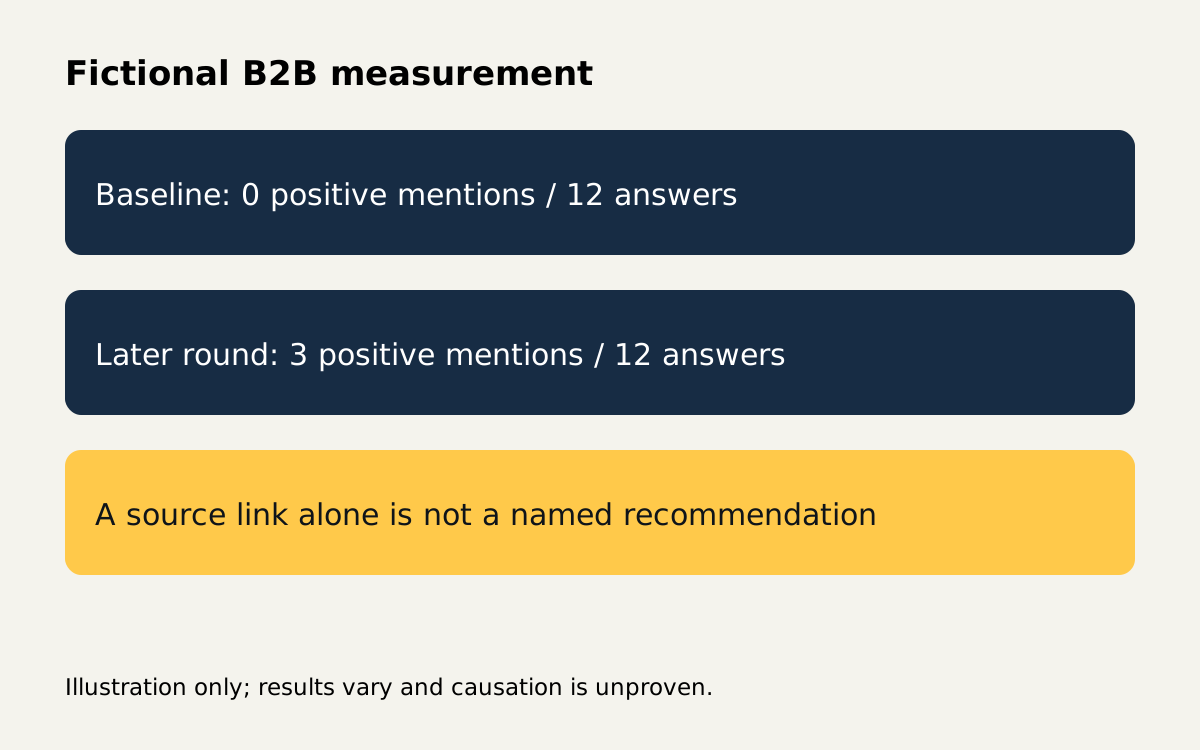
- Suppose the first round yields zero positive names in the twelve responses. Two assistants link to a software directory; one names an alternative. A source link alone is recorded separately from a name in the answer. This is a small baseline, not a market-wide share.
- Improve the workflow page with the supported input format, plan requirement and a short example. Add an honest comparison and ask the directory how to correct the listing. Record the dates and retain a copy of the previous text; do not invent integration support or pay for a positive review.
- Repeat the same questions weekly for four weeks. Imagine the product is named positively in three of the twelve answers in one later round. Check each complete answer and source, and note any change in assistant settings. Three of twelve describes that round only; other changes or ordinary variation may explain it.
- Use connected analytics to inspect identifiable AI referrals and completed demo requests separately. If pages receive visits but demos fail, test the form. If no referral is visible, do not conclude that no buyer used an assistant before arriving by another route.
The purpose is to decide the next action, not to award a score to a sample of twelve. Keep the question set, raw answers and dates together so another person can repeat the test. If a source refuses inclusion, move on to the next relevant source rather than treating a request as a completed placement.
When to fix the product before pursuing visibility
If your target segment cannot use the product without a missing integration, do not write an article that suggests otherwise. A misleading comparison may win attention and still waste the buyer’s time or damage trust. Fix the integration, qualify the supported configuration or choose a buyer question your current product can genuinely satisfy.
Likewise, do not expand content if the demo form fails, the onboarding team cannot handle leads or the only evidence is a handful of inconsistent test answers. Review the offer, capacity and tracking first. Search-focused content should be useful to people, not generated solely to attract traffic; see Google’s guidance at https://developers.google.com/search/docs/fundamentals/creating-helpful-content.
Review changes and decide what to do next
A positive mention is one observation, not an attribution model. Inspect changes by question and assistant, keep versions of important pages, and record whether web search or other settings changed. If a product is named but the answer is wrong, correct the relevant public information and track the correction. If the answer is accurate but no qualified prospect converts, inspect fit and the buying path.
Do not merge unlike prompts, languages or models into a single impressive number. A stable weekly sample can make changes visible, but it cannot establish causation without a stronger design. Record why each action was chosen and what would make the team stop, so the next review is a decision rather than a report of vanity metrics.
How sayurname works
The free test sends one question to ChatGPT, Gemini, Perplexity and Claude and saves the available answers. After subscription, sayurname works on the questions, requests inclusion where sources offer a route and measures weekly. The monthly service is $299 without lock-in. A one-time $599 bonus can be charged for a new positive name in a measured answer where the business was absent at baseline, or an AI-referred visit recorded by connected Google Analytics during the service. A team member checks the evidence first. Neither outcome is guaranteed.
Questions
Do directories guarantee an AI recommendation?
No. A directory may be a source, but editorial inclusion and the wording of an assistant response are separate decisions. Save the response and verify whether the business itself is named.
Should pricing always be public?
Not necessarily. If a quote is needed, explain what affects it, prerequisites and how buyers obtain a quote. Never invent a fixed price to make a page look complete.
Does a linked source count as a positive mention?
No. A link to a source and a positive name in the answer are distinct observations. Record both with the prompt and date.
How can a small team compare progress?
Choose a few actual buyer questions, keep the wording and settings stable, save full answers and repeat regularly. Treat the results as a sample, not a promise or proof of causation.
When should we stop this work?
Pause expansion if the product cannot deliver the promised job, the demo path is broken or the team lacks capacity to serve qualified leads. Resolve those constraints first.