
Published October 26, 2026
How a local business can become easier to recommend in AI answers
A local business can make it easier for people and AI assistants to assess by keeping its services, actual service area, contact details and hours accurate on its site and relevant profiles. Ask specific local customer questions and save the answers over time. A business profile, review or structured data does not guarantee an AI recommendation, and an answer that links to a source is not necessarily a positive mention.
Start with the service and location together
A homeowner asking for emergency plumbing in a particular neighborhood has different needs from someone seeking a bathroom renovation. List the services the business actually performs, the neighborhoods it can serve, the hours when someone can respond and the conditions that change the price. Use the customer’s words and consider urgency, travel and language when selecting questions.
Do not create a location page for every city on a map if the team cannot serve it. A useful page says what is available in that location, how to contact the business, and any travel or booking restrictions. A local answer that omits a real service area can waste a customer’s time; an invented location can mislead them.
Keep the facts consistent and current
Compare the name, phone, site, hours, address or service area on your website and major profiles. One wrong holiday schedule can make an otherwise useful recommendation frustrating. Assign an owner to verify changes after a move, closure or schedule change, and keep the date of the last check. Where a business serves customers without a storefront, follow the profile provider’s actual address and service-area rules rather than inventing an office.
Google explains how to represent eligible businesses and service areas in its Business Profile documentation: https://support.google.com/business/answer/3038177. A profile is one source among many, not a guarantee about a third-party assistant. If a listing is wrong, request a correction through the provider and record when it was submitted and whether it appeared.
Publish useful evidence, not unsupported superlatives
A service page can explain the problem, who performs the work, how to request a quote, what is included and when another provider is a better fit. If the work is regulated, describe only the credentials and permissions the business actually holds. Where a quote depends on inspection, explain that rather than presenting a fictional fixed fee as a fact.
Reviews can help people understand experience but are not interchangeable with proof of a particular claim. Invite honest feedback through approved channels, do not offer incentives in exchange for positive ratings, and respond without disclosing private customer information. Photos, guarantees and before-and-after examples should be real, authorized and dated when relevant.
Measure a local question, not a global rank
Choose a small group of questions for services and places where you can actually work. Save the exact wording, language, location setting if available, date, assistant, full answer and the business names mentioned. Ask without your own brand in the question; otherwise the answer can merely repeat what you supplied. Save an absent or negative answer as carefully as a positive one.
A local result may change with geography, wording, product settings and time. One saved answer is an observation, not proof that everyone nearby sees the same list. A source link is not the same as a business named in the answer, and a named business is not the same as an appointment. Track each signal separately and investigate the path between them.
Worked example: a fictional repair service
Consider North Lane Repairs, a fictional appliance repair business serving two neighboring districts. It offers weekday appointments but not emergency service. The numbers here are invented to illustrate how a small business can establish a baseline and avoid promising a capability it does not have. The team has a single person responsible for maintaining the details.
- Choose three questions: weekday washing-machine repair in district A, dishwasher repair in district B, and whether a technician gives an estimate before work. Ask each across four available assistants and save all twelve answers with dates and settings.
- Imagine that the business is not named in the twelve baseline answers, while two answers link to a local directory. Record those links separately. Confirm that the directory is relevant and provides a correction route; do not claim the links are recommendations.
- Correct a stale phone number and weekday hours on the site and profile. Add a service page describing both districts, an example appointment process and the limits of the estimate. Request a factual directory correction without assuming an editor will accept it.
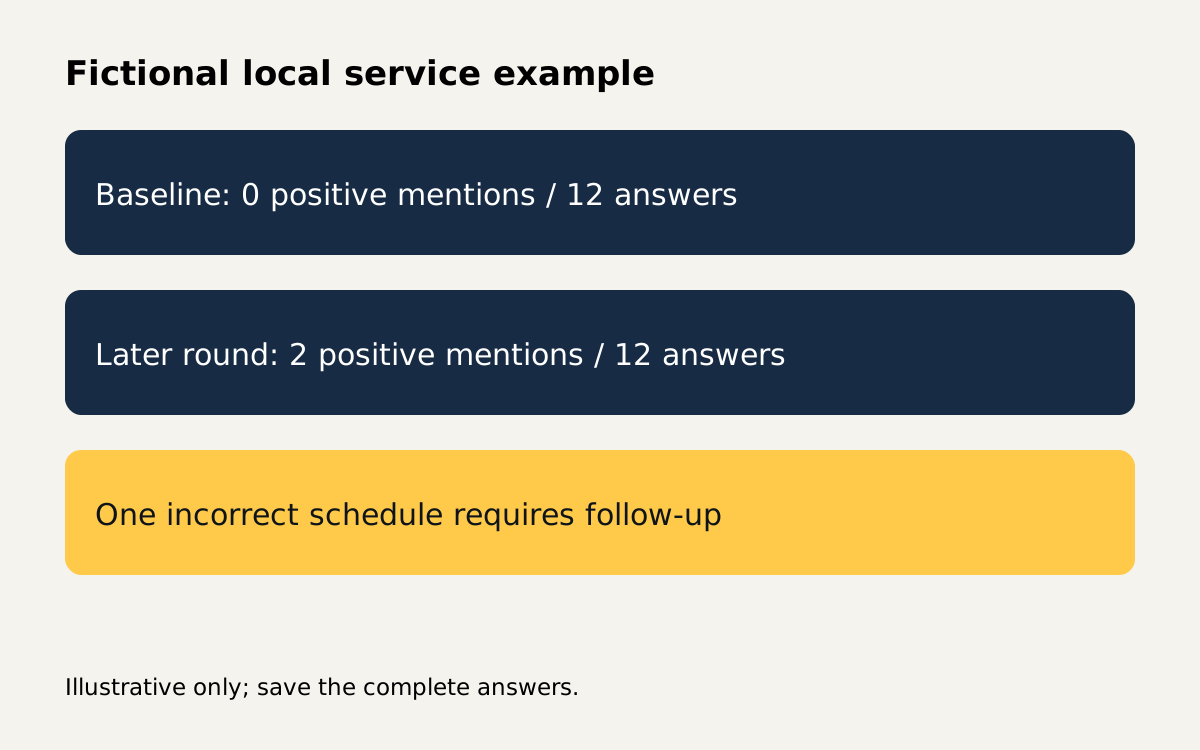
- Repeat the same twelve checks each week. In a hypothetical later round, two answers name North Lane Repairs positively and one names it with incorrect emergency hours. Save the positive and incorrect answers, update the public information where necessary and check again.
- Compare identifiable AI-referred visits with actual booked appointments, keeping contact details private. If the phone number works but booking slots are full, fix availability before spending more on visibility. A caller may have used AI without arriving from an identifiable referral.
Two positive responses out of twelve describe one hypothetical round, not an expected performance level or proof that the corrections caused the change. Compare equivalent prompts and settings, and preserve the negative example. A small local business can use the evidence to prioritize the next correction without turning it into a universal ranking claim.
When not to pursue a new local visibility campaign
If the business is closed, cannot take appointments or no longer serves the area, update that information before seeking more inquiries. Do not invent a storefront, duplicate listings for the same location or claim a license that cannot be checked. If the team cannot fulfill emergency work, make that limit prominent instead of competing for an emergency question.
Likewise, do not expose a customer’s address or case details as proof without permission. If a provider’s policies prevent a particular change or review request, respect the policy and use a permitted correction channel. A smaller accurate footprint can serve customers better than dozens of misleading location pages.
Turn observations into maintenance
A practical monthly review checks hours, service boundaries, the booking path and the status of requested corrections. When a service changes, update the site and relevant profiles together and note the date. Use a separate owner and escalation path for urgent changes such as a temporary closure. Public content should answer questions people actually have; Google’s people-first guidance is at https://developers.google.com/search/docs/fundamentals/creating-helpful-content.
For AI testing, keep the same prompts and settings when comparing periods and read the full answer before counting a mention. If a source contains stale facts, contact that source where possible; if the assistant itself is wrong, retain the evidence and recheck rather than assuming a guaranteed correction. Visits and bookings require their own measurement.
How sayurname works
The free test sends one question to ChatGPT, Gemini, Perplexity and Claude and saves the available answers. After subscription, sayurname works on the questions, requests inclusion where sources offer a route and measures weekly. The monthly service is $299 without lock-in. A one-time $599 bonus can be charged for a new positive name in a measured answer where the business was absent at baseline, or an AI-referred visit recorded by connected Google Analytics during the service. A team member checks the evidence first. Neither outcome is guaranteed.
Questions
Will a business profile make every assistant recommend me?
No. A profile can provide useful factual information, but each product handles sources and answers differently. Test relevant questions and record the full answer.
Should I create a page for every nearby town?
Only when it helps people and accurately describes a service you provide there. Do not suggest an office or coverage that does not exist.
Does a link to my website count as a recommendation?
A link is a source signal, not necessarily a positive name in the answer. Save and assess the text and source separately.
Can I ask customers for reviews?
You can invite honest feedback using the platform’s rules. Do not demand positive wording, manufacture reviews or disclose private customer details.
How should I handle a wrong schedule in an AI answer?
Check the site and relevant profiles for the correct hours, request a correction from the source if there is a route, save the response and retest. No single edit guarantees an immediate change.