
Published October 26, 2026
How an online store can make its products easier for AI to assess
An online store can help customers and assistants assess its products by keeping variant details, price, availability, shipping and returns accurate across its site and eligible feeds. Measure answers to real shopping questions and verify the purchase path. Product markup and feed submission can support eligible Google Search experiences, but neither guarantees that any assistant will recommend a product or complete a purchase.
Begin with the choice a shopper must make
A shopper may ask for a waterproof backpack that fits a laptop and can arrive before a trip. A list of product names cannot answer that question without dimensions, material, compatibility, availability, delivery area and an honest explanation of the waterproof claim. Identify the decisions that cause returns or pre-sale questions and use those to prioritize product information.
Group questions by product and meaningful constraints, such as size, use, delivery country and budget. Keep a small sample of realistic questions without the store name and save the answers before changing the catalog. Avoid inventing specifications or describing an item as suitable for a purpose its manufacturer does not support.
Make product and variant details match
Give each product an understandable name, current description, clear images and the characteristics a buyer needs. Distinguish a product family from a specific size, color or model, and make sure the selected variant’s price and availability match what the cart shows. If inventory changes quickly, a stale page can cause an assistant or customer to repeat a claim that is no longer true.
Show shipping restrictions, delivery estimates as estimates, return conditions and support contacts where customers can find them. Check taxes and currency for the actual market. A product page should not promise a delivery date the fulfillment process cannot meet. Assign ownership of catalog updates across merchandising, inventory and support rather than copying an old spreadsheet indefinitely.
Use structured data and feeds as supported channels
Google documents product and merchant-listing structured data for eligible search experiences: https://developers.google.com/search/docs/appearance/structured-data/merchant-listing. It also describes product variants and distinct URLs at https://developers.google.com/search/docs/appearance/structured-data/product-variants. Follow current requirements for the relevant feature and ensure marked-up facts match the visible page. Eligibility is not a promise of display, placement or an AI recommendation.
A feed can be useful for maintaining product information, but a feed accepted today can become inconsistent with the site after a price or stock change. Monitor errors and update the underlying catalog rather than patching a single copy. Rules and supported fields differ between providers, so check each provider’s documentation instead of assuming that a Google feature applies to every assistant.
Test the entire buying path
On a representative product, test the page, selected variant, cart, checkout and confirmation in the same country and currency a customer would use. Record where availability or shipping changes. A good answer that sends a buyer to an out-of-stock or unavailable item may create frustration, and a purchase flow must accurately show the customer what they are authorizing.
Do not assume every assistant supports purchasing, checkout or live inventory. Where an external agent can act on behalf of a customer, the merchant still needs accurate offer information, supported integrations and explicit confirmation in the actual flow. Policies, access and capabilities differ; check the current provider terms before making claims about a specific integration.
Worked example: a fictional backpack store
Consider Pine Market, a fictional online store that sells backpacks. One model comes in two sizes and is available only in one delivery region. The following figures and events are invented; they illustrate an audit and do not describe a sayurname client. The store selects one model and checks the full customer journey before changing the entire catalog.
- Save three questions about laptop fit, rain protection and delivery within the supported region. Ask the same questions on four assistants and keep twelve full responses, with dates, settings and source links. Note when the store or model is named and when it is absent.
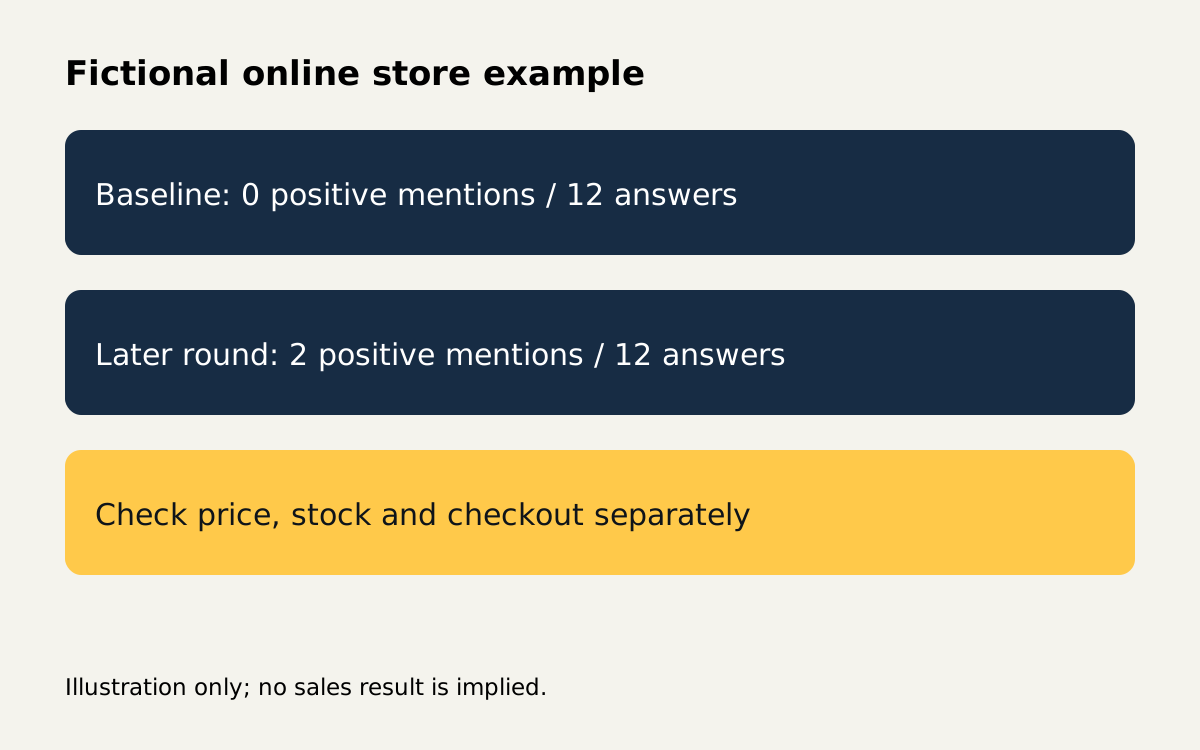
- Imagine that no answer names Pine Market positively, but one links to a product page with an old price. The baseline records zero positive names out of twelve answers; the stale link is a separate observation, not a sale or a recommendation.
- Correct the variant dimensions and price, label the rain-resistance test accurately, and update the product data feed. Verify the cart price and shipping restriction. Record each change date and request a correction from an independent source if there is a legitimate route.
- Repeat the same twelve checks weekly. In a hypothetical later round, two answers name the store positively and a third still shows an old price. Retain all three full responses and investigate the stale source; do not assume that updating one page immediately refreshes every answer.
- Separately compare identifiable AI referrals with product views, cart starts and completed purchases using the same reporting period. A visitor can learn from an assistant and later arrive without a detectable referral. Check consent and configuration before interpreting gaps.
The later round’s two positive names out of twelve are a small sample, not proof of incremental sales or causation. The useful outcome is knowing whether the facts, link and checkout agree. If inventory cannot be kept current, prioritize that operational fix before expanding the number of questions measured.
When not to add more visibility work
If an item is discontinued, unavailable in the advertised region or the checkout cannot complete, fix or withdraw the misleading offer first. Do not publish a fictitious discount, review or delivery promise to make a product look more attractive. Respect the platform’s policies and the customer’s consent throughout the actual transaction.
Avoid multiplying near-duplicate pages for variants when they do not help a shopper choose. If price or stock changes faster than the site and feed can be updated, improve the data flow and set realistic expectations. A larger audience will not repair an inaccurate catalog or an unreliable fulfillment process.
Measure answers, visits and purchases separately
A source link is not the same as a named product, a positive answer is not the same as a website visit, and a visit is not the same as a completed order. Save each signal in its own record. Compare the same questions, locale, assistant settings and reporting periods; document model or configuration changes instead of treating every change as an improvement.
Google explains its traffic acquisition report at https://support.google.com/analytics/answer/12923437. Use identifiable referral data as a partial view, not the total influence of assistants. If visits rise but orders do not, examine stock, shipping, price and checkout before commissioning more content. If the answer names a discontinued variant, correct public information and retest.
How sayurname works
The free test sends one question to ChatGPT, Gemini, Perplexity and Claude and saves the available answers. After subscription, sayurname works on the questions, requests inclusion where sources offer a route and measures weekly. The monthly service is $299 without lock-in. A one-time $599 bonus can be charged for a new positive name in a measured answer where the business was absent at baseline, or an AI-referred visit recorded by connected Google Analytics during the service. A team member checks the evidence first. Neither outcome is guaranteed.
Questions
Does product markup guarantee an AI recommendation?
No. Product markup may make eligible facts easier for Google Search to understand, subject to its rules. It does not guarantee appearance or a recommendation from any assistant.
Should every product variant have its own page?
The right structure depends on the product and platform. Make each selectable variant’s facts clear and follow the relevant provider’s current product-variant guidance.
Can an assistant always buy directly from my store?
No. Purchasing capabilities and merchant integrations differ by product and may be restricted. Verify the actual supported flow and ensure customers can review and confirm the transaction.
Is a source link the same as a sale?
No. A source link, positive name, referral visit and completed purchase are separate signals. Measure them separately with appropriate settings and consent.
What should I fix first if AI sends visitors to unavailable items?
Check the underlying inventory, product page and feed, then verify the cart and delivery area. Save the incorrect answer and retest after the information is corrected.