
Published November 19, 2026
How a law firm can tell which new clients came from AI
Add one optional question to the enquiry form and the reception script (“How did you first hear of us?”) with “AI assistant” as its own option, log the answer beside the enquiry, and compare the monthly count with what Google Analytics reports. Analytics sees only visits that arrive with a trace, while many people ask an assistant and then phone or search the firm’s name. Treat the analytics count as a floor and the intake count as the main measure, report counts rather than percentages while the numbers are small, and record the source only, never the facts of the case. This is general information, not legal advice.
Analytics counts visits, not clients
A person worried about a dismissal asks an assistant who can help in her city. It names three firms. She reads about yours in the answer, closes the window and phones the office the next morning. Your analytics shows nothing: there was no click, no visit and no referral. The phone log shows a call from a number you do not know. If the firm judges AI by its analytics alone, this client does not exist.
Three leaks explain most of the gap. Visits that arrive without a referrer, for example when someone copies the address or opens it from an app, are filed as direct. Phone calls leave no web trace at all. And many people ask an assistant and then type the firm’s name into a search engine, so the enquiry is credited to branded search. Analytics is still worth connecting, because a visit from an assistant is a real signal and the easiest one to count. It is a floor, not the total.
The other source is the person herself. She knows how she found you, and a receptionist can ask in ten seconds. What turns that into data is asking the same question in the same way every time and writing the answer in one place.
The intake question and the log
Put one question on the enquiry form, optional and early: “How did you first hear about us?” Give fixed options so the answers can be counted: a person who recommended us, a search engine, an AI assistant (ChatGPT, Gemini, Perplexity, Claude or similar), a directory or review site, social media, another lawyer, other. After the AI option, add one optional line: “Which assistant, and what did you ask?” That line is where the useful detail comes from, because the question a person typed tells you which of your frozen questions is working.
Use the same words at reception: “Before we start, may I ask how you first heard of us?” Read out the options if the person hesitates. Do not suggest an answer, and do not ask someone in distress who has not yet been helped. Urgent matters come first, and the question can be asked at the end of the call or left blank.
Keep the log in one sheet with a handful of columns: date, channel (form, phone, email, in person), source option, the free-text line, a general matter category and the outcome (retained, declined, referred). Record the source only. The facts of the matter belong to the client file under your professional duties and never to this sheet. Follow your data-protection and confidentiality rules on what you keep and for how long.
Read the two numbers side by side
At the end of each month, count the enquiries that chose the AI option, then take from your analytics the visits from AI sources that ended in an enquiry. The two numbers will not match, and the difference is the useful part. Check each enquiry that chose AI against the phone log and the analytics: how many were labelled as AI, how many arrived as direct, how many were calls with no visit, and how many searched the firm’s name afterwards.
Treat the intake count as the main measure and the analytics count as the floor. Report counts, not percentages, while you have fewer than thirty enquiries a month: with 12 enquiries, one person moves the share by eight points. Do not compare the retention rate of AI enquiries with the others until each group has dozens of cases. Three of nine and twelve of fifty are not different enough to mean anything.
Do not change the wording of the question during the first three months. A new option or a new phrase breaks the comparison with the month before, and you will not know whether the number moved because of the assistants or because of the form.
A worked example, step by step
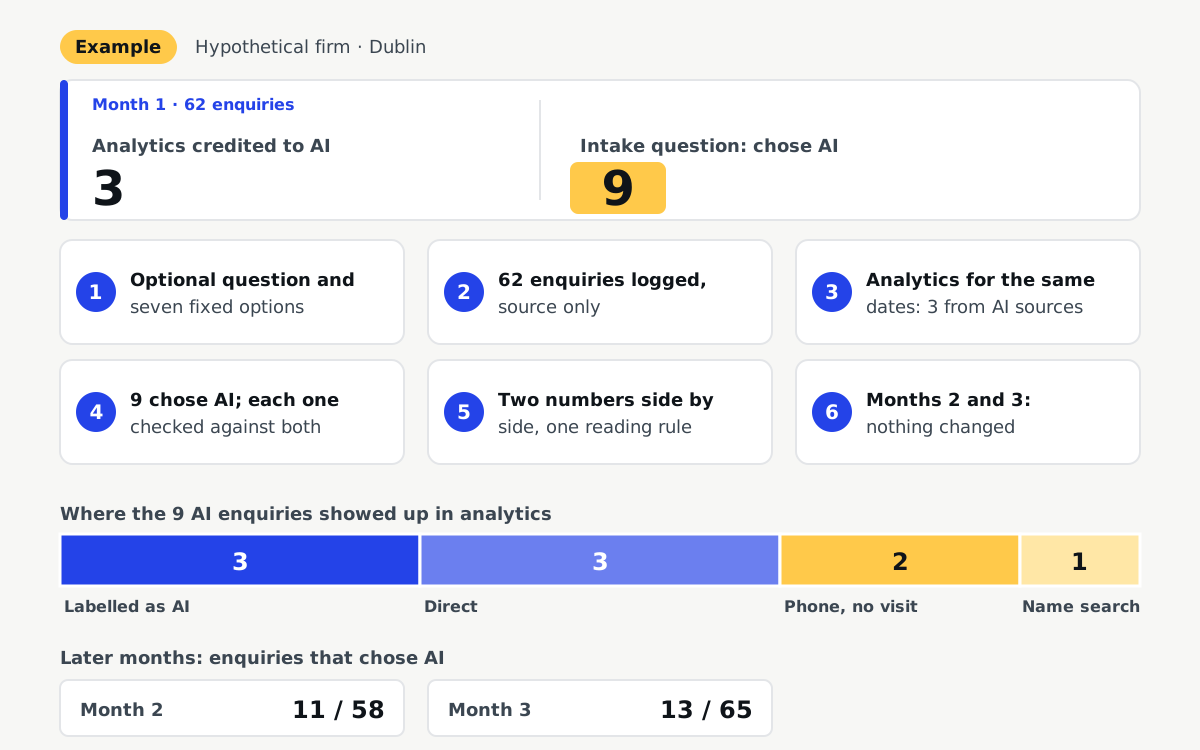
Example: a hypothetical firm, not a sayurname client. Marlowe Pike is an invented four-lawyer family-law firm in Dublin. It receives about sixty enquiries a month by form, phone and email. The managing partner believes AI sends it some of them and wants a number she can trust, not a guess.
She sets three rules before the first month: one optional question with the same seven options on the form and at reception, one sheet for the log, and a monthly comparison with the analytics report for the same dates.
- Added the optional question to the enquiry form and to the reception script, with seven fixed options and one optional line after the AI option: “Which assistant, and what did you ask?”
- Month 1: logged all 62 enquiries in one sheet, with date, channel, source option, the free-text line, a general matter category and the outcome. Nothing about the facts of any case.
- Took the analytics report for the same dates: visits from AI sources (chatgpt.com, perplexity.ai, gemini.google.com, claude.ai) that ended in an enquiry. There were 3.
- Counted the enquiries that chose the AI option: 9. Checked each against analytics and the phone log: 3 matched a session labelled as AI, 3 had arrived as direct, 2 were calls with no web visit and 1 had searched the firm’s name on Google afterwards.
- Wrote the two numbers side by side and the rule for reading them: the intake count is the main measure, analytics is the floor, and counts are reported as counts.
- Months 2 and 3: kept the question, the options and the sheet unchanged, and repeated the comparison.
In month 1, 59 of the 62 enquiries gave an answer. Nine of them chose the AI option, which is about 15% of the answers. Analytics credited AI with 3 enquiries, about 5% of the 62. Three of the nine became clients, against 12 of the other 50 whose source was known. With numbers that small, the firm drew no conclusion about quality.
Over the next two months the AI option was chosen by 11 of 58 and 13 of 65 enquiries. The partner now reports the three monthly counts to the firm with the analytics figure beside them as a floor, and she reads the free-text lines to see which questions people actually asked.
When it is not worth the effort, and what not to do
If the firm receives fewer than about ten enquiries a month, the log will show a handful of AI cases at best, and one person can change the picture. Keep the question anyway, because it costs nothing, and read the result over a quarter rather than a month.
If most clients come from referrals by other lawyers or institutions, the question will mostly say so. That is useful information, and it may mean that assistants matter little for this practice today. Do not push people to choose the AI option, do not reward staff for logging it, and do not guess a source when the person did not say.
Do not record what an assistant said about a person’s legal situation, and never copy personal details into the sheet. Source and outcome are enough. If your rules on enquiries or marketing limit what you may ask or keep, follow them first.
How the work runs
It starts with the free test. Once subscribed, we measure up to 10 questions every week and publish as much as we judge necessary for AI to cite your firm in the answers you want. Volume and format follow what each question needs, and that part is our call. We also ask for inclusion in the sites the assistants use. What we promise is the request, not the listing.
It costs $299 a month, with no lock-in. A one-time $599 bonus is charged only when an AI starts naming your firm for a measured question, checked by a person on our team, or Google Analytics shows a visit coming from an AI. Your firm stays responsible for validating the legal content of what is published, and each piece comes with one revision. It is not legal advice, and it promises no client.
Questions
Is it allowed to ask people how they found the firm?
In most places it is ordinary practice, but rules on enquiries, marketing and data protection differ by country and regulator. Ask for the source only, keep the question optional and check your own rules before you start.
Why not rely on Google Analytics alone?
It sees only visits that arrive with a referrer. Calls, copied links and people who search your name after asking an assistant are not credited to AI, so use it as a floor.
What if people say they do not remember?
Log “not known”. An honest blank is better than a guess, and the share of blanks tells you how far to trust the rest.
How many months before the numbers mean anything?
Read at least a quarter. With a small number of enquiries, a single month can swing on one or two people.
Can this prove that the assistant caused the client?
No. It shows where the person says they started. It is evidence for a decision, not proof of cause, and it promises no client.