
Published November 18, 2026
Is it worth paying to show up in ChatGPT? A way to decide before you spend
It is worth it only when four things are true: your buyers ask an assistant the kind of question you can answer, the assistants do not name you today, one new customer is worth clearly more than the monthly cost, and you can serve more customers. You can check the first two for free. Then set a spending cap, a date and a stop rule before you start, and read the result by what you can count, not by how an answer looks. No one can promise a mention, so do not buy on a promise.
The honest answer is that it depends, and you can find out for free
Paying to show up in ChatGPT is one of those decisions people make because everyone else seems to be making it. The better reason to do it, or not, is a short piece of arithmetic that you can fill in yourself. It needs four facts, and two of them cost nothing to find.
The first is whether your buyers ask an assistant at all for what you sell, and how they phrase it. The second is whether the assistants name you when they do. The third is what one new customer is worth to you. The fourth is whether you could serve more of them. If any of the four is a no, the spending does not pay, and it is better to know that before the first invoice.
The four checks, in order
Check one is demand. Write down the ten questions a buyer would type before choosing someone like you, in the buyer’s words and without your brand name. Ask yourself honestly whether people really do ask an assistant that, or only search for it. Your own customers are the best source: ask the next five how they found you and whether they asked an assistant first.
Check two is absence. Ask each of the four assistants (ChatGPT, Gemini, Perplexity and Claude) each question and save the complete answers with the date. A free test does this for one question. If an assistant already names you for the questions that matter, the money is better spent on something else. If none does, you have a starting line.
Check three is value. Take what a customer pays you over the time they stay, subtract what it costs you to serve them, and you have the margin of one new customer. That number, not your revenue, is what the spending has to beat.
Check four is capacity. A recommendation that arrives when you cannot take on work only produces a refused enquiry. If you are already full, fix capacity first.
Set a cap, a date and a stop rule before you start
The risk with any work that cannot promise an outcome is open-ended spending. Decide in advance the most you will spend and the date you will judge it on. A reasonable shape for most small businesses is a cap of three months of the fee and a judgement day at about ninety days, because assistants change slowly and a reading after two weeks proves little.
Write the stop rule as a sentence you can check, for example: “If none of the four assistants names us for at least two of the ten questions on two readings in a row, and the visits from assistants in our analytics have not started, we stop.” A rule with a number and two readings in a row protects you from stopping on a bad week and from continuing on a lucky one.
Choose what you will count that is not an assistant’s answer: visits that arrive from an assistant in your analytics, enquiries that mention an assistant, and customers who say they were told to contact you. Answers vary from run to run, so the count of real customers has to carry the decision.
A worked example, step by step
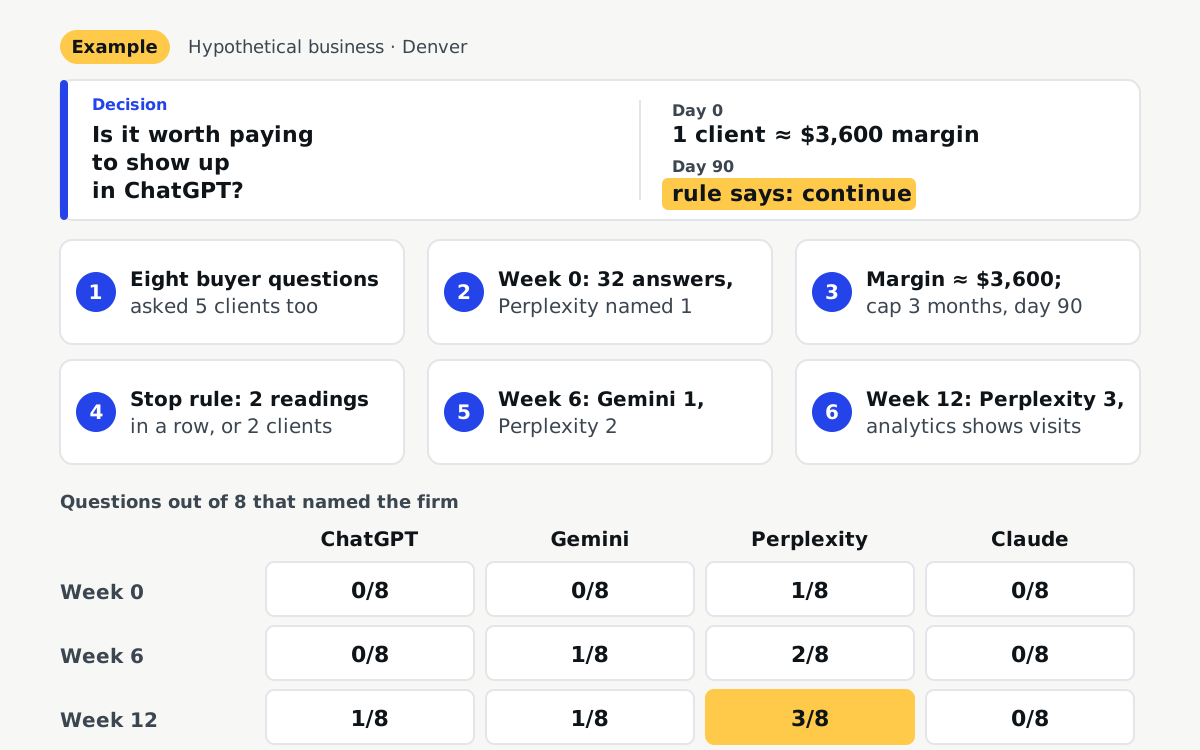
Example: a hypothetical business, not a sayurname client. Calloway Bookkeeping is an invented four-person firm in Denver serving small shops. A new client pays $320 a month and stays 28 months on average, with a margin of about 40%. One new client is therefore worth roughly $3,600 of margin over its life. The owner wants to know whether to pay for help, and sets the cap before she starts.
She wrote eight questions a shop owner would ask, without the firm’s name, and asked each of the four assistants once, which makes 32 answers at every reading.
- Wrote eight buyer questions in a shop owner’s words and asked her last five new clients how they had found the firm. Two had asked an assistant first.
- Week 0: asked the eight questions on four assistants and saved the 32 complete answers. Perplexity named the firm once. The others never did.
- Worked out the margin of one client: about $3,600. Set the cap at three months of the monthly fee and the judgement day at day 90.
- Wrote the stop rule: continue only if two readings in a row show at least two questions with the firm named, or if two new clients say an assistant sent them.
- Week 6: re-read the 32 answers. Gemini named the firm once and Perplexity twice. Nothing in analytics yet.
- Week 12: Perplexity named the firm in 3 of the 8, Gemini in 1, ChatGPT in 1, Claude in none, and analytics showed visits from an assistant.
Perplexity met the rule across two readings, with 2 of 8 at week 6 and 3 of 8 at week 12. Gemini and ChatGPT named the firm for only one question each, so neither met it, and Claude had not moved. The owner counted two enquiries that mentioned an assistant, and one of them became a client. That client’s margin, about $3,600, was larger than the capped spend.
On day 90 the rule said continue, with the same cap for the next three months. Another business might read zero in twelve weeks and stop. That would also be a useful result: it would have cost three months of the fee to find out.
When it is not worth it
Skip it if your buyers do not ask assistants for what you sell. A business that is found through a trade referral, a tender or a licence register gains little from a ChatGPT mention, and the free test will show that in one afternoon.
Skip it if you need customers this month. Assistants change over weeks, and no one controls the answer. Money that has to produce work in thirty days belongs in something with a faster, more direct return.
Skip paying for it if you have the time to do the work yourself and the site is already clear about what you sell, where and to whom. The work is mostly clear pages, accurate facts and requests to be included in the sources assistants read, and a careful owner can do it. Paying is for having it written, kept up and measured every week by someone else.
Do not buy on a promise. Anyone who guarantees that an assistant will name you, or who offers a screenshot as proof, is selling something no one can deliver. Ask what is measured, how often, and what you are charged if nothing changes.
How the work runs
It starts with the free test. Once subscribed, we measure up to 10 questions every week and publish as much as we judge necessary for AI to cite you in the answers you want. Volume and format follow what each question needs, and that part is our call. We also ask for inclusion in the sites the assistants use. What we promise is the request, not the listing.
It costs $299 a month, with no lock-in. A one-time $599 bonus is charged only when an AI starts naming your business for a measured question, checked by a person on our team, or Google Analytics shows a visit coming from an AI. Each piece of content comes with one revision. It promises no citation and no customer.
Questions
How much should a small business spend on this?
Set the cap from the margin of one new customer, not from what others spend. A cap of about three months of the fee, with a judgement day at ninety days, limits the risk if nothing changes.
Can I check whether it is worth it without paying?
Mostly yes. Ask the buyer’s questions on the four assistants, save the complete answers, and ask your last five customers how they found you. A free test does the first part for one question.
How long before I know?
About ninety days gives two or three readings. A single reading after two weeks proves little, because answers differ from run to run.
What if the assistants already name my business?
Then the money is better spent elsewhere for now. Keep measuring the same questions, so you notice if that changes.
Is it safer to do it myself?
It is cheaper in money and slower in time. The work is clear pages, accurate facts and requests for inclusion, and an owner with time can do it. Paying is for having it done and kept up.