
Published October 28, 2026
How to get AI assistants to talk about your business
Start with the question a customer would ask without naming your business. Save the full answers, then improve accurate public information that addresses the need and request corrections where outside sources are wrong. Repeat the same questions with comparable settings. An assistant can link to a source without mentioning your business, mention it negatively or give different answers later; no action guarantees a positive recommendation.
Choose the conversation you want to earn
“Talk about us” is too broad to measure. A buyer may ask for a provider in a city, compare products for a task or ask whether a service meets a constraint. Choose a question that describes a real need the business can serve, without inserting its name. A highly competitive general question and a specific local question are different tests and should not share a baseline.
A separate branded question can check whether an assistant describes your business correctly. It should not be used as evidence that the assistant independently discovered it. Save the exact prompt, language, location, date and available search settings. Keep the complete response, including caveats, negative references and answers without a name; a cropped favorable quote loses essential context.
Give people reasons to trust the answer
Explain what you do, for whom, where and under which conditions. A service page should answer practical buyer questions: what is included, what is excluded, how to contact the team and which facts are current. Make claims specific enough to verify. If a result is hypothetical, say so; do not turn an invented scenario into a customer testimonial or an implied case study.
Independent sources can supply context beyond your own site, but their owners control what they publish. Identify relevant sources that already discuss the buyer’s need, check whether they describe your company accurately, and send a correction or inclusion request when a legitimate route exists. Track sent, pending, accepted and declined separately. A request is not a guarantee of publication or recommendation.
Understand the path from a page to an answer
A page may be crawled, indexed, retrieved or displayed as a source through a product-specific process. Those stages are not interchangeable, and not every assistant searches the web on every question. OpenAI documents separate search and training crawlers; Google documents its own Search discovery process. Check the current documentation for the product and settings you are testing.
Even when an answer links to a page, it might omit the company name from its prose. When it names the company, read the surrounding words: a warning or negative mention is not a positive recommendation. An AI-referred site visit is another distinct signal, with its own measurement limits. Keep these observations separate so the report does not imply an outcome that did not occur.
Worked example: test a specific buyer question
Imagine Harbor Window Repair, a fictional four-technician company serving one city. It wants to be considered when a homeowner asks about residential window leaks. This is an invented illustration, not a result for a sayurname customer. The owner selects the question before changing the site and saves four available assistant responses.
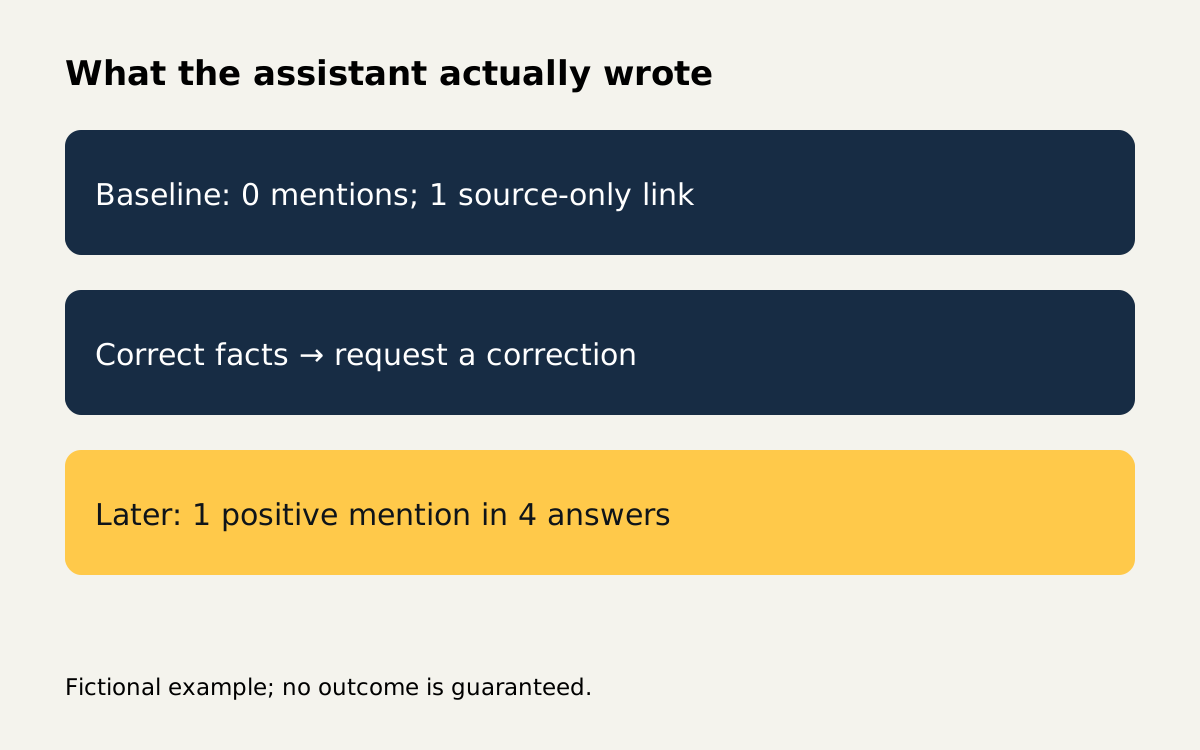
In the hypothetical starting run, no answer names Harbor. One answer links to Harbor’s existing service page, while two recommend other businesses and one explains how to choose a repairer. The business also has a separate branded answer containing an outdated service area. The owner has enough information to begin a focused correction without claiming a source-only link as a recommendation.
- Record the exact unbranded question and complete answers with date, language, city, assistant and available settings. Mark positive mention, negative mention, source-only link, absence and unavailable result separately.
- Ask the owner to confirm the service, geographic boundary and exclusions. Update the relevant page with those facts and an appointment route that works, then keep a dated copy of the change.
- Correct the business profile under the owner’s control. Submit a factual correction to an independent listing with an outdated service area, and record its status without claiming it has been accepted.
- Repeat the unchanged buyer question weekly. Suppose a later fictional run has one positive Harbor mention in four available answers; save that complete answer and the other three. Run the separate branded accuracy question again as well.
- Compare the records, not just the favorable sentence. If the name appears but the scope is wrong, fix the relevant claim. If the answer names no business, inspect whether the question instead asks for general advice before changing the entire website.
The before-and-after results show what appeared in these sampled responses, not that the page edit caused the change. The provider, other sources and demand may have changed too. Continue the same measurement long enough to recognize variation, and report both the number of available answers and the number that contain a positive mention.
When not to pursue a mention
Do not seek a recommendation for a service you cannot deliver or a region you do not serve. Repair a broken contact form and inaccurate prices or coverage before attracting more visitors. If your resources are limited, address the customer journey that would fail today before spending time on a broad question unrelated to buying.
Avoid fake testimonials, fabricated independent coverage and a flood of repetitive pages. Google’s published guidance warns about large-scale content that adds no value. Do not post private customer details or copy another source without permission. A useful page and a documented correction are actions within your control; another publisher’s decision and an assistant’s answer are not.
Sources and limits
Google explains how its search engine discovers and indexes pages at https://developers.google.com/search/docs/fundamentals/how-search-works and discusses its generative search features at https://developers.google.com/search/docs/fundamentals/ai-optimization-guide. OpenAI describes different user agents for search and training at https://developers.openai.com/api/docs/bots. These sources document specific products, not a universal recipe for every assistant.
A search-enabled answer can vary with the question, language, location, account context and available search settings. Save these alongside the complete answer and date. One result is an observation, not a ranking or a reliable probability. You cannot see all of the information an assistant considered, and a link in the sources is not proof that the business was positively named in the answer.
How sayurname works
The free test sends one question to ChatGPT, Gemini, Perplexity and Claude and saves the available answers. After subscription, sayurname works on the questions, requests inclusion where sources offer a route and measures weekly. The monthly service is $299 without lock-in. A one-time $599 bonus can be charged for a new positive mention in an answer to a measured question where the business was absent at baseline, or an AI-referred visit recorded by connected Google Analytics during the service. A team member checks the evidence first. Neither outcome is guaranteed.
Questions
Does a link in the sources count as a recommendation?
No. A linked page, a business named in the answer and a positive recommendation are distinct observations. Save each separately, together with the complete answer and the question.
Can I guarantee that an assistant will name my business?
No. You can improve accurate public information, request corrections and repeat a consistent measurement, but an independent assistant controls its own answers.
Should I include my business name in the test question?
Use a separate unbranded question to test whether the assistant can identify the business for a buyer’s need. A branded question is useful for checking factual accuracy, but it answers a different question.
How often should I repeat the check?
Use a consistent schedule that you can maintain, such as weekly. Record dates, exact questions and settings. A single change or result does not prove a cause.