
Published October 28, 2026
How to help AI assistants discover your business
Help discovery by publishing accurate, accessible information about your business and correcting relevant public profiles. Check the discovery controls documented by each provider, then ask an unbranded buyer question and preserve the complete answer. An assistant may have encountered a page without naming the company, and a mention does not prove a recommendation. You cannot force a particular product to read a page or remember a private conversation.
Define what discovery can mean
A customer might use “knows my business” to mean that a search result finds a page, an assistant links to it, or the answer actually names the company. These are different observations. An assistant can also name a business incorrectly or in a negative context. Define the outcome you care about before changing pages so that a linked source is not mistakenly reported as a recommendation.
A branded query can reveal whether an answer describes your business accurately. An unbranded buyer question asks a different thing: can the assistant identify relevant businesses when a person describes a need? Save both if useful, but do not combine their results. A question that includes the company name makes it easier for the answer to repeat that name and is a poor baseline for discovery.
Build a useful public reference
A good starting page states the business name, the service or product, the audience, its operating area, current contact route and relevant limitations. Explain what a buyer can actually expect and how to take the next step. Use details you can keep current rather than a long list of unsupported superlatives. If you serve only one city or do not perform a particular job, say so.
A clear page is not a secret instruction to an AI. It gives people and automated discovery systems an accessible reference when they encounter it. Keep the same core facts in profiles you control and identify an owner for changes. If a phone number, service or location changes, update the source page and those profiles together; contradictions create work for customers as well as uncertainty in automated answers.
Check access for the relevant product
Open the page without a privileged account and confirm that the main information loads. A login requirement, server error, incorrect canonical, blocked crawler or noindex directive can affect a particular path to discovery. Google documents how crawling and indexing work in Google Search. OpenAI documents OAI-SearchBot for its search features separately from GPTBot for training. Consult the provider concerned rather than treating one robots rule as a universal switch.
A successful request in a server log confirms a request reached the server; it does not prove that the page was indexed, read in an answer, or used to select a brand. Similarly, allowing a crawler does not guarantee inclusion. If an outside source holds outdated information, use its published correction channel and record the outcome without assuming an editor will accept the request.
Worked example: a local business with inconsistent information
Harbor Window Repair is a fictional company with four technicians. It serves one city and wants buyers looking for residential window leak repairs to find it. The business has a public website, a controlled profile with an old telephone number, and an independent directory that still lists a neighboring city where it no longer works. None of these numbers is a real customer result.
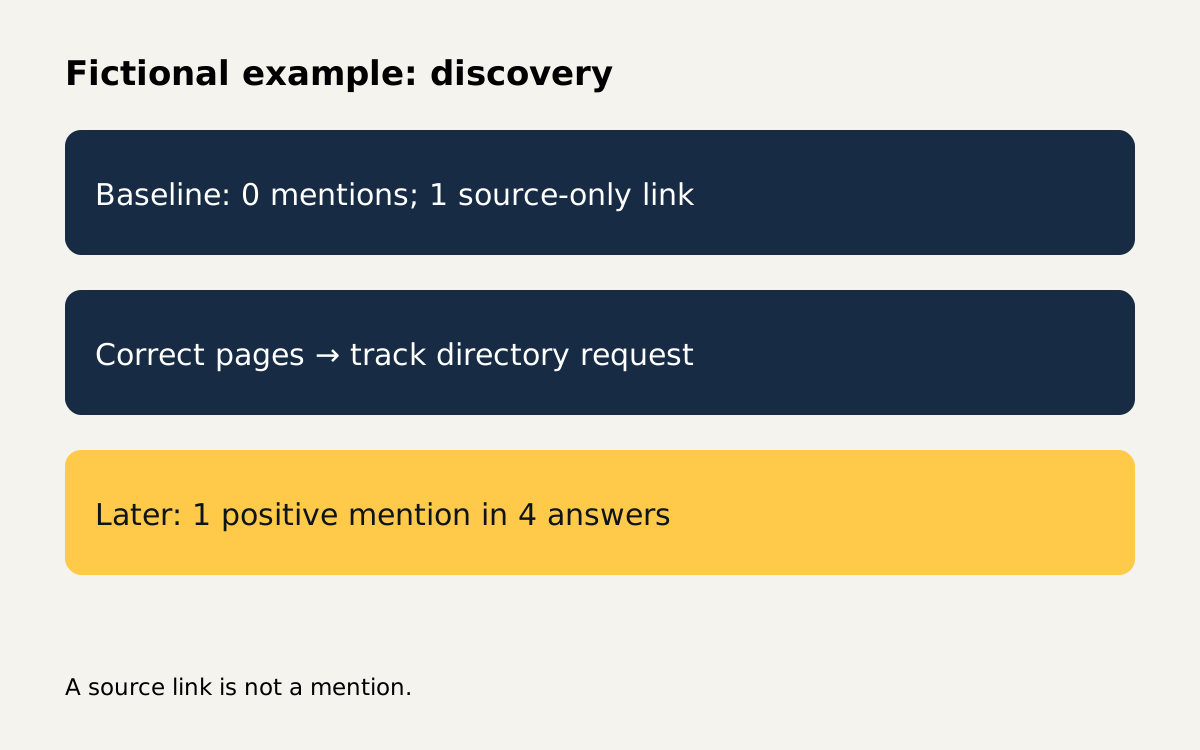
At the fictional baseline, the owner asks four assistants the same unbranded question, with search enabled where available. No answer names Harbor, but one links to its service page. The owner also runs a separate branded accuracy check and finds the old service area repeated. Both observations matter, but they answer different questions.
- Save the unbranded prompt, date, city, language, available model and search settings, full answer, source links and any unavailable results. Record the branded accuracy check in a separate row.
- Check that the service page loads publicly. Replace a generic description with the actual leak repair service, current city, limitations and a contact route tested by a person. Record the old and new versions and the date.
- Correct the telephone number in the controlled profile. Ask the independent directory to remove the outdated city and save the request; mark it pending until an editor confirms the change.
- Repeat the unchanged questions weekly using comparable settings. In a later invented run, one of four available answers names Harbor positively and the branded answer gives the correct city. Keep the other answers and source-only links too.
- Review what changed and what remains uncertain. Several pages, an external listing or provider behavior may have changed; the observation does not prove which change caused the new mention. If the business is described incorrectly, address the specific claim and repeat the accuracy check.
The business now has a record it can act on: a corrected page, a tracked request and two distinct measurements. It still cannot infer how often every user sees the answer. If one assistant was unavailable, report the number of available answers rather than silently treating the missing result as a negative.
When discovery is not the next job
Fix a misleading offer, an inaccessible contact path or a service capacity problem before promoting the page. If the company does not actually serve the region in the buyer’s question, correcting the question is more useful than trying to appear there. A public website is also not the right place for private customer data, account secrets or unpublished operational information.
Do not create dozens of nearly identical pages just to give a crawler more URLs. Google’s guidance warns that generating many pages without value can violate its scaled content abuse policies. A smaller number of accurate, useful pages is easier to maintain. Repeated checks are evidence about those sampled answers, not a promise of indexing, training or a recommendation.
Sources and limits
Google explains how its search engine discovers and indexes pages at https://developers.google.com/search/docs/fundamentals/how-search-works and discusses its generative search features at https://developers.google.com/search/docs/fundamentals/ai-optimization-guide. OpenAI describes different user agents for search and training at https://developers.openai.com/api/docs/bots. These sources document specific products, not a universal recipe for every assistant.
A search-enabled answer can vary with the question, language, location, account context and available search settings. Save these alongside the complete answer and date. One result is an observation, not a ranking or a reliable probability. You cannot see all of the information an assistant considered, and a link in the sources is not proof that the business was positively named in the answer.
How sayurname works
The free test sends one question to ChatGPT, Gemini, Perplexity and Claude and saves the available answers. After subscription, sayurname works on the questions, requests inclusion where sources offer a route and measures weekly. The monthly service is $299 without lock-in. A one-time $599 bonus can be charged for a new positive mention in an answer to a measured question where the business was absent at baseline, or an AI-referred visit recorded by connected Google Analytics during the service. A team member checks the evidence first. Neither outcome is guaranteed.
Questions
Does a link in the sources count as a recommendation?
No. A linked page, a business named in the answer and a positive recommendation are distinct observations. Save each separately, together with the complete answer and the question.
Can I guarantee that an assistant will name my business?
No. You can improve accurate public information, request corrections and repeat a consistent measurement, but an independent assistant controls its own answers.
Should I include my business name in the test question?
Use a separate unbranded question to test whether the assistant can identify the business for a buyer’s need. A branded question is useful for checking factual accuracy, but it answers a different question.
How often should I repeat the check?
Use a consistent schedule that you can maintain, such as weekly. Record dates, exact questions and settings. A single change or result does not prove a cause.