Published October 28, 2026
Why your business can appear on Google but not in a ChatGPT answer
A Google result and a ChatGPT answer are produced by different experiences, so appearing in one does not guarantee a name in the other. Google Search has its own discovery, indexing and ranking processes; a search-enabled assistant may use different queries and sources. Save the exact customer question and the complete answer, check the page and visible sources, and treat any explanation of the difference as a hypothesis until you have evidence.
Compare the same need before comparing results
A person might search Google for a business name and ask ChatGPT for a recommendation without naming any business. Those are different questions. A high result for your own name does not establish that an assistant should list you for a broad service question. Use the same intended service, city and customer need in each comparison, while recognizing that the products can rewrite or interpret a query differently.
Google’s documentation describes discovery, crawling, indexing and serving as separate stages, none of which guarantees a particular placement. An assistant with search enabled can retrieve sources as part of answering a question. A result that you see in one interface is therefore not a complete list of all information available to the other. Do not infer the internal ranking of one system from a screenshot of another.
Check facts, access and source evidence
Open the actual page that appears in Google and confirm that it describes the service, location, customer and constraints accurately. Check the final URL, public access, redirects and important text with the site operator. A page can be suitable for a person but inaccessible to a particular crawler because of a login, robots policy or CDN rule. A successful check from your own browser does not by itself verify access by a provider’s crawler.
If an assistant displays a source link, open that page and record what it actually says, when it was updated and who controls it. A cited source is a useful lead, not a full trace of the assistant’s decision. Compare other named businesses with the question, but do not copy claims or assume a competitor was selected because of a single sentence. If the answer provides no source or the assistant fails, record the limitation.
Measure the answer, not only the search position
Choose an unbranded question that a real buyer would ask and keep its wording, language and intended market stable. Save each full response with the date, assistant and visible search setting. A positive mention of the business in the answer, a link only among sources, a negative mention and an unavailable response are separate observations. Do not count the source-only link as a positive name or silently treat a failure as an absence.
Repeat comparable checks on a schedule and keep the available-answer denominator beside each count. A later name is an observation, not proof that a particular site edit caused it. Other pages, indexes, the model or the settings may have changed. A connected analytics report can separately show AI-referred visits; a visit, a Google position and a name in an answer should not be combined as if they were the same event.
Worked example: a fictional window-repair firm
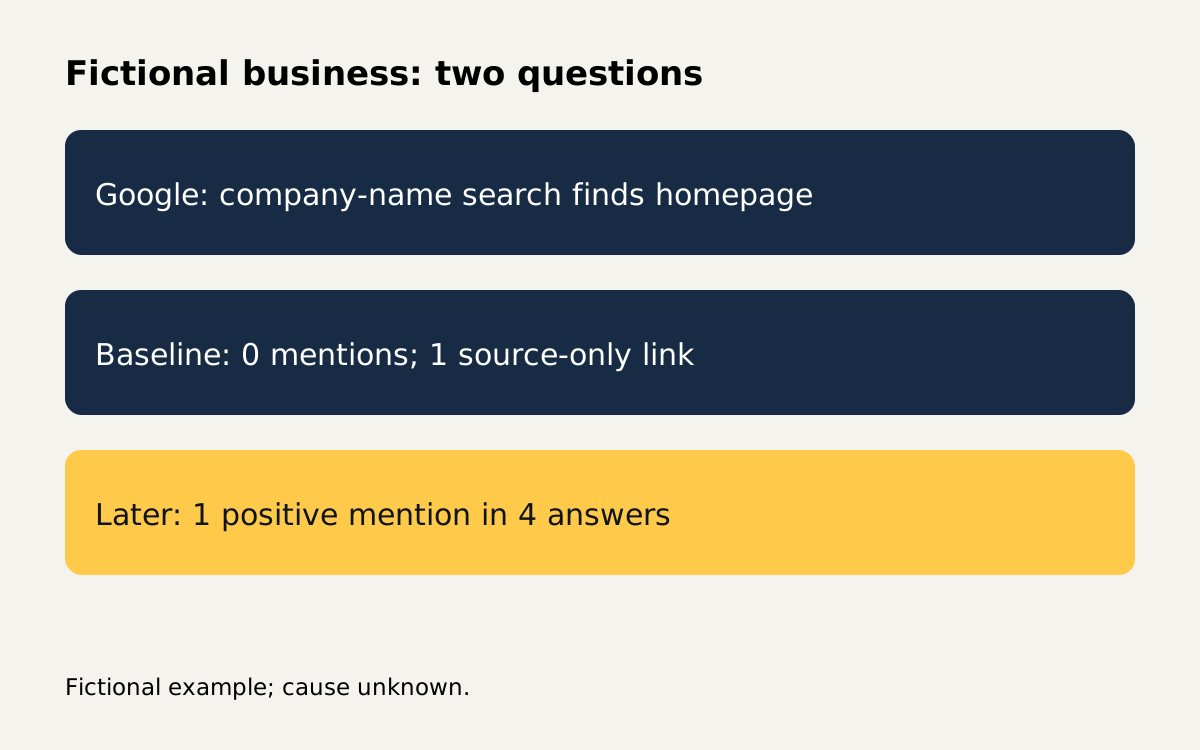
This example is hypothetical, not a sayurname customer or a measured case. Harbor Window Repair has four technicians and repairs leaking windows in one city; it does not install roofs. The owner searches Google for the company name and sees the homepage. The owner then asks an assistant, “Who repairs a leaking window in this city?” and the response names other firms. The branded search and unbranded question are not equivalent evidence.
The owner saves the unbranded question and asks it of four assistants. In the invented initial run, none of the four available answers names Harbor positively. One answer links to Harbor’s page as a source, two name competitors and one offers general advice. The business keeps all responses and dates. A source link without the name in the answer is not a positive name, and these four responses do not describe every future customer.
- Record the exact question, city, language, date, assistant and visible search settings. Save the complete answers and separately note positive names, negative statements, source-only links and unavailable results. Keep the branded Google query in its own record rather than treating it as the baseline for an unbranded question.
- Open the service page shown in Google. In the fictional example it says only ‘general construction’ and omits window-leak repair. Ask the owner to confirm the actual service, service area and what the company does not do. Do not claim roof installation simply because a competitor offers it.
- Check the final public URL and any relevant crawler policy with the site operator. If the page is behind a login or a CDN blocks a verified search crawler, decide with the owner whether public access is intended and make a narrowly scoped correction. Google and OpenAI document different crawlers; consult each provider instead of assuming one rule applies to all.
- Update the visible service page with the verified repair, service area, how to book an appointment and exclusions. Correct an outdated profile you control. If an independent directory contains the wrong service, request a correction through its published channel and record the outcome; a request is not an accepted listing.
- Repeat the unchanged unbranded question weekly in fresh conversations. In a fictional later run, one of four available answers names Harbor positively. Save all four answers, including those that do not, and keep any source-only link separate. A negative mention is not a positive recommendation.
- At review, compare the initial and later answers with the dated page change and directory status. The new name is an observation, not proof that a particular edit caused it or that future customers will see it. If the business is already fully booked, more visibility may not solve its immediate problem.
Do not discard useful Google work merely because one assistant omitted the company. Equally, do not promise that a high Google position will transfer to a different assistant. The comparison helps identify an inaccurate offer, an access problem or an external listing worth investigating; it does not reveal every hidden factor behind an answer.
If the cited competitor serves another city or a different kind of customer, it may be a poor comparator. If a page is intentionally private, do not remove access controls merely to chase discovery. Resolve those business constraints with the owner before changing an access policy.
Sources and limits of the comparison
Google explains the stages of Search at https://developers.google.com/search/docs/fundamentals/how-search-works. OpenAI describes its crawlers at https://developers.openai.com/api/docs/bots and its web-search tool at https://developers.openai.com/api/docs/guides/tools-web-search. These documents describe different systems and can change; consult the current provider guidance before changing access rules.
Keep the page URL, dated versions, submitted requests and full answers together so another person can inspect the comparison. Search results, source links and assistant outputs vary, and not all providers expose the information needed to attribute a specific choice. If the available evidence does not explain the omission, report that uncertainty rather than turning a plausible guess into a finding.
How sayurname works
The free test sends one question to ChatGPT, Gemini, Perplexity and Claude and saves the available answers. After subscription, sayurname works on the questions, requests inclusion where sources offer a route and measures weekly. The monthly service is $299 without lock-in. A one-time $599 bonus can be charged for a new positive mention in an answer to a measured question where the business was absent at baseline, or an AI-referred visit recorded by connected Google Analytics during the service. A team member checks the evidence before billing. Neither outcome is guaranteed.
Questions
Does a Google ranking guarantee a ChatGPT recommendation?
No. The experiences can use different queries, sources and systems. A result in one does not guarantee a positive mention in the other.
Should I stop working on Google visibility?
Not merely because one assistant omitted the business. Keep useful, accurate and accessible pages, and measure the question that matters to the customer.
Is a link in the assistant’s sources the same as a recommendation?
No. A source link and a positive mention of the business in the response are different observations and should be recorded separately.
Can one page change prove why the answer changed?
Not on a simple before-and-after alone. Other information, systems and settings may have changed; preserve the evidence and avoid claiming a cause without stronger comparison.