
Published October 28, 2026
How to prepare for AI assistants that buy or book
An AI assistant can help a person compare options, and some services can complete a purchase or booking when the user authorizes it. You cannot make every assistant transact with your business or assume an open protocol means access to a particular checkout. Start by making your offer and booking or buying flow clear, accurate and usable; check eligibility and supported integrations for each provider. Keep the buyer in control of approval, payment and confirmation.
Separate discovery from an actual order
A customer may ask an assistant for a recommendation, follow a link to your site, or use an eligible integrated checkout. These are different paths. A response naming a company does not establish that a visitor clicked, a cart exists or an order was placed. Likewise, an assistant reading a booking page does not reserve a time slot. Each step requires its own confirmation and its own evidence.
An agent can only perform the actions its product, permissions and connected tools support. A browser-based assistant may need a person to step in when authentication, a payment or an unclear screen appears. The customer should review the item, conditions and total before authorizing a transaction. Your business remains responsible for verifying availability, honoring an accepted order and providing support.
Make the offer usable before adding integrations
Put the information a buyer needs on the relevant public page: the service or product name, what it includes, who can buy it, service area, current price or pricing method, availability and a direct path to buy or book. State required qualifications, cancellation terms and contact details where the decision is made. If exact availability changes by time or location, say so and provide the live selection step rather than publishing an outdated promise.
Keep the page, inventory system and checkout consistent. A search result may cache a price while the actual purchase uses a later inventory response. Clearly show taxes, delivery or appointment fees before the buyer confirms. Do not expose private customer information to make the flow easier for bots. Structured product data may support discovery where a provider uses it, but it cannot guarantee placement, a sale or an integration.
Check eligibility before committing engineering time
OpenAI documents an Agentic Checkout specification for merchants and states that Instant Checkout in ChatGPT is currently available to approved partners. An open specification is not the same as automatic approval or availability in every market. The merchant must implement the supported session and order workflow, accurately calculate totals and handle order updates. See https://developers.openai.com/commerce/specs/checkout.
Google describes its Universal Commerce Protocol and checkout for select merchants and eligible products in the United States, Canada and Australia. Its documentation distinguishes protocol-based checkout from an agent operating a merchant website at the customer’s direction: https://support.google.com/merchants/answer/16837055. Availability and requirements change; read the provider’s current eligibility and contract before planning a rollout. These examples do not imply that every booking business has an integration.
Worked example: a fictional repair appointment
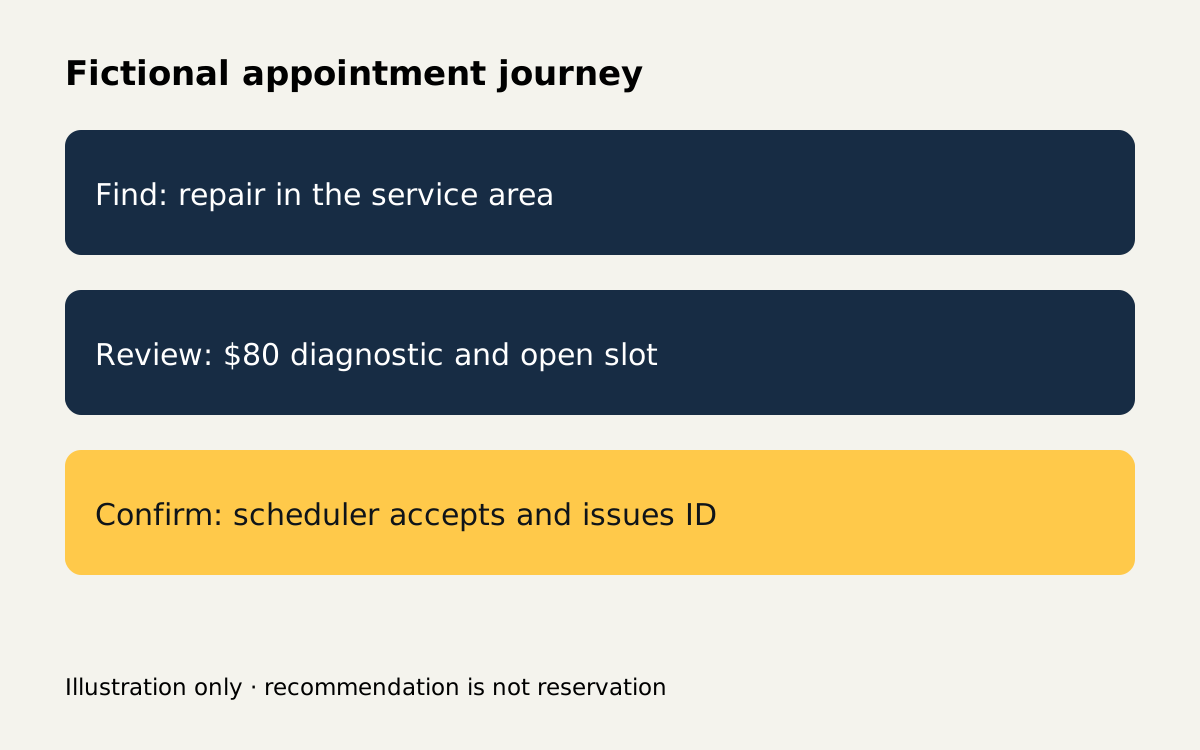
Harbor Appliance Repair is fictional and is not a sayurname customer. It serves one city, charges $80 for a diagnostic visit, and credits that fee toward an accepted repair. The owner wants people using assistants to book a visit without the assistant guessing the final repair price. The business has four technicians and a booking page that checks its current schedule. The following is a practical preparation exercise, not a claim that any provider currently offers this merchant an integration.
- Write one page for the diagnostic visit. State the $80 fee, service area, supported appliances, credit toward an accepted repair and the policy for cancellations. Say that parts and labor are quoted after inspection, so the assistant does not present $80 as the complete repair cost.
- Show available time slots from the scheduling system. In this example Tuesday at 10:00 has one slot and Tuesday at 14:00 has two. The page must recheck availability when the person selects a slot; a search result or screenshot is not a reservation.
- Ask the customer to review the address, selected slot, diagnostic fee and cancellation terms. Confirm the booking only after their explicit approval and the scheduler accepts it. If that last slot disappears before confirmation, explain the conflict and offer available alternatives instead of silently choosing another time.
- Return a confirmation number and send the ordinary customer confirmation through the established booking flow. Keep a support route for rescheduling or cancellation. Do not collect card numbers in a prompt or expose another customer’s appointment details to an assistant.
- Test one authorized journey from question to confirmation, then test an expired slot and a cancelled appointment. Record whether the assistant offered a link, the person completed the form or an integration actually reserved a slot. Do not count a recommendation as a booked appointment.
Suppose 20 people view the appointment page, four start the booking form and two receive confirmed appointments. The observed confirmation rate is two of 20 page views for this small fictional sample, not a forecast of future revenue. Review the people who could not finish, the time taken and the accuracy of the confirmation before investing in more automation.
When not to automate the transaction
If the offer changes during a conversation, the business cannot verify stock or the total price is unknown until inspection, do not let an assistant invent an amount or commit the company. Use a request for a quote, a callback or an explicit human review. Sensitive services may need identity checks and additional safeguards; publish the next step without exposing private data or pretending an assistant can waive those checks.
Do not bypass an authentication challenge, a payment confirmation or a provider’s eligibility requirements to manufacture a completed booking. If the current flow cannot reliably show the final terms or issue a confirmation, fix that flow first. Keep an accessible route for people who do not use an assistant. Automation is useful only when the business can fulfill the same obligation through its ordinary systems.
Measure the parts you can actually observe
Save a dated answer to a consistent, unbranded customer question separately from the site visit and the order record. In Analytics, document your attribution dimension and the event that represents a completed order; some AI-influenced journeys will not carry an identifiable referral. A source-only link is different from a positive name in an answer, and neither proves an order.
Compare changes using the same event definitions, dates, markets and available assistant settings. Log unavailable responses rather than quietly removing them. If 10 answers mention your brand but no booking is confirmed, investigate whether the offered service, price or flow fits the customer’s request. A small before-and-after comparison can guide a test, but it does not by itself prove which change caused a result.
How sayurname works
The free test sends one question to ChatGPT, Gemini, Perplexity and Claude and saves the available answers. After subscription, sayurname works on the questions, requests inclusion where sources offer a route and measures weekly. The monthly service is $299 without lock-in. A one-time $599 bonus can be charged for a new positive name in a measured answer where the business was absent at baseline, or an AI-referred visit recorded by connected Google Analytics during the service. A team member checks the evidence first. Neither outcome is guaranteed.
Questions
Can I force an assistant to book my service?
No. Capabilities depend on the assistant, its integrations, eligibility and customer authorization. Make the offer and booking flow accurate, then check the provider’s current options.
Does supporting an open protocol guarantee ChatGPT checkout?
No. OpenAI states that Instant Checkout in ChatGPT is available to approved partners. Implementing a public specification is not automatic approval.
Is a price in an answer a confirmed order?
No. Verify the current price, availability and total in the transaction flow, and obtain the customer’s approval and a confirmation from the merchant’s system.
What if my booking requires an inspection?
Explain the diagnostic fee and what remains to be quoted. Allow a person to review and approve the eventual repair rather than presenting an uncertain total as final.
Can visits from AI measure every influenced customer?
No. Some people may return through another route or without a detectable referrer. Treat recorded AI referrals as a partial view.