
Published November 20, 2026
How to get more customers from ChatGPT
A customer from ChatGPT needs three things to happen in a row: your business is named in the answer to a question a buyer really asks, the buyer can verify you in a few seconds on a page that agrees with the answer, and the next step (booking, calling, asking for a quote) works on the first try. Test the buying questions and save every full answer, find the weakest of the three links, and fix that one first. No one can promise a citation or a customer, so measure with one intake question and read the result over several weeks, not days.
Where customers from ChatGPT are lost
Someone asks an assistant for the best physiotherapist for runner’s knee in her city. The answer names three clinics, with a line about each. She opens one or two, checks that the address, the price and the hours match what she read, and books or calls the one that makes this easiest. By the time she reaches you she has already compared. That makes her a good prospect and an impatient one.
The chain has three links, and a break in any of them costs the customer. First, the assistant has to name you for that question. Second, the page she opens has to confirm the answer in the first screen. Third, the next step has to work without effort. Most businesses spend all their attention on the first link and lose most of the people at the second and third, where the fix is cheap and the result is visible within days.
Link one: be named for a question a buyer really asks
Curiosity questions (“what is generative engine optimization?”) bring readers. Buying questions bring customers: “best [service] for [problem] in [city]”, “who can help me with [problem]”, “how much does [service] cost”. Write six to ten of them the way your customers phrase them, without your own name in them, one language per question. Freeze the wording, ask each one in ChatGPT, Gemini, Perplexity and Claude with the same settings, and save every complete answer with its date.
Read the answers for three facts: are you named, which sources the assistant cites for the answer, and who is named instead of you. A name without a source is weak, because the next run may drop it. A named business with a source you control (your own page) is solid. If a directory or an old article is the source, your first task is to correct that page, not to write a new one. Answers vary from run to run, so a single reading proves nothing: read at least two in a row.
Link two: be easy to verify in ten seconds
The page the buyer opens should repeat the answer, in plain words, in its first screen: what you do, for whom, where, what it costs or how pricing works, and one proof the reader can check. Everything the assistant said about you must also be true on the page. When the answer says weekend appointments and the page says weekdays only, the buyer trusts neither and leaves.
Check the places an assistant reads besides your site: the business profile, the directory entries, the booking page and the most recent press mention. Opening hours, address, service names and prices should match everywhere. Hiding the price rarely helps, because assistants and buyers both read it as a warning. If you cannot publish a price, publish how it is calculated and a typical range, and say what changes it.
Link three: make the next step work for someone who already chose
A buyer who arrives from an answer usually has one question left: how do I start. Give one primary action above the fold (book, call or request a quote), a phone number that can be tapped on a phone, a form with no more than four fields, and a reply promise you can keep (“we answer within one working day”). Remove anything that makes her search for the button, such as a menu with eleven entries or a booking link in the footer.
Then ask where she came from. One optional question on the form and at reception, “How did you first hear about us?”, with “AI assistant” as its own option and an optional line for which assistant and what she asked, tells you what analytics cannot. Many people ask an assistant and then phone or search your name, and analytics files those visits as direct or branded. Treat analytics as a floor and the intake count as the main measure.
A worked example, step by step
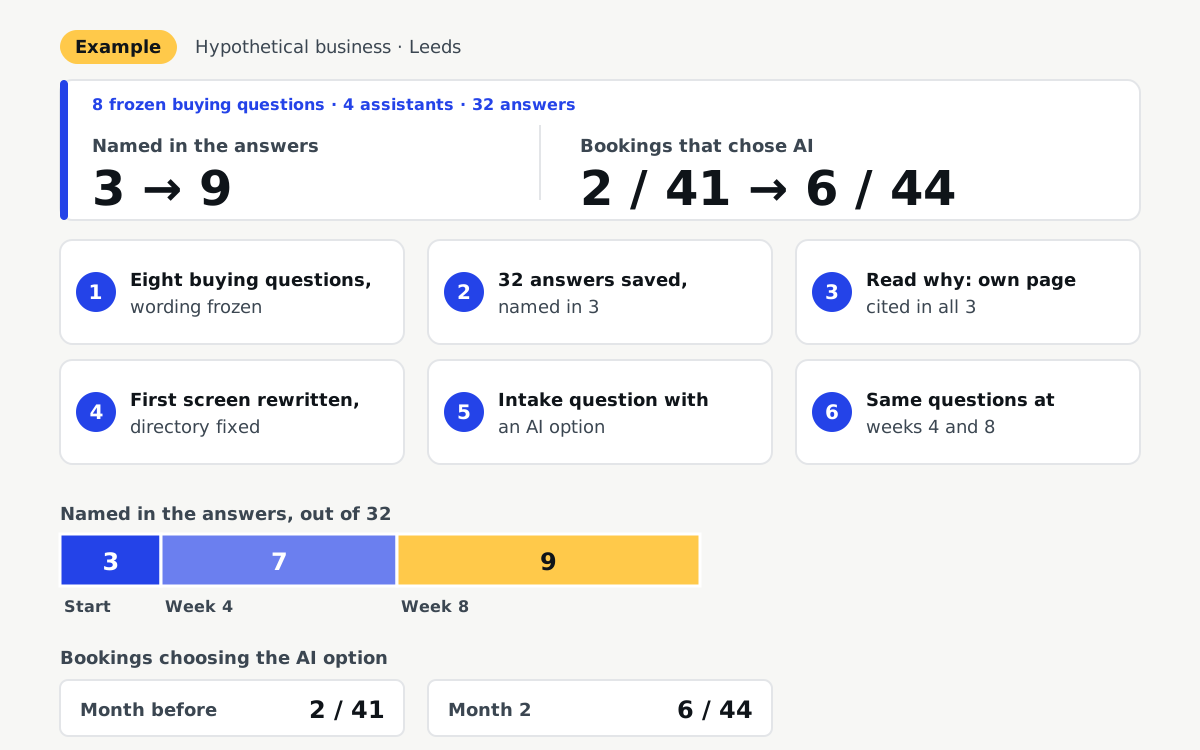
Example: a hypothetical business, not a sayurname client. Harbour Street Physio is an invented three-therapist clinic in Leeds. It takes about forty new bookings a month and wants to know whether ChatGPT can send it more runners with knee pain.
The owner works through the three links in order, one week each, and changes only one thing at a time so she can read the effect.
- Wrote eight buying questions as a patient would ask them (for example “best physiotherapist for runner’s knee in Leeds”), none with the clinic’s name, and froze the wording.
- Ran each question in the four assistants, 32 answers in all, and saved the full text and the sources. The clinic was named in 3 of the 32.
- Read the 3 answers that named it: all cited the clinic’s own runner’s-knee page. The other 29 cited a directory with old opening hours and two competitors’ pages.
- Opened the runner’s-knee page as a patient would: price missing, address only in the footer, booking link under the fold. Rewrote the first screen with the answer, the price per session, the address, the hours and a booking button, and corrected the directory entry.
- Added the optional intake question, with “AI assistant” as an option, to the booking form and to the reception script.
- Repeated the same eight questions after four weeks and again after eight, with the same settings.
After four weeks the clinic was named in 7 of the 32 answers, and after eight in 9. In the month before the changes, 2 of 41 new bookings chose the AI option, against 6 of 44 in the second month. Analytics credited 1 and 3 of those.
The owner reports the counts as counts and does not claim the changes caused every booking: answers vary, and the season changed too. What she knows for certain is which page was cited, which links were broken and that the cheap fixes came before any new content.
When it is not worth the effort, and what not to do
If almost nobody asks an assistant for what you sell, there is little to win yet. Check by asking the buying questions and looking at what the assistants answer: if they send people to marketplaces or to a service you do not offer, your first customers will come from elsewhere. Keep the page honest and the intake question running, and come back in a quarter.
Do not pay anyone who promises a guaranteed citation or a fixed number of customers, because no one controls what an assistant says. Do not stuff pages with the question phrases, invent reviews or copy a competitor’s page: assistants lean on what other sources confirm, and a contradiction costs you the mention. Do not change the questions in the middle of a series, or you will not know what moved.
How the work runs
It starts with the free test. Once subscribed, we measure up to 10 questions every week and publish as much as we judge necessary for AI to cite you in the answers you want. Volume and format follow what each question needs, and that part is our call. We also ask for inclusion in the sites the assistants use. What we promise is the request, not the listing.
It costs $299 a month, with no lock-in. A one-time $599 bonus is charged only when an AI starts naming your business for a measured question, checked by a person on our team, or Google Analytics shows a visit coming from an AI. Each piece of content comes with one revision. It promises no citation and no customer.
Questions
Can I pay to be recommended by ChatGPT?
No one can buy a place in an assistant’s answer. You can improve the pages and sources it relies on, ask for inclusion in the sites it reads and measure the result, but the answer remains the assistant’s.
How long before customers start arriving?
Fixes to a page and a profile can show up in a few weeks, while new third-party mentions take longer. Read at least two measurements in a row before judging, and expect the first customers to be few.
Do customers from ChatGPT show up in Google Analytics?
Some do, as visits from chatgpt.com and similar sources, but many arrive as direct traffic, by phone or after a name search. Add one intake question so you can count them.
Which matters more, the answer or the page?
Both, in order. Being named gets you the visit, and the page and next step decide whether the visit becomes a customer. Start with the weakest link.
Is it worth it for a small local business?
Often yes, because local buying questions are specific and the competition is thin, but check first that people ask assistants for what you sell and that you can serve more customers.