
Published October 27, 2026
Write useful business information that assistants can accurately describe
Write first for the people deciding whether a service fits their needs. Clear claims, specific scope, accessible pages and supporting evidence make information easier to verify, but they do not force an assistant to repeat or recommend it. Keep essential facts current, distinguish your own claims from independent evidence, and review complete assistant answers separately from source links and visits.
Give the reader a usable answer
A prospective customer wants to know what you do, who you serve, where the service is available, what happens next and any important restrictions. Put those facts in ordinary language on the relevant page. Use specific examples where they clarify the decision, and explain material qualifications close to the claim. A page filled with repeated business names or generic superlatives gives a reader little to verify and does not establish that an assistant will recommend the company.
An assistant may summarize, paraphrase, omit details or draw on other material. It may not access your page at all. Treat your own site as a source you can maintain, not as a script you can force an assistant to recite. If a claim changes, update the page and the people who answer customer questions. Clear information should remain useful even when no assistant mentions the business.
Connect claims to evidence and limits
Replace a vague claim such as 'best local service' with relevant, supportable facts: the services offered, actual coverage, opening arrangements and the process for obtaining a quote. If you use a customer story, obtain appropriate permission and distinguish an individual experience from a guaranteed outcome. Explain exceptions and limits. A source page should help a person check the claim, not just repeat the same promotional sentence elsewhere.
Separate first-party descriptions from independent reviews or official records. A third-party source may be outdated, disputed or applicable only to a particular location. Check dates and context, and correct your own material when a service or area changes. Do not fabricate endorsements or present an invented result as a real one. An honest limitation can be more useful to a customer than a sweeping claim that the business cannot fulfill.
Make the page usable and maintainable
Give each important service a clear heading and a stable, relevant page. Use descriptive links and ensure the page works for visitors using different devices and assistive technologies. Coordinate with the site operator to check redirects, access, rendering and errors. Google Search documentation describes how its crawler discovers and processes pages; its guidance is specific to Google and is not a guarantee about other assistants or their sources.
Assign a person to review service facts and localized versions when availability, prices or contact details change. A page that is technically reachable but factually obsolete can mislead both readers and systems that rely on it. Keep the change date and an internal record of what was checked. If the business cannot maintain a large content program, prioritize a small number of accurate pages that answer real customer questions.
Worked example: a fictional window repairer
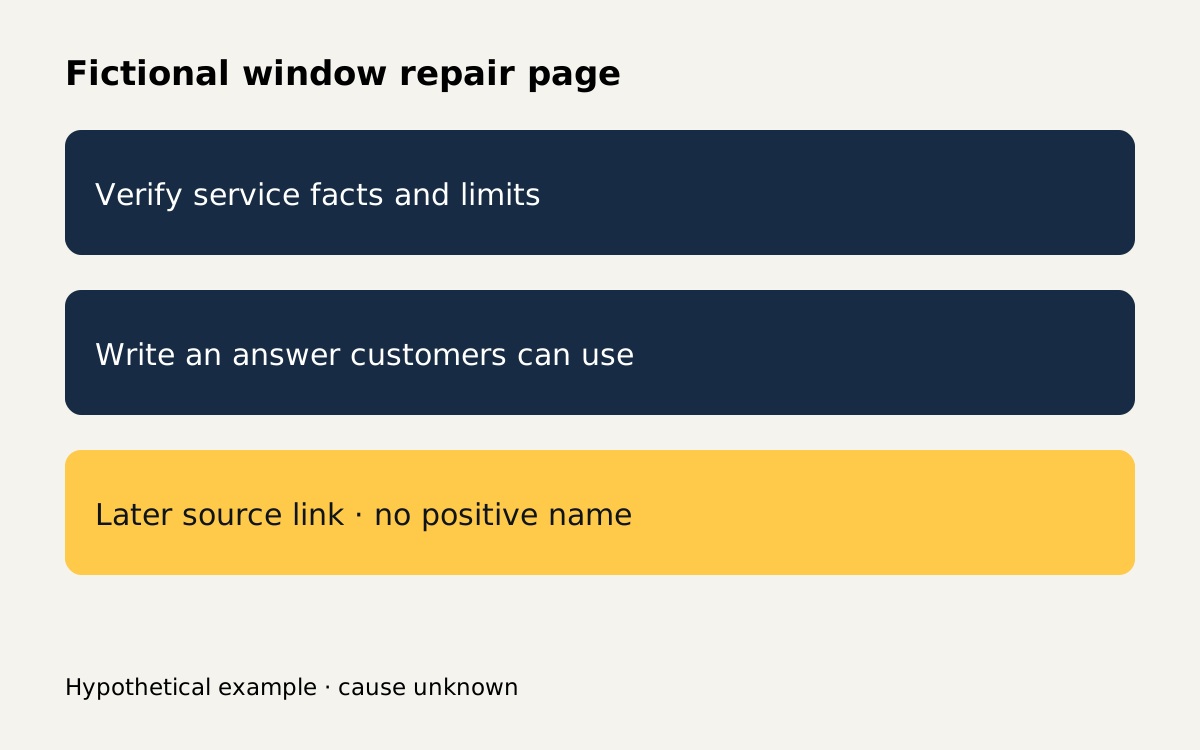
This example is hypothetical, not a sayurname client or a measured result. A window repair business serves one city and receives eight questions a month about condensation between panes and has two technicians. Its existing page says only that it offers 'the best window solutions' and has no clear service boundary. The owner wants to explain what the team can inspect and when replacement may require a separate quote.
The team writes an accessible service page that describes the inspection, the actual area served and the way to request an appointment. It does not claim every pane can be repaired or include invented customer results. It records an assistant-answer baseline separately so it can observe what changes later without assuming the new page controls the assistant.
- Ask the service team which customer question occurs frequently and confirm what the business actually offers. Write down service boundaries, practical next steps and meaningful exclusions before drafting marketing copy.
- Review the current page as a customer would. Note the missing explanation, ambiguous coverage and unsupported superlatives. Check the actual booking process and contact details with the person who operates them.
- Draft a clear answer explaining inspection, possible outcomes and the need for an individual quote when appropriate. Place qualifications beside relevant claims and use evidence that can be checked. Have the technician and a fluent editor review it before publication.
- Check the final page on a phone and with the site operator for accessibility, stable links and a successful public response. Assign an owner to update the content when the service changes; do not assume technical access guarantees indexing, citation or recommendation.
- Save the exact local unbranded question, date, assistant, visible settings and full available answer before and after the edit. In an invented later answer the assistant describes the issue and links to the page but does not name the company positively. Record a source link, not a positive name or a visit, and do not attribute the citation to the edit without stronger evidence.
Do not publish a claim simply because it seems likely to be repeated. If the company cannot deliver the described service, verify an assertion, obtain permission for a story or maintain the page, correct those issues first. A large volume of near-duplicate text can increase maintenance work while giving readers no clearer basis for choosing a service.
A later positive name in an answer, a linked source and a recorded AI-referred session are distinct signals. A citation does not prove anyone clicked, and a session does not reveal the exact answer a person saw. Use each record for the question it can support and review ambiguous claims with a person.
Sources and review
Google's guidance on creating helpful, reliable people-first content is at https://developers.google.com/search/docs/fundamentals/creating-helpful-content. Its explanation of how Google Search works is at https://developers.google.com/search/docs/fundamentals/how-search-works. These sources concern Google Search and reader-focused content; they do not promise that a particular assistant will cite or recommend a page.
Keep the page owner, evidence for material claims, date of review and a change history. Retain complete assistant responses separately with the question and context. If an observation changes after publication, describe the sequence and the limits of the evidence instead of declaring the page caused the result. Use customer questions and accurate operations as the basis for the next revision.
How sayurname works
The free test sends one question to ChatGPT, Gemini, Perplexity and Claude and saves the available answers. After subscription, sayurname works on the questions, requests inclusion where sources offer a route and measures weekly. The monthly service is $299 without lock-in. A one-time $599 bonus can be charged for a new positive name in a measured answer where the business was absent at baseline, or an AI-referred visit recorded by connected Google Analytics during the service. A team member checks the evidence first. Neither outcome is guaranteed.
Questions
Can I force an assistant to repeat my copy?
No. Assistants can use different sources, paraphrase or omit information. Clear content is useful but does not control their answers.
Should I repeat my business name throughout a page?
Use the name where it helps readers identify the business. Repetition alone does not establish relevance or guarantee a recommendation.
Does a linked page mean the business was recommended?
No. Review the answer for a positive business name and record a source-only link separately.
What should I update first?
Correct inaccurate service facts, contact details and important limitations on the pages customers actually use.