
Published November 6, 2026
Can a small law firm be named instead of a bigger one?
A small firm is named when the question is narrow enough that a large firm has no page for it, and the small firm does. “Best lawyer in the city” is the question the large firm wins, because many pages repeat its name. “Who handles this one kind of estate, and what the first piece of work is not” is a different question. Nobody can promise the small firm will be named. This is general information, not legal advice.
Two questions, two lists
Ask “who is a lawyer in this city” and the assistant summarizes the names that appear most often. A firm with dozens of lawyers and years of directories is that name. A two-lawyer firm is absent, and that absence is not a mistake.
Ask the matter the two-lawyer firm actually does, with a boundary, and the large firm’s general page has nothing to quote. The small firm’s page can. The criterion is the sentence, not the headcount.
Where the narrow answer comes from
With web search on, each assistant looks for a page that states the matter, the city, and what the work is not. A homepage that says “full service” matches the broad question and loses the narrow one. A page about one estate procedure matches the narrow question.
The four assistants still disagree between runs. One screenshot of the broad question does not tell you how the narrow question will go.
The most common mistake: competing on the broad question
Almost every small firm publishes “a trusted firm for all your legal needs” and then wonders why a larger name is the answer. It happens because the broad question is the one the partners type when they test the assistant. The client with one problem does not type that.
The remedy is to leave the broad question to the large firm and publish the narrow one. The trade-off is that “lawyer in [city]” will keep naming the large firm. That question was never the small firm’s. Advertising rules differ by bar. Check yours.
A worked example, step by step
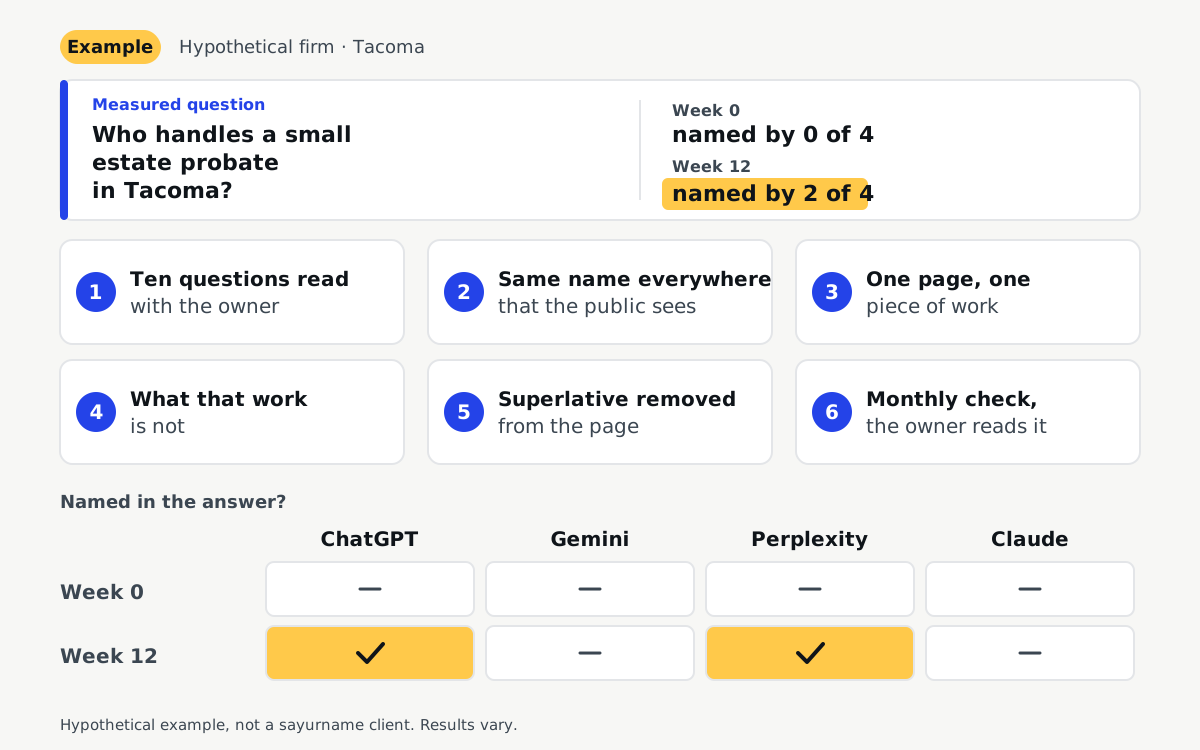
Example: a hypothetical firm, not a sayurname client. Imagine Narrow Estate in Tacoma, Washington: two lawyers, nine years, 40 Google reviews averaging 4.8. They handle an informal probate of an estate whose assets are under $100,000, for the person named in the will. A first written look is $1,800 to $2,800. They do not do a will contest. The site links to the Washington bar lookup and does not invent a bar number. The old site said “Tacoma’s trusted firm for every legal need”.
Two questions were measured. “Who is a lawyer in Tacoma?” And “Who in Tacoma handles an informal probate under $100,000 and says it is not a will contest?”. At week 0 the firm was named by 0 of 4 on the narrow question, and the broad question named two large firms.
- Read both answers and kept them apart. The broad question was not the one they tried to win.
- Fixed the base: the same legal name and address, with a link to the bar lookup.
- Replaced “every legal need” with one page: informal probate under $100,000, first look $1,800 to $2,800, not a will contest.
- Wrote who the client is: the person named in the will, not a creditor and not the person challenging the will.
- Removed “Tacoma’s most trusted small firm”.
- Kept a monthly note when the description of the probate changed, each read by a lawyer. The broad question stayed on the list only as a check.
On the narrow question, nothing moved for five weeks. In week 6 Perplexity named the firm and quoted the $100,000 line. In week 12 ChatGPT followed. Gemini still led with the largest firms on the broad wording, and Claude named the firm in one run of four, which does not count.
On “who is a lawyer in Tacoma?” the firm was still absent at week 12. That was expected. A paid “best of Tacoma” badge changed neither question. Another firm might see the narrow question stay at zero.
When it is not worth it
If the two lawyers want the broad question, a page will not outvote a firm that a hundred directories already name. Hire, or accept that question. If they will not name a matter they decline, the narrow page collapses back into “everything”.
Nor does it pay when the bar record does not match the door, or the page promises an outcome in the probate. Fix that first.
How the work runs
It starts with the free test. Once subscribed, we measure up to 10 questions every week and publish as much as we judge necessary for AI to cite your firm in the answers you want. Volume and format follow what each question needs, and that part is our call. We also ask for inclusion in the sites the assistants use. What we promise is the request, not the listing.
It costs $299 a month, with no lock-in. A one-time $599 bonus is charged only when an AI starts naming your firm for a measured question, checked by a person on our team, or Google Analytics shows a visit coming from an AI. Your firm stays responsible for validating the legal content of what is published, and each piece comes with one revision. It is not legal advice, and it promises no client.
Questions
Can a small firm win “best lawyer in the city”?
That question rewards the name repeated most often. In the example the large firms kept it. The small firm was named on the probate question.
Does a low review count block the narrow question?
Not by itself. The assistants quoted the $100,000 line and the boundary, not the star count.
Should the small firm hide that it is small?
No. Two lawyers and nine years were on the page. The matter was what the answer used.
How long until the narrow question changes?
In the example, the first assistant named the firm in week 6 and the second in week 12. The broad question did not move.
What if the estate is over $100,000?
Then it is a different page. The example’s page says the line so the assistant does not send a larger estate there by guess.