
Published October 27, 2026
Do AI crawler visits mean an assistant will recommend your business?
A crawler request shows that a client asked your server for a resource; it does not show that an assistant will name or recommend your business. Different crawlers serve different purposes. Check the provider’s current documentation, verify a suspected bot using its published method, and distinguish robots rules from firewall behavior. Then inspect complete answers to a consistent customer question rather than turning a visit count into a recommendation score.
A request is not a recommendation
A server log can record a time, URL, status code and claimed user agent. It is operational evidence that a request reached the server or edge, not proof that the page was indexed, used to train a model, selected as a source or shown to a customer. A successful response for a homepage says nothing by itself about whether the specific service page was retrieved. A missing line also has limits: a provider might use an index, another source, a cache or infrastructure whose logs you cannot see.
User-agent strings can be imitated. Before calling traffic an official crawler, use the verification method and published addresses in that provider’s documentation. Do not change a firewall rule solely because a request says it is a particular bot. Review status codes and the exact requested path with the person responsible for the site; a rate limit, redirect, access policy or server error can explain a failed request without proving what any assistant would have answered.
Different purposes require different decisions
OpenAI’s crawler documentation distinguishes OAI-SearchBot, used for search discovery, from GPTBot, associated with content that may be used for training. ChatGPT-User is associated with user-triggered requests. These labels describe the provider’s stated purposes, not a universal taxonomy for every company. Decisions about search access and training are distinct; do not assume that allowing one user agent automatically authorizes every use or guarantees inclusion in search results.
A robots.txt policy communicates crawl preferences to compliant crawlers; it is not an access-control system or a secrecy mechanism. A firewall or login can block a request even if robots allows it. Conversely, to prevent access to genuinely private information, use appropriate access controls. Google also explains that blocking crawling is not the same as preventing a URL from being indexed; its documented noindex mechanism must be accessible to the crawler to be read.
Check the route before changing a policy
Start with the public page that answers the customer’s actual question. Check the final URL after redirects, the response code, visible service facts and whether important content is available to the intended visitor. Inspect the relevant robots rules and, with the site operator, any CDN or firewall logs. Preserve the previous configuration and identify a rollback before changing access. A broad allow rule can affect more paths than the page you intended to expose.
Decide which provider and use you actually want to enable, and document the trade-off with the business owner. A paid listing, a crawler visit or a successful page request is not a promise of recommendation. If a provider documents separate search and training controls, evaluate them separately. If the service page itself is wrong or the business cannot serve the question, fix that issue rather than trying to compensate with bot traffic.
Worked example: a fictional repair company
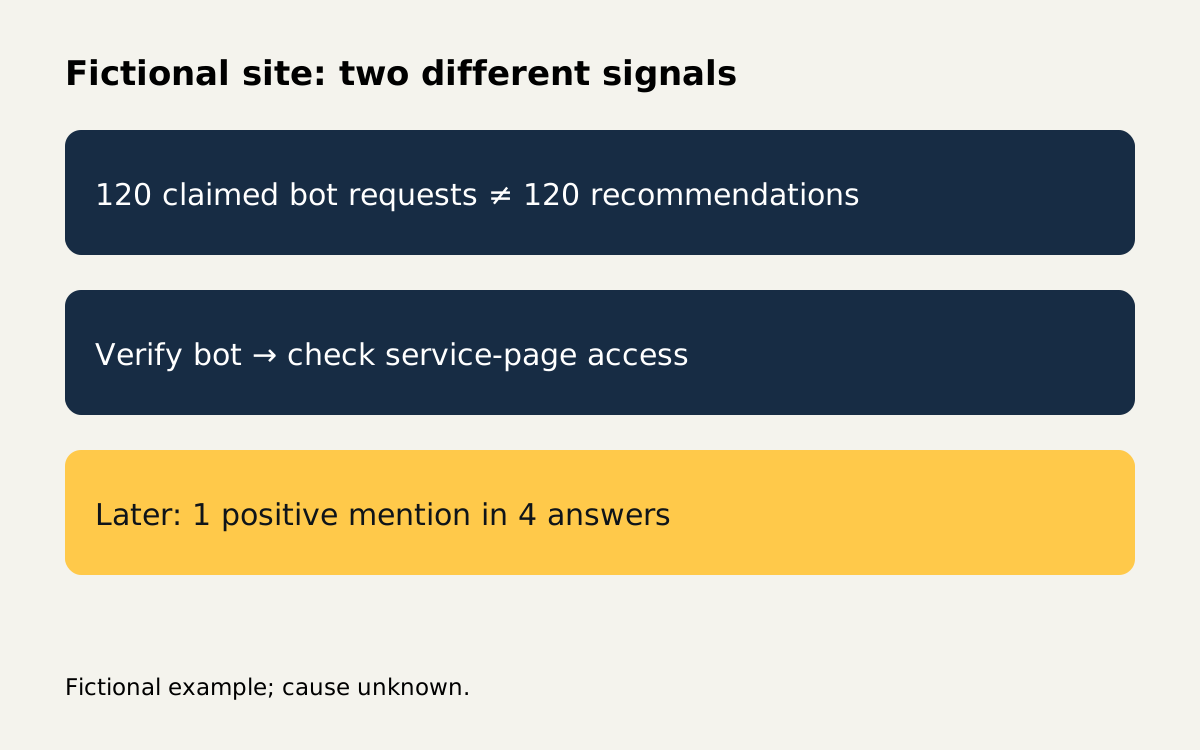
This is a hypothetical illustration, not a sayurname client or a measured result. Ridge Window Repair has four technicians serving one city and a public page about repairing leaks. The owner sees a dashboard claiming that an AI bot requested the homepage 120 times in a month and assumes the business should therefore be recommended. The team wants to find out what those numbers can establish without opening private customer records.
The team saves a baseline for one unbranded question about a leaking window in its city. In this invented run, none of four available assistants names Ridge positively; one links to the service page as a source, two name other businesses and one gives general advice. The source link is not a name in the answer. The log count and that one answer set describe different things; neither establishes the cause of the other.
- Record the exact customer question, city, language, date, assistants, visible search settings and complete responses. Mark a missing answer unavailable. Keep the number of available answers next to the number that name the business positively, and record source-only links separately.
- Ask the site operator for a limited log sample showing paths, times, response codes and claimed user agents. Avoid exporting patient records, credentials or unnecessary visitor data. Verify the suspected crawler against the provider’s published procedure and address ranges before attributing the traffic to it.
- Check the important service URL, not just the homepage. In the fictional sample, a robots rule allows the search crawler but a CDN rule returns 403 for that verified crawler on the service page. A separate training crawler has its own policy. The log establishes the observed response for that request; it does not prove the page would otherwise be selected.
- Have the owner decide which access is intended. If search access is desired, make a narrowly scoped CDN correction with the site operator and keep a rollback. Do not change the separate training preference merely as a side effect. Confirm the final response for the verified crawler using the provider’s supported verification method.
- Repeat the unchanged question on a regular schedule and save all available answers. In a fictional later run, one of four names Ridge positively. Keep any source-only link and unavailable result separate; a negative mention is not a positive recommendation.
- Review the configuration change, verified access and full answer series together. The change from zero to one name in two invented runs does not prove the CDN correction caused the name, establish a probability for every user or show a sale. Other pages, indexes, models and settings may have changed.
If the site deliberately restricts a crawler for a business, privacy or licensing reason, do not override that decision merely to increase a dashboard count. Ask whether a public subset or another documented route serves the purpose. A crawler identity and use can change, so consult the provider’s current documentation before editing the policy.
A positive name in an answer, a source link, an AI-referred visit recorded by connected analytics and a bot request are separate signals. Each can answer a different operational question. A log is useful for diagnosing access; it is not a reliable proxy for the business outcome.
Sources and verification
OpenAI describes its crawler purposes and verification information at https://developers.openai.com/api/docs/bots. Google explains the distinction between crawling and indexing at https://developers.google.com/search/docs/crawling-indexing/googlebot and documents noindex at https://developers.google.com/search/docs/crawling-indexing/block-indexing. Those documents are specific to each provider; check other providers separately instead of generalizing one rule.
Keep the actual request, the verification result, the relevant configuration and dates. If the claimed agent cannot be verified, label it unverified. If an assistant answer has no visible sources or cannot be obtained, record that limitation instead of inventing a link between a request and a recommendation. Compare only the questions and settings you can reasonably match.
How sayurname works
The free test sends one question to ChatGPT, Gemini, Perplexity and Claude and saves the available answers. After subscription, sayurname works on the questions, requests inclusion where sources offer a route and measures weekly. The monthly service is $299 without lock-in. A one-time $599 bonus can be charged for a new positive mention in an answer to a measured question where the business was absent at baseline, or an AI-referred visit recorded by connected Google Analytics during the service. A team member checks the evidence before billing. Neither outcome is guaranteed.
Questions
Does a verified crawler visit guarantee a recommendation?
No. It shows an observed request by a verified crawler; it does not establish what an assistant will say.
Are search and training crawlers necessarily the same?
No. OpenAI documents separate user agents for different purposes. Check the relevant provider’s current documentation and your own access preferences.
Does blocking a crawler make a page private?
No. Robots rules are not access control. Use appropriate authentication or other access controls for private content.
What should I measure alongside logs?
Save complete dated answers to comparable customer questions, recording names, source-only links and unavailable responses separately. Connected analytics can provide a different signal about visits.