
Published October 29, 2026
Does llms.txt help AI assistants recommend your business?
An llms.txt file is a proposed Markdown guide to a site, not a guarantee of discovery or recommendation. Its author describes a format for helping agents navigate information. Google says Google Search ignores llms.txt, including for its generative AI search features. Other products may behave differently, so check the documentation of the system you care about rather than assuming universal support. Clear, accessible and accurate pages remain useful regardless of whether a particular agent reads the file.
What the proposal actually describes
The llms.txt proposal describes a human- and machine-readable Markdown file that provides background, guidance and links to more detailed material. Its 2026 revision describes a file at the site root or under a path covering that section; it also discusses links to Markdown versions of pages. A file is public content, not a secret instruction channel. Its proposed conventions describe what an author may publish, not a binding obligation on every crawler or assistant.
A directory of links has value only if the linked material remains correct, accessible and maintained. A document may be useful to an agent that is explicitly directed to read it while having no role in another provider’s indexing or ranking. Identify the consumer and the task before spending time generating the file. Merely returning HTTP 200 for a URL does not prove that any assistant consulted it.
Separate Google Search from other consumers
Google’s own guide to generative AI features says Google Search ignores llms.txt and similar special files. The same guide says that special schema is not required for its generative search features. That is a statement about Google Search, not a universal statement about ChatGPT, Claude, every agent framework or every search provider. Do not extrapolate one provider’s documentation into a rule for all systems.
The proposal’s author documents a proposed format and examples, but publication by a documentation site does not establish that a particular assistant reads or weights the file when answering your buyer’s question. Look for provider-specific documentation or an observable, authorized access pattern. If a vendor has not documented a behavior, state that limitation instead of claiming either universal adoption or universal rejection.
What to fix before creating a directory
Start with the page a prospective customer needs: an accurate description of the service, where it is offered, its limits and a way to contact the business. Verify that the intended audience can reach the page and that an accidental login wall, robots rule, server error or conflicting canonical does not prevent the relevant discovery path. A public file pointing to a broken or outdated page does not repair that page.
Check dates and ownership of third-party references too. You can update your own site and controlled profiles, and you can ask an independent source to correct its listing. The request is an action you can track; an editor may refuse or ignore it. A precise source list and a log of what was actually changed are more useful than a promise that a new file will cause an assistant to recommend the business.
Worked example: a hypothetical repair business
This is a fictional example, not a sayurname customer or a measured case. Harbor Window Repair has four technicians serving one city. Its public service page describes window leaks, but an old profile lists a service area that the business no longer covers. The owner has three hours for this project and is considering an llms.txt file because a supplier promises that it will bring recommendations. Before changing anything, the owner writes one unbranded customer question and saves the complete available answers from four assistants.
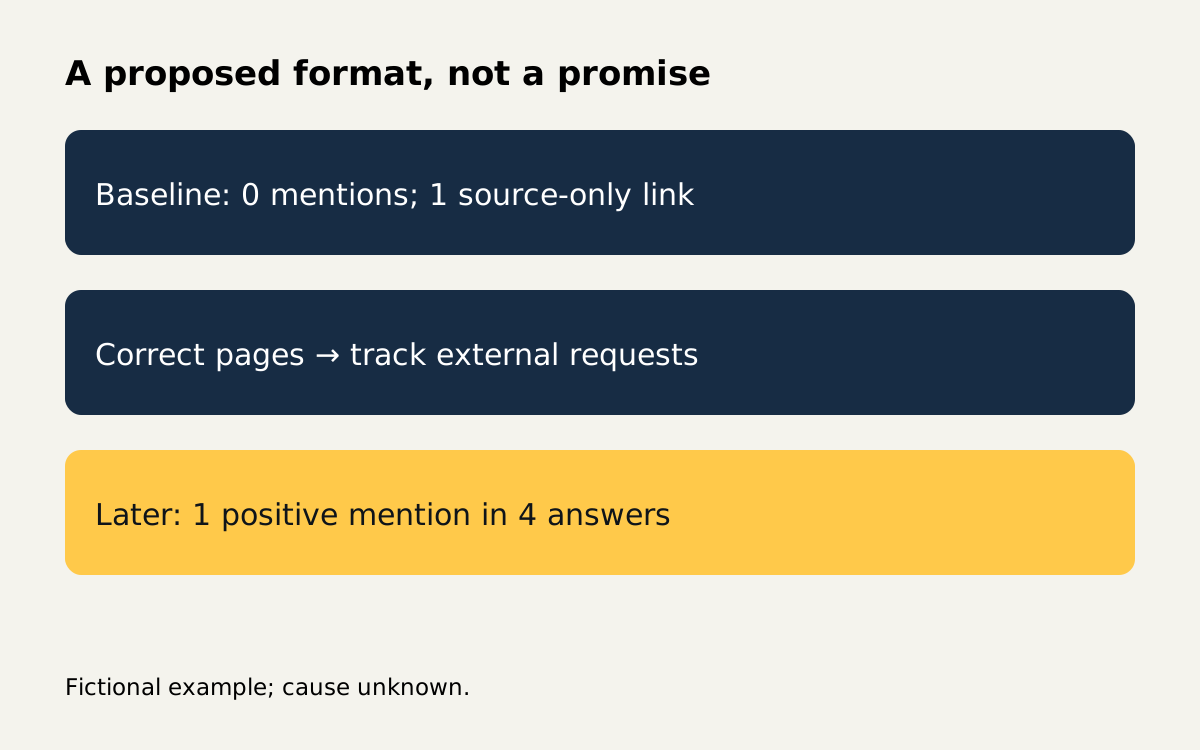
In the invented baseline, none of four available answers names Harbor; one answer links to the service page as a source and two mention competing businesses. The source-only link is not a name in the answer. These are observations for one question in one run, not a probability that Harbor will be absent for all users. They do not show which internal signals any assistant used.
- Record the exact question, date, assistant, full response and visible search settings. Keep unavailable answers separate rather than counting them as absences. If the question changes later, start a separate series with its own baseline.
- Check the service page as a customer would: confirm that it opens, that the location and repair offered are accurate and that an appointment path exists. Ask the owner to confirm the geographic boundary and what the team does not repair. Keep a dated copy of the previous page before making changes.
- Correct the outdated profile you control. If the incorrect listing belongs to a third party, send a correction request through its published channel and record the date and status. Do not claim the correction is live until the owner changes it.
- Decide whether an identified agent or documentation workflow needs a site map in the proposed format. If it does, create a short file that links only to relevant public pages, names an owner for updates and excludes private customer information. Do not add it solely because a salesperson guarantees a position in an AI answer.
- Ask the unchanged question again on a regular schedule and keep every complete answer. Suppose in a fictional later run one of four available assistants names Harbor positively. Save the source-only link and any unavailable result separately; a negative mention is not a positive recommendation.
- At review, compare the dated page change, listing request and answers. The later name is an observation in that run. The site edit, the external listing and other information could have changed together, so this simple before-and-after cannot establish which, if any, caused the result.
The owner may find the small directory useful for a specific agent while Google Search continues to ignore it. If no known consumer needs the file, or no one can keep it aligned with the site, the maintenance cost can outweigh the benefit. Check the provider’s current documentation again when the workflow or the specification changes.
Do not put credentials, unpublished customer information or access tokens in a public file. Do not promise that adding it will cause citation, and do not treat a server log entry alone as proof that a model used the contents in a response. If the service page is inaccessible or the business cannot serve the question honestly, fix that constraint first.
Sources and how to verify a claim
The proposal itself is at https://llmstxt.org/ and describes its scope and format. Google’s explanation is at https://developers.google.com/search/docs/fundamentals/ai-optimization-guide and concerns Google Search’s generative features. These sources answer different questions: one proposes a convention, the other describes one provider’s behavior. Read both before claiming that an llms.txt file is required or ignored everywhere.
A small before-and-after check is useful operational evidence, but it is not a controlled experiment: models, indexes, settings and other pages can change at the same time. Save the question, dates, complete responses, available settings and a record of changes. Report the number of available answers beside the number of positive names and avoid attributing a change to the file without stronger evidence.
How sayurname works
The free test sends one question to ChatGPT, Gemini, Perplexity and Claude and saves the available answers. After subscription, sayurname works on the questions, requests inclusion where sources offer a route and measures weekly. The monthly service is $299 without lock-in. A one-time $599 bonus can be charged for a new positive mention in an answer to a measured question where the business was absent at baseline, or an AI-referred visit recorded by connected Google Analytics during the service. A team member checks the evidence before billing. Neither outcome is guaranteed.
Questions
Does Google Search use llms.txt for AI Overviews?
Google says Search ignores llms.txt and similar special files, including for its generative AI search features. Check Google’s current guide for any later change.
Does that mean no AI product ever reads the file?
No. Google’s statement is about Google Search. Another tool or an agent explicitly directed to the file can behave differently; verify the relevant provider and workflow.
Will a file guarantee a recommendation?
No. A proposed directory of pages does not control an independent assistant’s answer or guarantee that it is read.
When should a business skip it?
When no known workflow needs it, the linked pages need correction first, or nobody can maintain the file. Never publish private data in a public file.