
Published October 30, 2026
Does schema markup help AI assistants recommend your business?
Structured data can describe facts on a page in a vocabulary that software can interpret, but adding it does not guarantee that an assistant will recommend a business. Google says no special schema.org markup is required for its generative AI search features. That statement concerns Google Search; other products may use information differently. Start with accurate visible information, use markup that matches it, validate the page and measure answers without assuming causation.
What the markup is for
Schema.org is a shared vocabulary for describing entities and relationships. A website can express some of that information as JSON-LD in the page: for example, the name and website of an organization or details of a local business. The vocabulary is not itself an instruction that a model must recommend the business. Structured data is one representation of information; the visible page must still communicate the actual offer to a person.
Google documents how it can use supported structured data for eligible search features and recommends that markup match the page content. Different consumers may support different types and properties. A syntactically valid block can still be incomplete, inconsistent or ineligible for a particular feature. A validator can detect some problems, but a green result is not proof that a model will choose the business in an answer.
What Google does and does not promise
Google’s current guidance for AI Overviews and AI Mode says no special schema.org markup is necessary to appear in those features. Its general structured-data guidelines also say that even valid markup does not guarantee a rich result. These claims describe Google Search, not every assistant, model or search provider. Do not turn a provider-specific statement into a universal claim that every system ignores structured data.
A search feature, a citation link, a business name in a generated answer and a visit recorded in analytics are different observations. A site can have correct markup without being named, and a named business does not prove that markup caused the name. Keep the question and full response to understand what was actually shown, and record unavailable answers separately.
Prioritize correctness over adding fields
Before touching code, confirm the business name, service, address or service area, contact method and any dates with someone who can verify them. Make those facts clear in the visible page and correct outdated controlled profiles. Then choose the applicable vocabulary and include only information the page actually supports. Do not invent ratings, locations or certifications to fill fields; a richer-looking block that contradicts reality is not an improvement.
Use an appropriate schema validator to check general syntax and Google’s Rich Results Test when evaluating eligibility for a supported Google feature. Inspect the page that users and crawlers receive, not just a code snippet in a document. A test result is a diagnostic, not a guarantee of indexing, display, recommendation or new customers. Keep the deployed version and its date so the team can identify what changed.
Worked example: a fictional repair business
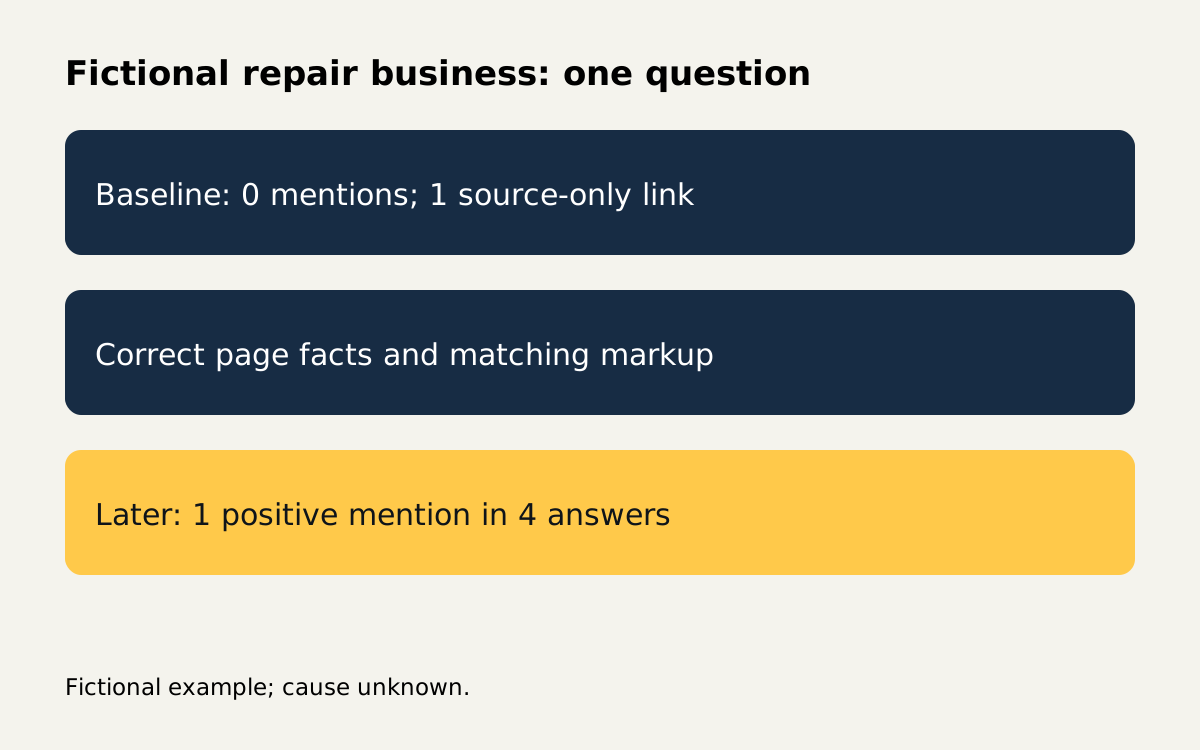
This is a hypothetical example, not a sayurname client or a measured case. North Pier Appliance Repair has four technicians in a single city. It repairs washing machines but does not sell appliances. Its service page shows the correct phone number; its existing organization markup contains an old number and incorrectly describes the company as an appliance store. The owner has two hours to verify the facts and wants to know whether correcting the markup will make assistants recommend the business.
First the owner records a baseline for one unbranded question about washing-machine repair in the city. In the invented run, none of four available answers names the company. One links to the service page as a source and two name competitors. The source link is not the company name in the response. These observations describe this question and run; they do not prove which source or page element drove any assistant’s answer.
- Write the exact customer question, city and language. Save every available full response, the date, assistant and visible search settings. Mark a failure as unavailable; do not count it as an absent name or remove it from the denominator without explanation.
- Ask the owner to confirm the current legal and trading names, contact number, service area and actual work. Compare the visible page with the JSON-LD and the controlled profiles. Record the mismatch and save a copy of the deployed page before changing anything.
- Correct the old contact information and remove the unsupported store description from the markup. Keep the visible service page and structured data consistent. If an external directory also has the wrong number, request a correction using its published process and record the request separately from its eventual acceptance.
- Run a general schema validator and, where applicable, the Rich Results Test on the actual page. Investigate any reported issue in context: a warning for an optional property is not the same as evidence of a wrong business fact, and eligibility is not a promise of a displayed feature.
- Repeat the unchanged question over several weeks, keeping full answers and visible settings. In a fictional later run, one of four available assistants names North Pier positively. Save the answer, links and other responses; a source-only link is not a positive name in the answer, and a negative mention does not count as a positive recommendation.
- At review, compare the dated page change, directory request and all saved answers. One new name is an observation, not proof that markup caused it. Other pages, search systems or model settings may have changed. If the correct number matters for urgent customer contact, update the site and profiles immediately rather than waiting for an AI measurement.
The example shows why a known mismatch deserves correction even without a proven effect on recommendations: it can mislead people and software that reads it. If no consumer needs the additional structured property or the team cannot maintain it, do not invent complexity merely to satisfy a checklist. Keep the underlying page correct first.
A source link or crawl entry does not disclose every internal signal used by an assistant. A before-and-after comparison is useful operational evidence, but it is not a controlled causal experiment. Keep the denominator of available answers and avoid attributing a result to one technical change without stronger evidence.
Sources to check before making a claim
Google’s guide to AI features is at https://developers.google.com/search/docs/appearance/ai-features and its structured-data guidelines are at https://developers.google.com/search/docs/appearance/structured-data/sd-policies. Schema.org describes its vocabulary at https://schema.org/. These sources have different scopes: a vocabulary defines terms; a provider documents which features it supports. Recheck their current versions before telling a client that a field is required.
Google’s Rich Results Test addresses supported Google features; the Schema Markup Validator checks general Schema.org markup. Neither answers whether every AI product uses a block or whether a particular response will name a company. Maintain a dated record of the page, tests and observed answers rather than treating a validator badge as a business outcome.
How sayurname works
The free test sends one question to ChatGPT, Gemini, Perplexity and Claude and saves the available answers. After subscription, sayurname works on the questions, requests inclusion where sources offer a route and measures weekly. The monthly service is $299 without lock-in. A one-time $599 bonus can be charged for a new positive mention in an answer to a measured question where the business was absent at baseline, or an AI-referred visit recorded by connected Google Analytics during the service. A team member checks the evidence before billing. Neither outcome is guaranteed.
Questions
Does Google require special schema for its AI search features?
Google says no special schema.org markup is required for AI Overviews or AI Mode. Normal search requirements and policies still apply.
Does a valid markup test guarantee a recommendation?
No. Validation is a diagnostic; it does not guarantee indexing, display or a business name in an assistant’s answer.
Does Google’s guidance apply to every AI provider?
No. It describes Google Search. Check the specific provider and workflow before making a broader claim.
What should I fix first?
Correct facts in the visible page and controlled profiles, then align any useful markup. Do not add properties that the business cannot substantiate.