
Published November 2, 2026
Can telling ChatGPT about your business make it recommend you to others?
Telling ChatGPT about your business can help it answer in that conversation, but it is not a reliable way to publish your business information to other people or guarantee a recommendation. Saved memory, when enabled, is an account-personalization feature rather than a public business listing. Product and data controls can differ, so check the relevant settings and documentation; do not assume a private correction becomes a verified fact in another person’s answer.
Context, memory and publication are different
A conversation can contain the facts, documents and instructions you provide for the task at hand. Depending on the product and your settings, relevant saved memory may also help personalize later conversations for your account. That is useful for drafting or checking your own material, but it is different from publishing a public page or being listed in a search index. Another person’s question is not a continuation of your private conversation.
Do not infer the provider’s training or retention rules from whether memory is enabled. Those are separate product and account controls, and they can vary by service. Even where data may be used to improve a system under applicable settings, a single chat is not an editable business profile and does not give you a promised route to change a future answer for everyone. Consult current provider documentation before entering sensitive information.
Why correcting one reply is not a public update
When an assistant gives the wrong address, correcting it in the same chat can make the next response reflect what you just supplied. That is a useful conversational correction, not evidence that the underlying public source changed or that another user will see the new address. A saved memory may change your own later experience if enabled; it is still not the same artifact as a public page controlled by the business.
If the same error matters to customers, verify the correct fact with the business, update the current page and profiles you control, and ask independent sources to correct their listings where they offer a process. Record the request and its outcome. A request is not acceptance, and a visible source in one response does not show the model’s complete decision process. An old article can be historically accurate without describing the current service.
Use a fresh check carefully
A fresh conversation can help inspect what an assistant says without the facts supplied earlier in that same thread. It is still a sample: account memory, location, settings, search availability and the provider’s systems can affect the result. Record what is visible and avoid claiming that a single answer represents all users. For a discovery test, ask an unbranded customer question; a question containing your name is useful for identity diagnostics but answers a different question.
Save the exact wording, date, assistant, visible settings and complete response, including available source links. Separate a business name in the answer from a site linked only as a source. Record an unavailable response as unavailable; a negative mention is not a positive recommendation. Repeat a comparable question over time and keep changes to the question or settings visible in the record.
Worked example: a hypothetical local studio
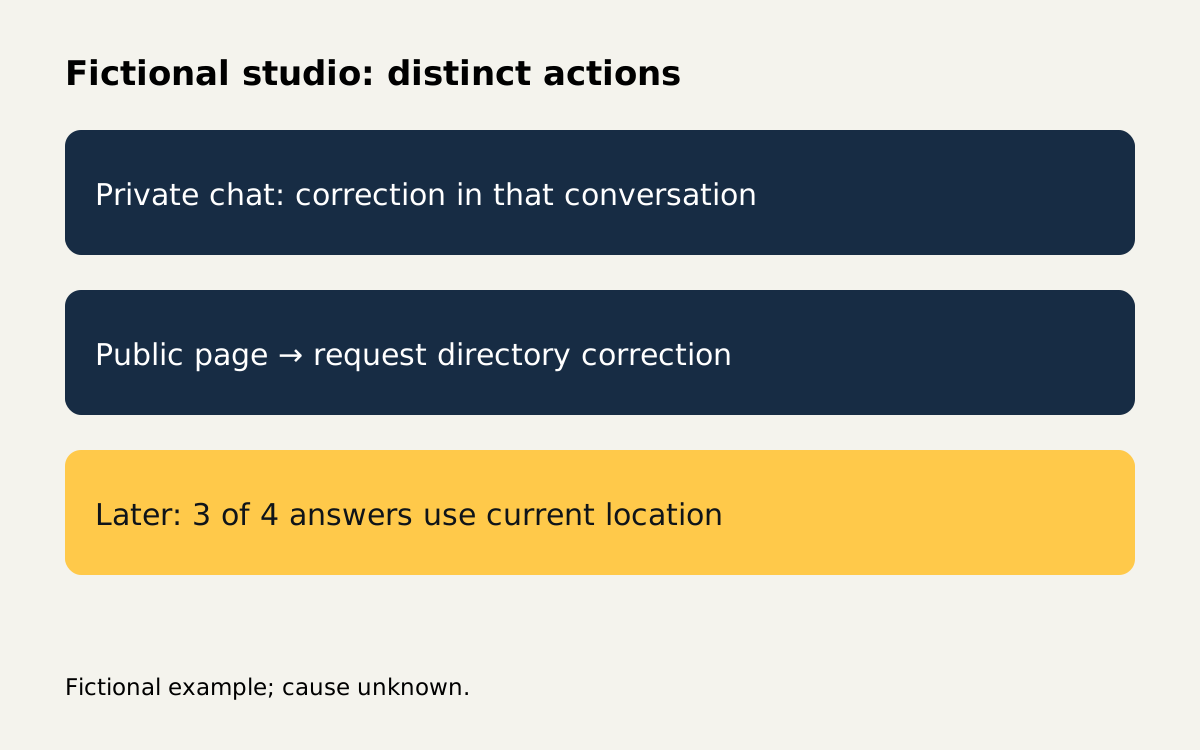
This example is fictional, not a sayurname client or a measured outcome. North Lane Pilates operates in one city and stopped offering a class at a second location on January 1. The owner asks an assistant about the studio in a private chat, sees the old location and types the correct address. The assistant’s next reply uses the correction. The owner wants to know whether a new customer will now receive the same answer.
For the example, the owner records a named diagnostic question and a separate unbranded question about Pilates in the city. In an invented initial run, two of four available answers to the named question contain the old location, one is correct and one is uncertain. A source linked in one answer shows an old directory entry. These are observations in that run; the link is a lead, not proof that it was the only source used.
- Save the original question, the complete available responses, the dates, assistants and visible search settings. Keep the private corrected conversation separate from the fresh diagnostic series. Do not count an unavailable answer as proof that the address was wrong or absent.
- Confirm the operating address, the date of the location change and the current class schedule with the studio. The person accountable for the business must establish the facts before a writer or agency repeats them. Avoid including private customer details in the prompts or public pages.
- Inspect the studio’s own site and controlled profiles. In the fictional example, one active page still advertises the former location, while a dated historical announcement accurately describes the past. Correct the active page and mark the announcement as historical rather than pretending the old location never existed.
- Open the external directory linked in the answer, check whether it really contains the old address and use its correction process. Save the URL, request date and reply. Do not mark the correction complete until the directory changes it; the owner may decline or take time to act.
- Repeat the same named question in fresh conversations over several weeks. In a fictional later run, three of four available answers use the current location and one remains uncertain. Save all responses, including the uncertain one, and record visible changes to model or search settings.
- Review the public changes, directory status and answer series together. The improved run does not prove which action caused the change or guarantee what the next customer sees. Evaluate the unbranded discovery question separately: it cannot be combined with the named identity question as though both measured the same thing.
The private chat was useful for preparing and checking a correction. The public site and the requested directory change are different pieces of work with their own owners and status. If the directory does not update, keep the request open and make the correct information easy for customers to find on the studio’s site.
Do not upload private customer records or credentials just to make an assistant describe your business. If the fact affects a legal, safety or financial decision, correct the customer-facing channels and contact the responsible person promptly; do not wait for a weekly measurement to reduce a potentially harmful error.
Where to verify the boundaries
OpenAI’s documentation on memory controls is at https://learn.chatgpt.com/docs/customization/memories and its crawler documentation is at https://developers.openai.com/api/docs/bots. These pages cover different subjects: personalization settings are not a public listing, and a crawler policy is not proof that a response used a page. Check the current settings and relevant product documentation rather than assuming all accounts, providers and plans behave identically.
When you test a fresh conversation, note any relevant limitations you can observe. A clean thread is useful for avoiding instructions from the previous thread, but it does not necessarily remove account-level personalization, location or changes in the provider’s system. Document the sample instead of claiming that a single test reproduces every customer’s experience.
How sayurname works
The free test sends one question to ChatGPT, Gemini, Perplexity and Claude and saves the available answers. After subscription, sayurname works on the questions, requests inclusion where sources offer a route and measures weekly. The monthly service is $299 without lock-in. A one-time $599 bonus can be charged for a new positive mention in an answer to a measured question where the business was absent at baseline, or an AI-referred visit recorded by connected Google Analytics during the service. A team member checks the evidence before billing. Neither outcome is guaranteed.
Questions
Does a correction in my chat publish the corrected fact?
No. It can affect that conversation, but it does not by itself update your public site or another organization’s listing.
Does saved memory guarantee that other people see my information?
No. Memory is a personalization feature for the account and product. It is not a public listing or a guarantee about another person’s answer.
Should I upload customer records to describe my service?
No. Use verified public business facts and avoid sending private customer information or credentials for this purpose.
Can I use a fresh chat as a test?
Yes, as one observation. Save the full answer and visible settings, keep branded diagnostics separate from unbranded discovery questions, and repeat comparably.