
Published October 29, 2026
How to prepare your business for purchases made with AI agents
Start with an accurate offer that a person and software can inspect: the seller, product or service, current price, availability, delivery, cancellation and the next step. Test the actual purchase path rather than assuming an agent can use it. Different assistants and merchant integrations have different capabilities; checkout can require a supported integration and customer authorization. None of this guarantees that an assistant will recommend or sell the product.
Separate discovery, comparison and checkout
A customer may ask an assistant to find a product, compare options, open a merchant page or help complete a purchase. Those are different stages. A page can be discoverable but lack current availability; a product can be visible in an assistant while checkout still happens on the merchant’s site. Decide which stage you intend to improve before buying a technical solution. A source link, a referred visit and a completed purchase are not the same business event.
Do not assume every assistant can book every service, submit a form or pay on a customer’s behalf. Capabilities depend on the product, merchant integration, geography, account settings and customer authorization. Test the particular supported flow using an authorized account and a sandbox or other no-charge method. A successful demonstration in one product is not proof of universal support, nor should a simulated confirmation be reported as a real sale.
Make the offer verifiable before adding integrations
A useful offer identifies the seller, exact product or service, price and currency, what the price includes, availability, delivery area or appointment terms, and the cancellation or return policy. If price depends on inspection, say what changes the quote and how the customer obtains it. An assistant should not have to infer an unlisted fee or a service you no longer offer. Clear information is useful to a person even when no agent reads the page.
Compare the product page, checkout and any structured feed. If one says the item costs $80 and another says $100, the discrepancy can produce an incorrect comparison or failed checkout. Decide which system is authoritative for inventory and assign an owner for updates. Machine-readable data is useful when it matches the offer the customer can actually accept; adding more fields is not a substitute for verifying them.
Treat each integration as a specific contract
OpenAI’s Agentic Commerce documentation describes product feeds and a checkout protocol. It says building with the protocol is open, while Instant Checkout in ChatGPT is available to approved partners. A feed can describe items, price, availability and seller; it is not a universal switch that activates checkout for every merchant or product. Check current requirements and eligibility before planning a launch. Other providers can have different arrangements.
For any platform, ask who receives the order, which system controls price and stock, how payment is confirmed and what happens if a reservation expires. Keep the integration’s error messages and test the response to inventory changing during checkout. The merchant still needs a workable fulfillment and support process. An assistant’s ability to retrieve a page does not establish that an order was accepted, paid or delivered.
Keep consent and recovery visible
Before a real payment or booking, the customer needs to inspect the item, total, timing and applicable terms and authorize the consequential action in the supported flow. Do not infer consent merely because someone asked for suggestions. Never put credentials or customer records on a public page to make an offer easier to read. An inaccessible cancellation policy is a problem for people as well as automated tools.
Plan for unavailable stock, an expired reservation, a declined payment and a duplicate request. Assign an owner to reconcile the merchant’s records and provide a customer contact. Distinguish an agent’s suggestion from an authorized transaction and an order confirmation from successful delivery. If a transaction requires a human review or appointment, explain that step rather than presenting it as an instant purchase.
Worked example: a fictional bicycle shop
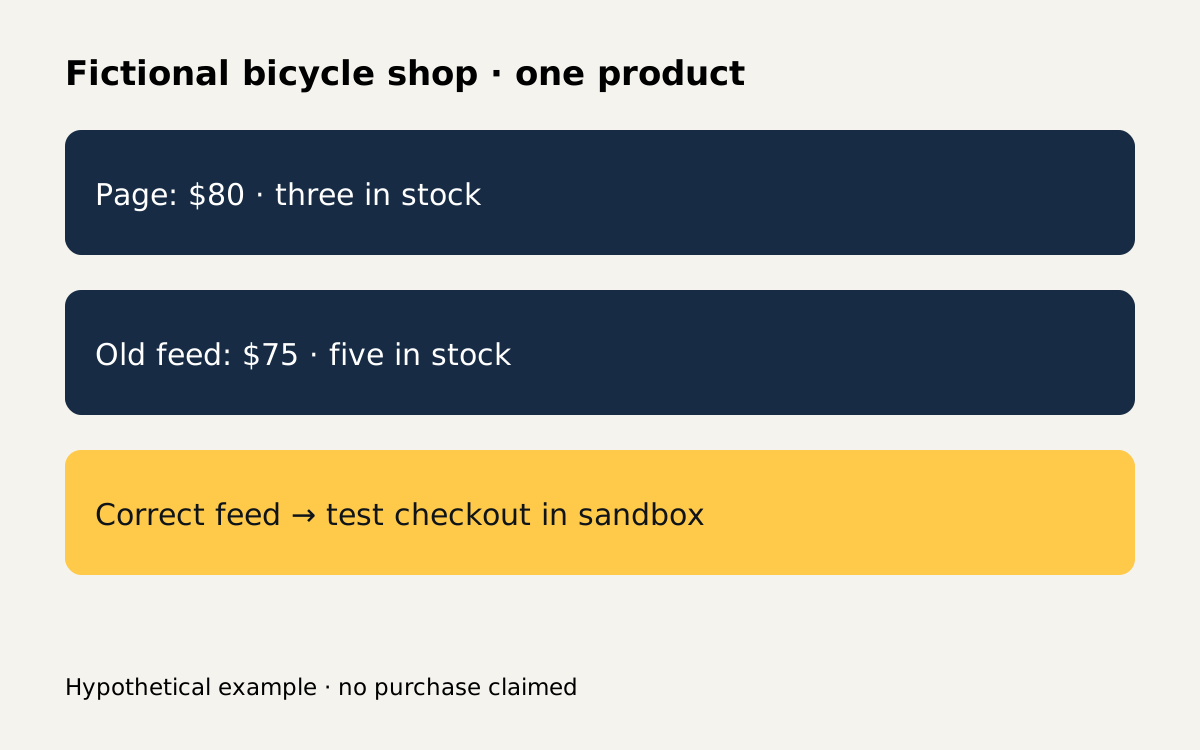
This example is hypothetical, not a sayurname customer or a measured result. North Quay Bikes sells one commuter helmet in a city. Its product page lists a medium helmet for $80, with three units available, local collection in two business days and returns within 30 days. A feed exported the previous evening still lists $75 and five units. The owner wants to know whether a shopper using an AI-assisted flow can compare and buy without seeing stale information.
The owner runs a test with a sandbox account and no real charge. In this invented example an assistant finds the product page, while the chosen integration displays a different price during checkout. Save the page, feed snapshot and test time before correcting the catalogue. The observations below do not claim that a real platform has accepted this merchant or that the same result will occur for every assistant.
- Document the product identifier, seller, current price, currency, stock, collection window and return policy. Confirm each with the catalogue owner. Keep customer names, payment credentials and other private data out of public pages and test notes.
- Compare the visible page, feed and checkout at the same time. In the fictional example the page says $80 and three units while the feed says $75 and five. Identify the source of truth; do not silently choose whichever figure produces the better-looking answer.
- Correct the feed to match the merchant catalogue and check the integration’s update process. Verify when the receiving system actually reflects the change. Uploading a file alone does not prove a platform accepted, indexed or displayed it.
- Run a second sandbox test with the same product in a fresh session. Verify seller, item variant, total and collection terms before simulated confirmation. If stock changes during the test, check that the customer is informed and can stop or revise the order.
- Simulate an expired reservation and a repeated submission. The store’s order system should let the team inspect whether one order, no order or a duplicate was created. Document the result and the recovery owner; do not claim the assistant caused a sale.
- Keep dated snapshots, integration messages and test outcomes. If the merchant is not eligible for an embedded checkout, direct the buyer to the ordinary merchant flow and test that path. Review the experiment when product details, provider requirements or availability change.
The example diagnoses an inconsistent offer and a specific sandbox flow. It does not prove that a feed correction changed a recommendation, that every assistant can purchase or that a real customer placed an order. To evaluate a business outcome, inspect actual authorized orders separately from any saved assistant answer or AI-referred visit.
Do not automate a consequential step while stock, price or consent is uncertain. If a business sells a custom service requiring human assessment, a clear request-for-quote path may be more appropriate than pretending there is a fixed instant checkout. Fix the offer and support process before adding a new integration.
Sources and what they establish
OpenAI describes product feeds and the scope of its Agentic Commerce Protocol at https://developers.openai.com/commerce/guides/key-concepts and product-feed requirements at https://developers.openai.com/commerce/specs. These are provider-specific documents; they do not establish that every assistant supports the same checkout or that every merchant has access. Recheck current eligibility and requirements before committing development work.
For a public page, Google’s guidance on helpful, reliable information is at https://developers.google.com/search/docs/fundamentals/creating-helpful-content. It supports making the offer useful to the intended person; it does not guarantee a recommendation by ChatGPT or another assistant. Keep evidence of your own test and the actual terms shown to the customer.
How sayurname works
The free test sends one question to ChatGPT, Gemini, Perplexity and Claude and saves the available answers. After subscription, sayurname works on the questions, requests inclusion where sources offer a route and measures weekly. The monthly service is $299 without lock-in. A one-time $599 bonus can be charged for a new positive name in a measured answer where the business was absent at baseline, or an AI-referred visit recorded by connected Google Analytics 4 during the service. A team member checks the evidence first. Neither outcome is guaranteed.
Questions
Can every AI assistant buy or book for my customer?
No. Capabilities and access depend on the assistant, merchant, integration, location and customer authorization. Test the specific supported flow.
Does an accurate product feed guarantee a recommendation?
No. A feed can provide current product facts to a supported integration, but it does not control an independent assistant’s answer.
Should I expose private customer data to an agent?
No. Publish only information intended to be public and use the integration’s authorized flow for sensitive or transactional data.
What if I sell a service without a fixed price?
Explain what affects the quote, the service area and how a person can request an assessment. Do not invent a fixed price to enable automation.
Is Instant Checkout in ChatGPT available to every merchant?
OpenAI’s documentation says Instant Checkout is available to approved partners; verify current eligibility and integration requirements.