
Published October 28, 2026
Share of model: what an AI answer sample can actually tell you
Share of model is a measurement label, not a standard built-in assistant metric. Define a set of customer questions and assistants, save the answers, and calculate the share of available answers in which a specified business is named positively. Always report the numerator, denominator, dates and rules. A source-only link, an AI-referred visit and a business name are different signals; none alone measures every user's experience or proves a sale.
Define the unit before calculating
A useful version of share of model asks: in how many available answers from this defined sample was a business named positively? The numerator is the number of answers meeting that rule; the denominator is the number of answers actually obtained and reviewed. Divide the numerator by that denominator. The result describes the sample you collected, not the share of all conversations, the percentage of people who saw the brand, or a platform-provided market share.
An answer may name several businesses, so different companies' shares can add up to more than one hundred percent. A business named twice in the same answer still counts once under this answer-level definition. A link in a source list without a positive business name is a separate observation. A criticism or a neutral passing mention should not silently become a recommendation; write your classification rules before looking at the results and have a person review ambiguous cases.
Build a question set that reflects real choices
Select unbranded questions that prospective customers might actually ask, with clear service, location and language where relevant. Include several relevant needs rather than repeating a single favorable phrase. Record the exact wording and the reason for including each question. A question asking only about a brand's name measures a different thing from a customer comparing providers without mentioning that brand.
Record the assistant and available settings, the date, language, location context and whether search was enabled or visible. Assistants can change answers between runs, and products may personalize or use different sources. A small sample is a directional observation, not a statistically representative panel. Do not compare two periods as equivalent if you changed the questions, assistants, collection procedure or definition without explaining the change.
Keep the observations separate
For every question and assistant, retain the complete response and a stable record of the collection context. Code positive names, neutral or negative names, source-only links and unavailable responses separately. If an assistant refuses a question or the response cannot be saved, mark it unavailable; do not quietly count it as an answer without a name. Privacy and account settings matter, so remove unnecessary customer information before retaining the record.
A source link can point to a page that supports an answer without the assistant recommending its owner. Conversely, an answer can name a business without visibly citing it. A session recorded by connected analytics is evidence of a visit under that property's collection rules, not evidence of a particular answer. Counts of names, links and visits answer different questions and should never be added together as though they were the same unit.
Worked example: a fictional appliance repairer
This example is hypothetical, not a sayurname client or a measured result. A local appliance repairer wants to learn whether it appears in answers to people looking for washing machine repair. The owner chooses four customer questions and asks each of two assistants once using a recorded language and city. The planned sample is eight question-and-assistant observations; one assistant is unavailable for one question.
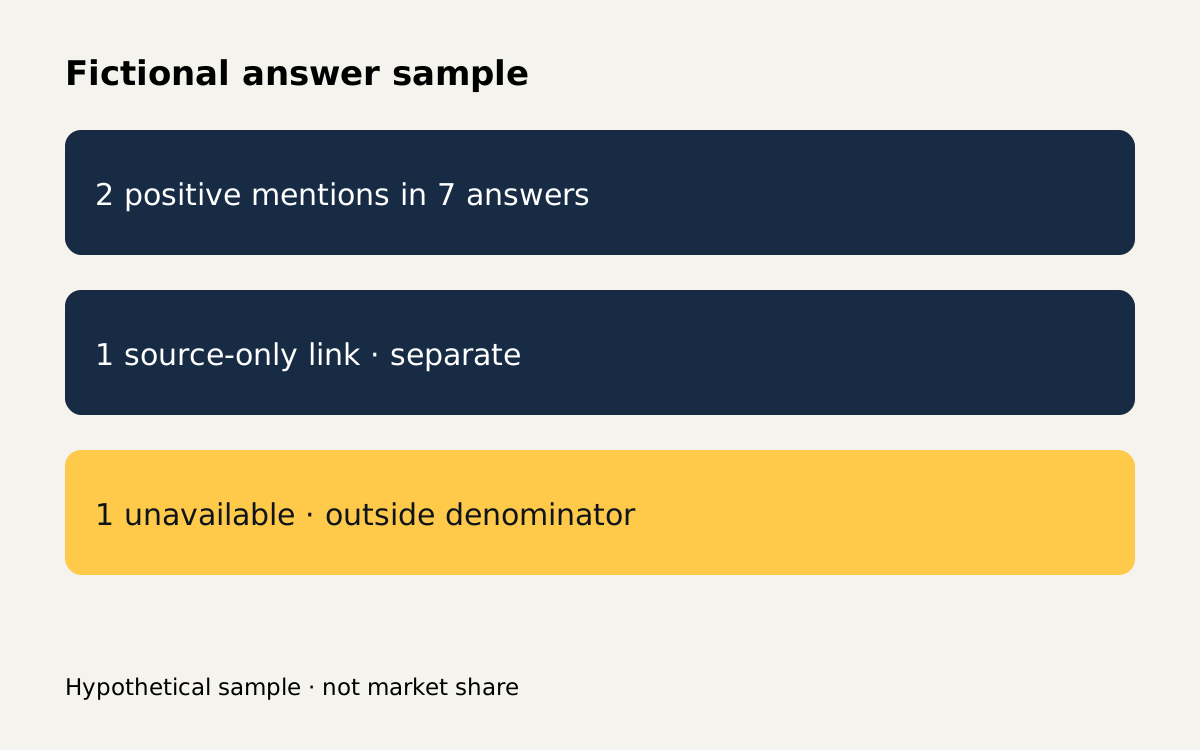
A human reviews the seven available complete answers. Two name the repairer positively, one links to its page without naming it positively, and four other answers do not meet the positive-name rule. Under the chosen definition, the sample share is two out of seven available answers, about twenty-nine percent. The source-only answer stays outside the numerator, and the unavailable eighth answer stays outside the denominator. These numbers are invented to illustrate the calculation.
- Write four realistic unbranded questions, the local service area, language, two assistants and collection date. Save the planned eight observations before running the questions so the sample is not selected after seeing favorable results.
- Collect and retain the full available answers with relevant settings. Mark the one unavailable observation separately, along with a reason if known. Do not substitute a different assistant or silently call the unavailable result a negative answer.
- Have a person apply the same rule to each answer: positive business name, neutral or negative name, source-only link, and no name. Resolve ambiguity using the complete context, preserving the original answer rather than editing it to fit a category.
- Calculate two divided by seven and show the underlying counts alongside the rounded percentage, the dates and the missing observation. If another business is also named in either answer, it can receive its own count; the shares need not sum to one hundred percent.
- At the next review, repeat the same questions and collection settings as closely as practical. Explain any changes and show the new numerator and denominator. If the result rises, do not claim that an intervening edit caused the rise without stronger evidence or that every customer now sees the same answer.
If only one or two answers are available, if questions do not match the services offered, or if no one can review the underlying responses, do not advertise a precise percentage as market share. Record the individual observations and improve the sample first. A precise-looking number can hide a weak or inconsistent denominator.
Track referrals or bookings in their own systems if those outcomes matter, respecting the limits of their collection. A positive name is neither a source citation nor a visit, and none of the three establishes revenue. Explain this distinction to anyone using the sample to decide where to invest.
Sources and reporting checklist
Google defines session acquisition dimensions in its GA4 Traffic acquisition documentation at https://support.google.com/analytics/answer/12923437. That report concerns recorded sessions and is not a source of assistant-answer share. For the answer sample described here, the numerator, denominator and coding rules are an explicit working definition created for the exercise, not a standardized statistic issued by the assistants.
Publish the question list or a useful summary, assistants, dates, location and language, collection conditions, coding rules, number of unavailable observations and both counts. Retain full responses for human review. If the sample is too small or inconsistent, say so and avoid generalizing beyond it. Repeating a transparent procedure is more useful than selecting an impressive percentage without its denominator.
How sayurname works
The free test sends one question to ChatGPT, Gemini, Perplexity and Claude and saves the available answers. After subscription, sayurname works on the questions, requests inclusion where sources offer a route and measures weekly. The monthly service is $299 without lock-in. A one-time $599 bonus can be charged for a new positive name in a measured answer where the business was absent at baseline, or an AI-referred visit recorded by connected Google Analytics during the service. A team member checks the evidence first. Neither outcome is guaranteed.
Questions
Is share of model an official platform metric?
Not under this definition. It is a label for a defined sample calculation; explain your method and denominator.
Do shares for competing businesses have to add up to one hundred percent?
No. One answer can positively name more than one business, so each can be counted in that answer.
Does a source link count as a positive name?
Not in this definition. Record source-only links separately and review the answer's wording.
Does a larger share prove more sales?
No. A sampled answer and a sale are different observations; a before-and-after comparison also does not establish causation.