
Published November 17, 2026
Should a law firm publish its fees so AI can quote them?
Yes, for matters the firm can price in advance: one statement per defined matter, with a range, what it includes, what is extra and what moves the price, dated and reviewed. Without a figure, an assistant quotes a directory’s average or names a firm that published one. Publish only a number the firm can hold, check your regulator’s rules on fee advertising first, and promise no outcome. This is general information, not legal advice.
The question is about money, and a page without a figure loses it
Before “whom should I call?”, many people ask an assistant “how much does a lawyer cost for this?”. The assistant answers with what it can find: a range from a directory, a figure from a firm that published one, or a refusal to give a number. A page that says “contact us for a quote” gives it nothing to repeat, so the firm does not appear in that answer even when it is the right firm for the matter.
The firm that publishes a clear range does not become the cheapest. It becomes the one the assistant can describe without guessing. A figure is a fact the assistant can repeat, and a fact with a date and a scope is more likely to be repeated as written.
What a quotable fee statement contains
One matter per statement, defined narrowly enough that two clients would agree on whether they are inside it: “a letter before action for an unpaid invoice up to £10,000”, not “debt recovery”. Then the range, how it is billed (fixed, capped or hourly), what it includes, what is extra, and what would push the price up or out of the range.
Add the date it was last reviewed and who reviewed it. An old figure repeated by an assistant for two years is a wrong fact with the firm’s name on it, so the review date is not decoration. It is how the firm keeps its own page true.
Write it the way a partner would say it to a caller, in two or three sentences, and keep the longer terms below it. An assistant tends to quote the first clear statement it finds, so the short version goes first and has to be complete on its own.
What to leave out
A lone “from £250” with no scope is the figure most often quoted out of context. Leave out “affordable”, “competitive rates” and “no hidden fees”: nothing in them can be repeated as a fact. Leave out any phrase that suggests an outcome, or that the fee depends on winning, unless your regulator allows that arrangement and a lawyer at the firm has approved the wording.
Do not publish an hourly rate alone either. “£220 an hour” answers a question nobody asked. People want to know what the whole thing costs, so pair the rate with an example of a typical total, flagged as an example, and with what would make it larger.
And do not publish a figure you would not honour on the phone. The page is a quote that an assistant keeps repeating long after the partner who wrote it has forgotten it.
A worked example, step by step
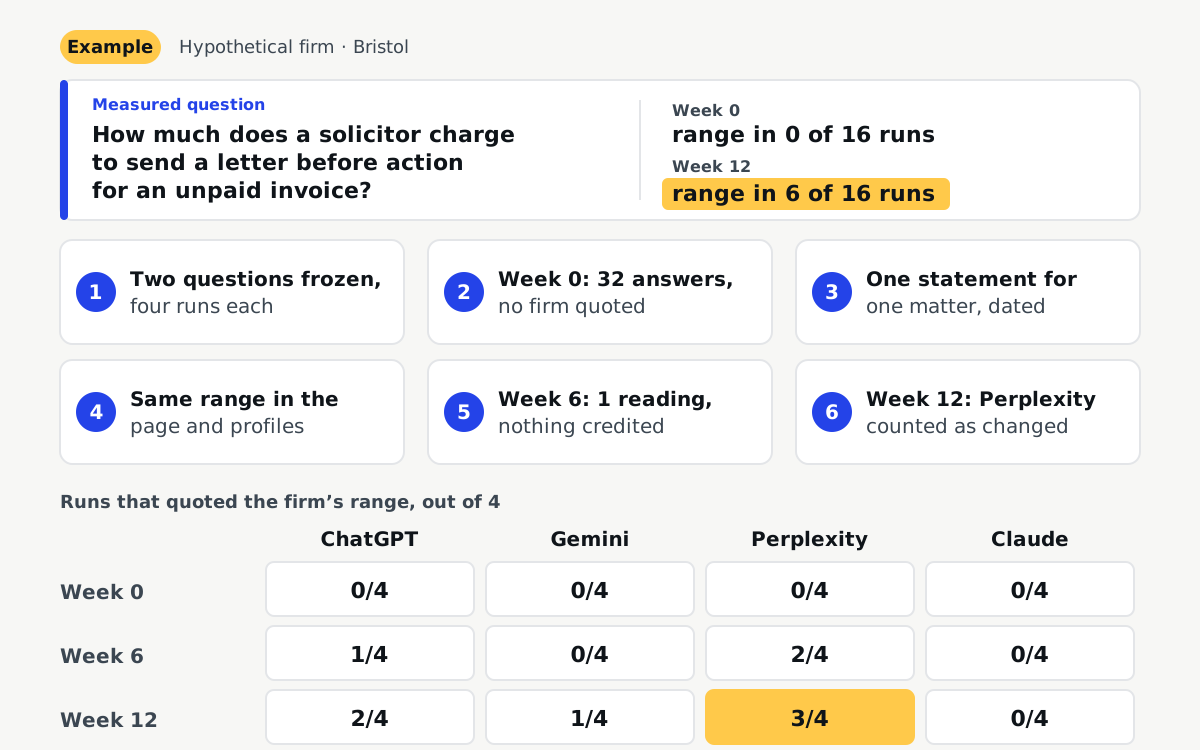
Example: a hypothetical firm, not a sayurname client. Kestrel Law is an invented four-lawyer firm in Bristol that acts for small businesses. Its fee page said “contact us for a quote” and “competitive rates”. The measured question was “How much does a solicitor charge to send a letter before action for an unpaid invoice?”.
The firm froze two questions: that one, and a control about the cost of a commercial lease review, whose fee page it would leave alone. Each was asked four times on each of the four assistants, which makes 32 answers at every measurement.
- Froze the two questions, four assistants and four runs each, and saved every full answer with its date.
- Week 0: read the 32 answers. None of the 16 runs on the fee question quoted the firm. The answers gave a general range from a legal directory, or no figure at all.
- Wrote one statement for one matter: a letter before action for an unpaid invoice up to £10,000, £350 to £550 plus VAT, fixed. It includes one letter, one follow-up and one call. Court fees are extra, and a defended claim moves to hourly with a written estimate before any step. Reviewed 3 November, by the partner who approves it.
- Removed “contact us for a quote” and “competitive rates” from the page and from the two directory profiles, and put the same range in both.
- Week 6: Perplexity quoted the range in 2 of 4 runs and ChatGPT in 1 of 4. One reading, so nothing was credited.
- Week 12: Perplexity 3 of 4, counted as changed. ChatGPT 2 of 4 after 1 of 4, not yet two readings in a row. The control stayed at 0 of 4.
Perplexity quoted the range and linked the firm’s page. In the runs where ChatGPT quoted the range, it took it from the directory profile that the firm had updated at the same time, so the firm credited the page for one assistant and the profile for the other.
At the quarterly review the firm looked at its own files. The fixed fee had covered the work in the cases it took, and the partner raised the upper figure by £50 and changed the date on the page. Another firm might see no assistant quote its figure in twelve weeks, and would still have a page a client can rely on.
When publishing figures is not worth it
If the cost of a matter depends on facts nobody can know before the first meeting, do not invent a range. Publish how the firm bills, the main things that move the cost, and one worked total clearly marked as an example. That still gives the assistant something it can repeat.
Some regulators limit how fees may be advertised, and some countries treat certain fee arrangements as off limits. A firm in more than one country needs the rule of each. Ask the lawyer responsible for compliance before publishing anything, and keep the page to what that person has approved.
Do not publish figures to win a comparison. A firm that sets its range below what the work costs will have to raise it, and the old figure will keep circulating in answers and in directories.
How the work runs
It starts with the free test. Once subscribed, we measure up to 10 questions every week and publish as much as we judge necessary for AI to cite your firm in the answers you want. Volume and format follow what each question needs, and that part is our call. We also ask for inclusion in the sites the assistants use. What we promise is the request, not the listing.
It costs $299 a month, with no lock-in. A one-time $599 bonus is charged only when an AI starts naming your firm for a measured question, checked by a person on our team, or Google Analytics shows a visit coming from an AI. Your firm stays responsible for validating the legal content of what is published, and each piece comes with one revision. It is not legal advice, and it promises no client.
Questions
Will a published range attract only small matters?
It can bring more enquiries from small matters. A range with a clear scope and a statement of what is extra also lets the firm say no early. Some firms add a minimum matter size to the statement.
Can an assistant quote a figure we published years ago?
Yes. That is why each statement carries a review date, and why the firm re-reads its fee pages every quarter. Change the page first, then the directory profiles.
Do we have to publish every matter?
No. Start with the one matter people ask about most and that the firm can price in advance. Add others one at a time, each with its own statement.
Is publishing fees allowed where we practise?
That depends on the regulator and the country. Ask the lawyer responsible for compliance before publishing. This page does not say what any regulator permits.
Does a published fee mean we will be named?
No. In the example one of four assistants moved in twelve weeks. A figure gives the assistants a fact to repeat, and nothing more.